
Vandaag of morgen in huis

Kwaliteit gegarandeerd

Welkomstaanbiedingen ontgrendelen: GRATIS bezorging | Tot 80% korting | Gratis 30 dagen JoyPlus-proefperiode
Download de app
Choosing a new outdoor light may seem straightforward, but small details determine whether your purchase works well in practice. A light may look attractive in the product photo and still be unsuitable for an open driveway, dark garden path or exposed façade.
Three common pitfalls are:
For many covered entrances, balconies and patios, IP44 is a practical rating. The first 4 indicates protection against solid particles from 1 millimetre in size; the second 4 means protection against splashing water from various directions.
It is therefore best to position an IP44 outdoor light beneath an overhang or on a sheltered façade. For a location where the light is directly exposed to driving rain, splashing water or a garden hose, a product with a higher protection rating may be more suitable. Always follow the manufacturer's installation instructions.
An E27 outdoor light gives you plenty of choice when it comes to colour temperature, brightness and dimmability. The Brilliant Newport, for example, has one E27 fitting and a maximum power output of 60 watts, but is supplied without a light source. The Philips Juli and Philips Ulio also use an E27 fitting.
A GU10 outdoor light is often compact and suitable for directional lighting. The Philips Fylx and Brilliant Jelani have a GU10 fitting and, according to the product specifications, are supplied without a spotlight bulb. When replacing a bulb, check the fitting, maximum wattage and dimensions.
Integrated LED outdoor lighting does not require a replaceable bulb. The Philips Zyra uses integrated LED technology with 4.3 watts and a stated light output of 800 lumens per light point. According to Philips' product information, this model has a stated lifespan of up to 50,000 operating hours. An integrated light source is practical, but if it develops a fault, you will usually need to replace the complete fitting.
Many households choose warm white light for an entrance or patio. According to the product specifications, the Philips Cylr ground spotlight has a colour temperature of 2700 K, 350 lumens and comes with a 4.6-watt GU10 LED spotlight. This is suitable for illuminating shrubs, trees, a gate or a driveway.
For a garden path, the direction of the light is at least as important as the number of lumens. Garden post lights spread light from a higher point, while an outdoor ground spotlight mainly highlights an object or part of the garden. An outdoor wall light with a downward-facing beam can illuminate an entrance without brightly lighting up the entire façade.
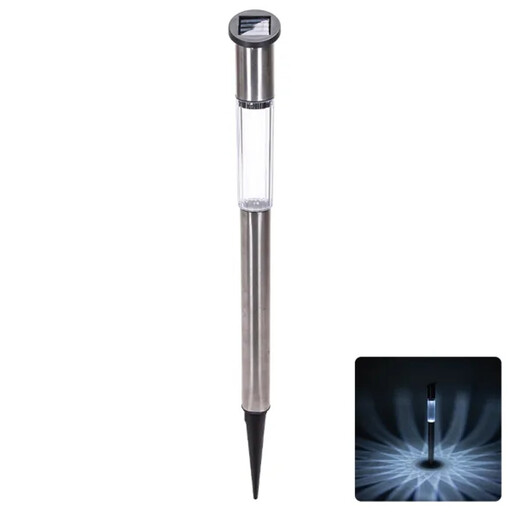
Why it suits this type of buyer: This solar garden light works without a fixed mains connection and is designed for garden paths, borders and grass edges. Position the light somewhere with sufficient sunlight.
The product specifications state IP44, a polycrystalline solar panel and a NiMH battery. However, check that the chosen location receives enough light every day.
Stainless steel housing, 550 mm height, IP44 and, according to the product information, 8 to 12 hours of battery life.
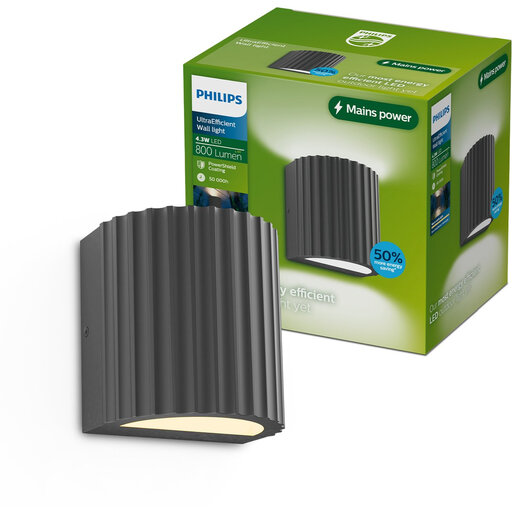
Why it suits this type of buyer: This anthracite outdoor light complements a modern façade and casts light in two directions. The integrated light source means you do not need to choose a fitting or separate bulb.
The integrated LED eliminates the risk of choosing the wrong fitting. The IP44 rating must still be matched to a sheltered mounting location.
4.3 watts, 800 lumens, 2700 K, integrated LED and an aluminium-plastic housing according to the product specifications.
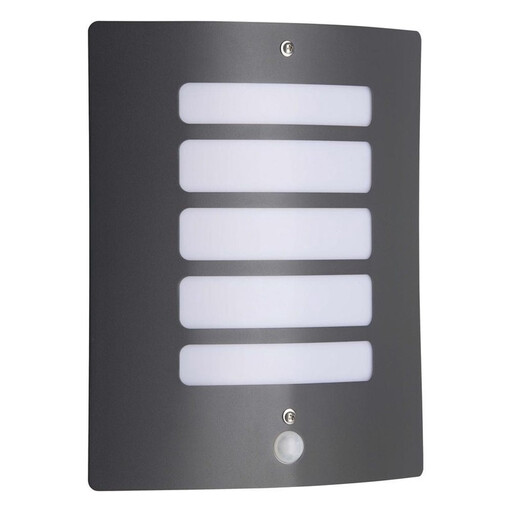
Why it suits this type of buyer: This anthracite outdoor wall light is designed for entrances, façades and passageways where light is only needed when movement is detected.
The motion sensor is clearly listed as a feature. The light is supplied without a light source, so you will need to add a suitable E27 LED bulb yourself.
E27 fitting, maximum 60 watts, integrated motion sensor, IP44 and a compact design measuring 29 cm in height.
We have put together a complete, up-to-date list of products that fully meet these strict selection criteria and the applicable European safety regulations.
According to the product information, fixed outdoor lighting connected to 230 volts must be installed by a qualified professional. Switch off the power before installing, cleaning or changing the light source. Use suitable plugs for brick, concrete or another surface.
Clean the fitting with a soft, dry cloth. Do not apply liquid directly to the fitting or housing. With an E27 or GU10 light, regularly check that the seal is correctly positioned so that the stated IP protection is maintained.
IP44 is suitable for many sheltered outdoor applications, such as a covered front door, balcony or patio. The rating means protection against splashing water, not waterproofing. Do not place the light underwater or somewhere exposed to direct high-pressure jets.
This depends on the wattage and the number of operating hours. A 4.3-watt light that runs for five hours a day uses approximately 7.85 kWh per year. Multiply this by your electricity tariff. A sensor or timer can limit the number of operating hours, but actual consumption depends on usage.
Lifespan varies according to the model, usage and conditions. Check the stated operating hours in the product specifications. With integrated LED lighting, you will generally need to replace the complete fitting when the light source stops working. With an E27 or GU10 outdoor light, you can usually replace just the light source.
