
Vandaag of morgen in huis

Kwaliteit gegarandeerd

Welkomstaanbiedingen ontgrendelen: GRATIS bezorging | Tot 80% korting | Gratis 30 dagen JoyPlus-proefperiode
Download de app
Good outdoor lighting should suit the location, purpose and conditions around your home. A lamp for ambient lighting on a balcony needs different features from outdoor security lighting for a driveway or shed.
Yet many buyers focus mainly on appearance or the number of LEDs shown on the packaging. This can lead to disappointing light output, a solar panel that runs out of charge quickly or damage caused by rain. With these practical checks, you can compare solar outdoor lighting, an LED outdoor lamp, path lighting and outdoor wall lighting more fairly.
A high lumen count does not automatically mean that a lamp will provide comfortable light for every application. A bright lamp by the front door can be useful when you arrive home, but too harsh for a patio where you want to relax. For a garden path, even distribution is often more important than maximum brightness.
Also pay attention to the colour temperature. 2700 to 3000 K generally produces warmer-looking light. A value of 6500 to 7000 K appears brighter and cooler. So check both the lumens and Kelvin rating, and see whether the lamp is intended for ambience, orientation or security.
Marketing copy sometimes uses terms such as water-resistant or waterproof without explaining what they mean in practice. The IP code provides more useful guidance:
Also check the installation instructions. An IP rating does not automatically make an incorrectly installed lamp safe.
A solar-powered outdoor lamp only works effectively when the panel receives enough daylight. In a Dutch garden, shade from a fence, trees and cloudy weather can affect charging performance. A lamp that stays lit for a long time in summer may operate for less time during the darker months.
Pay attention to the position of the panel, the battery capacity and how the lamp is charged. A solar-powered string light can decorate a large area, for example, but the panel must be positioned in an unobstructed location facing the daylight.
Use this simple classification as a starting point:
When looking at LED lamps, check the lumens, colour temperature, energy source and whether the light source can be replaced. A GU10 or E27 fitting is often supplied without a bulb. You can then choose a suitable LED bulb yourself, but you must also take the maximum wattage into account.
Choose the IP rating based on the installation location. An IP44 solar wall light may be suitable beneath a canopy or on a sheltered façade. For a lamp exposed to more rain and dust, a higher level of protection such as IP65 is more appropriate.
Remember that “suitable for outdoor use” is not the same as suitable for direct contact with water jets. Product information may also state that a lamp must not be submerged. Always follow these instructions.
Solar garden lighting is usually easy to install because no power cable is required. However, check that the screws and mounting materials are suitable for the surface. A fixed wall lamp operating at 220–240 V must be connected by a qualified installer in accordance with the product information.
For every type of outdoor lighting, two simple maintenance steps can help:
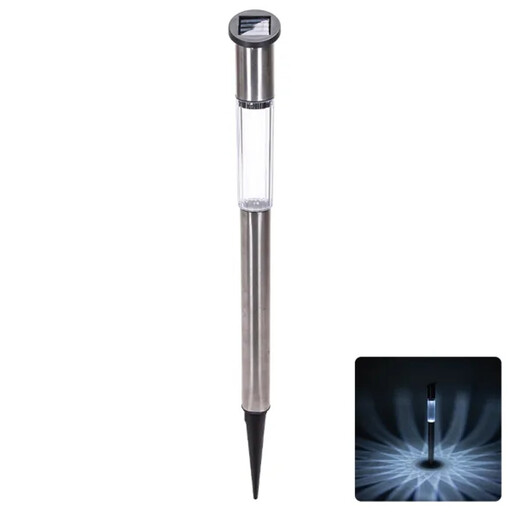
Why it suits this profile: This spike light is easy to push into the ground and is suitable for a garden path, border or lawn. The set runs on solar power and does not require fixed wiring.
The specifications state a charging time of 4–6 hours, an operating time of 8–12 hours and IP44 protection. This means you can see in advance that sufficient sunlight is required and that the lamp is mainly suitable for sheltered outdoor locations.
Stainless steel construction, a polycrystalline solar panel and compact dimensions of 55 cm in height.
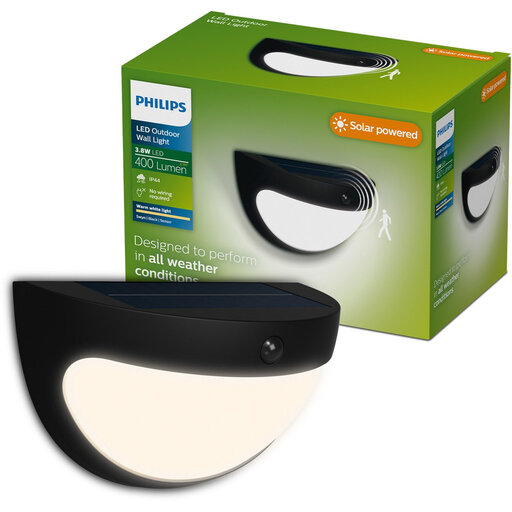
Why it suits this profile: This solar wall light is ideal for an entrance, patio or façade where automatic lighting and a well-finished design are important.
The product description clearly states IP44, two lighting modes, a daylight sensor and a motion sensor. The lamp is therefore not intended for submersion or direct water jets.
Integrated LED, warm 2700 K light and no mains connection required according to the product information.

Why it suits this profile: This solar floodlight is designed for driveways, garages, yards and larger areas where a motion sensor and broad illumination are desirable.
The product information lists three lighting modes, a 180° detection angle and IP65 protection. However, check that the high light output is suitable for your neighbours, façade and intended use.
302 LEDs, a stated 3000 lumens, three adjustable heads and an 1800 mAh lithium-ion battery.
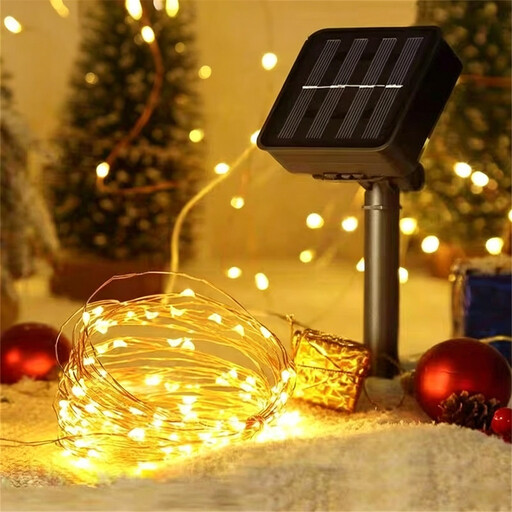
Why it suits this profile: The two string lights are designed for decoration around trees, balcony railings, pergolas and patios. The warm light creates a gentle evening atmosphere rather than functional illumination.
The product information specifies two 49 ft strings with 75 LEDs each, plus eight lighting modes. The solar panel must be positioned outdoors in direct daylight.
Warm white light, eight modes with a memory function and a stated operating time of 8–14 hours, depending on the conditions.
We have put together a complete, up-to-date list of products that fully meet these strict selection criteria and the applicable European safety regulations.
That depends on the amount of daylight, the positioning and the battery. Cloudy weather and shade can reduce the operating time. Position the solar panel as unobstructed as possible, keep it clean and check whether the product information specifies an expected charging time and operating duration.
IP44 means that the lamp is protected against solid objects measuring 1 millimetre or more and against splashing water. This makes it suitable for many sheltered outdoor locations, but not for submersion or direct water jets. For an exposed location, a higher rating such as IP65 may be more suitable.
A solar outdoor lamp does not use mains electricity during normal operation. A fixed LED outdoor lamp generally has a lower wattage than traditional lighting, but the actual cost depends on the power rating and the number of hours it is switched on. With a lamp fitted with a sensor, automatic activation can limit the number of operating hours.
