
Vandaag of morgen in huis

Kwaliteit gegarandeerd

Welkomstaanbiedingen ontgrendelen: GRATIS bezorging | Tot 80% korting | Gratis 30 dagen JoyPlus-proefperiode
Download de app
A dark driveway, poorly lit entrance or atmosphere-free patio calls for a practical solution. However, choosing outdoor lighting is not simply a matter of selecting the lamp with the highest light output. A high lumen rating can be too bright, a low IP rating is not suitable everywhere, and a solar outdoor light will perform less effectively when its panel receives little sunlight.
Three common pitfalls cost Dutch households unnecessary money:
Looking only at lumens
More lumens means more light, but not automatically a more pleasant result. For wall or patio lighting, 300 to 800 lumens may be enough. A powerful 3000-lumen light is more suited to a driveway, garage or large garden.
Treating IP44 and IP65 as the same
IP44 outdoor lighting is protected against splashing water and small solid objects. This rating is often suitable for a sheltered wall, balcony or covered area. IP65 outdoor lighting offers greater protection against dust and water jets, making it a more logical choice for a more exposed location. No rating means that a light can be left under water indefinitely.
Installing solar lighting without considering the sun
A solar outdoor light needs sufficient direct daylight during the day to charge its battery. Positioning it beneath a balcony, tree or deep roof overhang can reduce its operating time. Also check whether the motion sensor and lighting range suit the location where you want to use the light.
Before buying, check where the light will be mounted or placed. For a sheltered outdoor wall light, IP44 may be practical. Consider a covered entrance, a wall beneath a roof overhang or a patio with a permanent cover. For an open garden, garage wall or driveway, a higher level of protection, such as IP65, is an important specification to compare.
Also pay attention to the difference between splash-proof and waterproof. A product description stating IP44 should not be interpreted as meaning the light is suitable for direct water jets. Follow the installation instructions and prevent plugs, connections or cable joints from being placed in wet areas.
Light output is measured in lumens. Here are some practical guidelines:
Colour temperature is measured in kelvin. Around 2700K produces warm white light with a soft appearance. 3000K is slightly brighter but still warm. 4000K looks more neutral. Check the product details carefully: a light described as “warm white” may still have a higher colour temperature according to its specification.
Also consider the light distribution. An outdoor ground spotlight is suitable for highlighting a tree, shrub or architectural feature. A light with several adjustable heads spreads light over a larger area. For a narrow path, a wide beam is not always necessary.
A solar outdoor light eliminates the need for cabling and is practical for locations without a mains connection. Its performance does depend on sunlight, battery capacity and operating mode. For a light with a motion sensor, it is useful to check how far away the sensor detects movement and at what angle.
An LED outdoor light with a permanent 230V connection generally provides a predictable operating time, but may require installation by a qualified electrician. A GU10 or E27 bulb offers flexibility when replacing the light source. Integrated LED lighting is compact, but on some models the light source cannot be replaced by the user.
Dimmable outdoor lights and smart garden lighting offer extra control. For smart models, check which app is required, whether Wi-Fi or Bluetooth is needed, compatibility with voice assistants and whether account registration is required.

Why it suits this profile: This compact black outdoor wall light runs on solar power and has a motion sensor. That makes it suitable for an entrance, patio or small garden path without the need for new electrical cabling.
The product details state 180 lumens, IP44 and an integrated battery. This makes it clear that the light is primarily intended for orientation and accent lighting, rather than as a powerful area light.
Solar power, motion sensor, integrated LED, 2700K and compact dimensions of 11.5 × 10 × 11 cm.
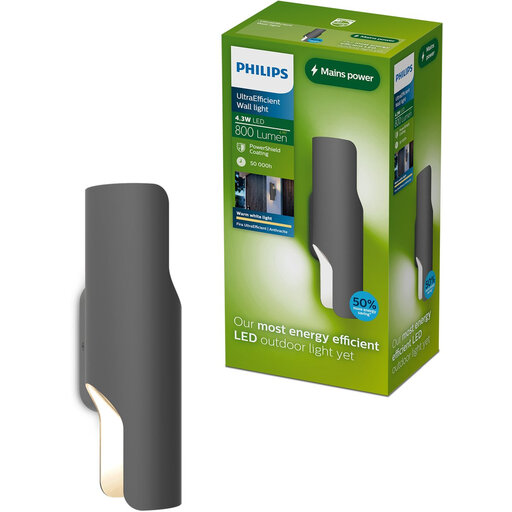
Why it suits this profile: If you are looking for a permanent wall or patio light with an understated appearance, this 230V model provides light in two directions and has an aluminium housing.
The specifications state 800 lumens, 2700K, IP44 and 230V. This means you can assess the light output and positioning limitations against your wall or covered area in advance.
Two-way lighting, 800 lumens, warm white 2700K, aluminium and PowerShield coating according to the product description.

Why it suits this profile: This model is designed to provide broad lighting for a driveway, garage, garden or large patio. Its three adjustable heads are intended to illuminate a wide area.
The IP65 rating, 180° detection angle and stated detection range of 60 feet are clearly specified. However, check that these measurements suit your installation in the Netherlands.
302 LEDs, 3000 lumens, three lighting modes, three adjustable light heads and a solar panel with an integrated 1800mAh lithium-ion battery according to the product details.
Position a solar outdoor light somewhere with as much direct daylight as possible. Clean the solar panel and sensor window with a soft, slightly damp cloth. With permanent outdoor lighting, the power must be switched off before installation or maintenance. Have a hardwired outdoor wall light connected in accordance with the applicable regulations.
Stability is important for ground spotlights and garden posts. Do not place an outdoor ground spotlight where cables could create a trip hazard. For a plug-in light, check that the outdoor socket is suitable and properly protected.
We have compiled a complete, up-to-date list of products that fully meet these strict selection criteria and the applicable European safety regulations.
That depends on the application. For mood and orientation lighting, around 180 to 350 lumens is often suitable. For an entrance or wall, you can look at around 350 to 900 lumens. A driveway, garage or large garden may need more light. Also consider the beam angle and mounting height.
IP44 is suitable for splashing water and is often used in sheltered outdoor locations. Do not position such a light where it will be exposed to direct water jets or continuous heavy rainfall. For an open and more exposed location, IP65 outdoor lighting may be a more suitable specification.
A solar outdoor light does not use mains electricity during normal operation. Its practical performance depends on sunlight, battery capacity, lighting mode and how often the motion sensor is activated. In winter or in a shady location, the operating time may be reduced.
