
Vandaag of morgen in huis

Kwaliteit gegarandeerd

Welkomstaanbiedingen ontgrendelen: GRATIS bezorging | Tot 80% korting | Gratis 30 dagen JoyPlus-proefperiode
Download de app
An atmospheric garden lamp can make a patio more enjoyable, while good lighting by the front door or driveway makes everyday use more convenient. However, outdoor lighting is not just about appearance. A lamp that discolours after a few months, produces too little light or cannot cope properly with rain will mainly result in extra expense and hassle.
So watch out for these three common pitfalls:
The IP code indicates how well a product is protected against solid particles and water. The first digit refers to dust and solid objects; the second digit refers to water.
An IP rating does not automatically make a lamp suitable for every situation. Also check that cables, connections and mounting materials are positioned correctly.
Lumens (lm) indicate how much light a lamp produces. Wattage mainly tells you about energy consumption and is less suitable for comparing brightness.
As a guide:
Colour temperature is expressed in Kelvin. Warm white at around 2700K to 3000K creates a relaxed look for patio lighting and façades. Cooler white can be more functional for a driveway, shed or side passage. When checking product information, look out for any differences between the title, specification table and description.
Measure the available space in advance. For example, a 108 cm tall floor lamp will not fit on every balcony, while a compact GU10 outdoor wall light takes up very little space. Aluminium, plastic and glass are commonly used for weather-resistant outdoor lights. However, the material affects more than just the appearance: also consider the mounting method, maintenance and stated IP rating.
A solar outdoor light needs direct sunlight to charge its battery properly. Do not place the panel under a solid canopy or next to a tall wall that creates a lot of shade. Clean solar panels and light covers occasionally with a soft, damp cloth. With a fixed LED outdoor light, the light source may be integrated and non-replaceable, so check this before buying.
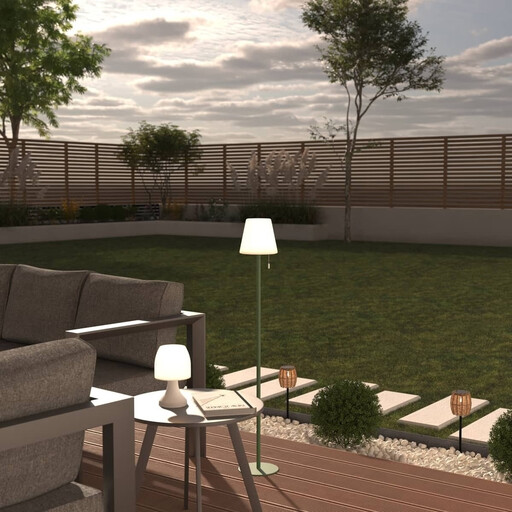
Why it suits this profile: This portable lamp runs on batteries and does not need to be permanently connected. That means you can move it around on a patio or balcony.
The specifications state IP44, battery operation and a runtime of up to ten hours. However, make sure the lamp is positioned in a sufficiently sheltered spot.
108 cm tall, with three lighting modes and a removable light source according to the product information.
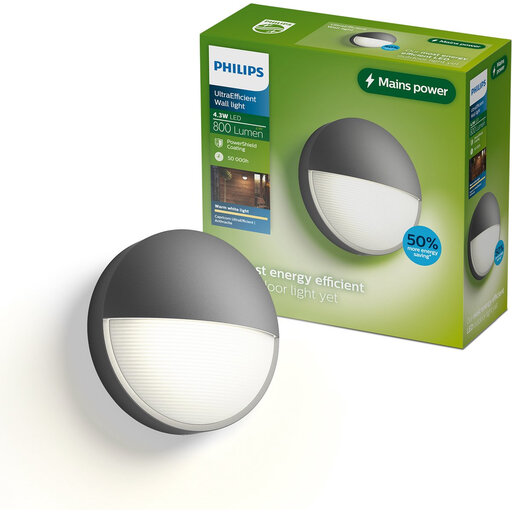
Why it suits this profile: For anyone looking for a fixed LED outdoor light with warm illumination by a façade, balcony or entrance.
The product details clearly state IP44, 800 lumens and 2700K. However, the lamp must be professionally connected to the mains.
Aluminium housing, integrated LED and warm white light at 2700K.

Why it suits this profile: This solar outdoor light is designed to provide wide-area illumination for driveways, garages, gardens or back gardens.
The IP65 rating, three lighting modes and motion sensor are clearly specified. Direct sunlight is needed for good charging performance.
302 LEDs, a stated light output of 3000 lumens and three adjustable lamp heads.

Why it suits this profile: The three spike spotlights are suitable for paths, borders and flower beds when app control is preferred.
The set specifies IP44 and an eight-metre cable. Keep the cable away from walkways and bear app and account requirements in mind.
3-piece set, 660 lumens, dimming function, RGB and adjustable colour temperature from 3000 to 6500K.
We have put together a complete, up-to-date list of products that fully meet these strict selection criteria and the applicable European safety regulations.
Low spike spotlights or narrow path lights are practical for a garden path. Choose an even, glare-free distribution of light and position several lamps with sufficient space between them. For mains-powered models, check where the cable will run. A solar-powered garden lamp is flexible to position, but performs less predictably in a shady location.
IP44 outdoor lighting is protected against splashing water, but not against immersion or powerful water jets. It is best to position these lamps on a sheltered façade, beneath a canopy or on a balcony. For a completely exposed location, IP65 outdoor lighting may offer greater protection. Always follow the installation and safety instructions for the specific product.
An LED outdoor light generally uses fewer watts than older light sources while providing a similar light output. For a fair comparison, look at wattage, lumens and the number of hours the light is on. A lamp with a motion sensor can also switch on only when movement is detected. A solar outdoor light does not use electricity from the mains, but its battery still needs to be charged sufficiently by daylight.
