
Vandaag of morgen in huis

Kwaliteit gegarandeerd

Welkomstaanbiedingen ontgrendelen: GRATIS bezorging | Tot 80% korting | Gratis 30 dagen JoyPlus-proefperiode
Download de app
Choosing new outdoor lighting seems straightforward. Yet many buyers fall for the same marketing tricks: a high lumen count without any explanation of the light distribution, an IP rating presented as completely waterproof, or a solar outdoor lamp that can barely charge in a dark location.
The right choice depends on the location, purpose and available power supply. Do you want to light an entrance, create a cosier atmosphere on a patio or have a driveway light up automatically? Check these points first.
Lumens indicate how much light a lamp emits according to its product specification. More lumens do not automatically mean that a garden path or façade will be better illuminated. A focused beam may be more practical by a door, while broad lighting is better suited to a driveway.
For atmospheric garden lighting or patio lighting, a lower light output is often sufficient. For security lighting, it is more important to consider the combination of brightness, detection angle and mounting height.
An IP44 outdoor lamp is protected against solid objects and splashing water. This makes the rating suitable for many sheltered façades, balconies and entrances, but not automatically for locations where the lamp is directly exposed to powerful jets of water.
An IP65 outdoor lamp offers greater protection against dust and water jets. Even then, correct installation remains important. Also check whether the connections, cables and fixing points are suitable for outdoor use.
Solar garden lighting only works effectively when the panel receives sufficient light during the day. Shade from a wall, tree or canopy can limit charging time. In winter, the days are shorter and output is usually lower.
When choosing a solar outdoor lamp, therefore, consider the position of the panel, the battery capacity and the operating mode. A lamp that stays brightly lit continuously uses more energy than a model that switches on briefly only when motion is detected.
An outdoor lamp with a motion sensor switches on when movement is detected. Check the detection range and angle. A wide-angle sensor is useful by a driveway or garden path, but it may also react more frequently to pets or passers-by.
A dusk sensor switches the lamp on when there is less ambient light. Some models combine both functions. For example, Philips states that various solar products operate automatically via dusk and motion sensors. Treat this as a product specification from the brand; practical performance also depends on the installation location and settings.
Colour temperature is expressed in kelvin:
Also consider the light distribution. A lamp with several adjustable heads can cover a larger area than a compact wall lamp with a single fixed light source.
Aluminium, plastic and glass are commonly used for LED outdoor lighting. Do not just look at the material; also check the installation instructions and how the connections are protected.
A wall lamp with an E27 or GU10 fitting allows you to choose a suitable LED bulb yourself. With integrated LED, the light source is already built in. This often makes installation more straightforward, but the light source may not be replaceable by the user.
According to the product information, 230V wall lamps must be connected by a qualified electrician. Solar and rechargeable models generally do not require fixed wiring, but they must still be securely attached to a suitable surface.

Why it suits this profile: This compact solar outdoor lamp is designed for an entrance, balcony, garden wall or patio where you do not want to install a power cable. The built-in motion sensor switches the lamp on when needed.
The product specification states that it is solar-powered, has a motion sensor and offers IP44 splash protection. However, install the lamp in a location with sufficient daylight and not in an area exposed to direct water jets.
180 lumens, warm white light at 2700 K, an integrated battery and installation without fixed wiring.
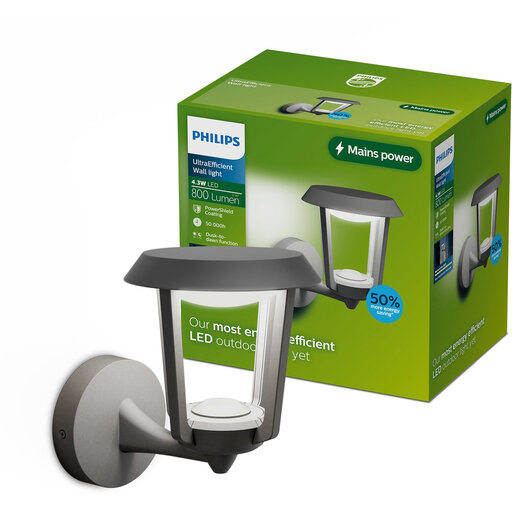
Why it suits this profile: The Nuvy is a fixed wall lamp for a façade, entrance, balcony or garden. Its integrated LED provides warm white light, while the aluminium housing is well suited to a permanent installation.
The specification clearly identifies the IP44 rating as protection against splashing water. This means you know the lamp is mainly suitable for ordinary outdoor use, not for direct water jets.
800 lumens, 2700 K warm white light, integrated LED and an aluminium housing with PowerShield coating according to the product description.

Why it suits this profile: This solar security lighting is designed for larger areas such as a driveway, garage, grounds or spacious garden. The three adjustable light heads are intended to illuminate several directions.
The product specification states not only 3000 lumens, but also three lighting modes, a detection range of 60 feet and a detection angle of 180 degrees. Check beforehand that the powerful beam is suitable for your surroundings.
302 LEDs, 3000 lumens, IP65 rating, three light heads and a solar panel with an 1800mAh battery according to the product data.
We have put together a complete, up-to-date list of products that fully meet these strict selection criteria and the applicable European safety regulations.
Choose the installation location before placing your order. A solar outdoor lamp needs an unobstructed view of the sky to receive sufficient daylight. For a mains-powered wall lamp, you need to consider cable routing, a suitable wall and connection by a qualified installer.
Clean solar panels and sensor windows regularly with a soft, slightly damp cloth. Do not use a pressure washer with IP44 lamps. Also check that the fixing screws are still tight and that the housing has no cracks. With integrated LED models, the light source is often not replaceable; therefore, check the warranty terms and statutory guarantee before buying.
For a sheltered façade, entrance or balcony, IP44 is often suitable. For an exposed location with greater exposure to dust and water jets, IP65 may be more practical. Also check the installation instructions and the protection provided for the connections.
A solar outdoor lamp does not use electricity from the mains. However, the purchase price, battery life and light output vary from one model to another. A lamp with a motion sensor may use the available energy more efficiently than one that stays brightly lit all evening.
Lifespan varies depending on the product and operating conditions. According to Philips’ own information, some models are stated to have a long LED lifespan, but actual service life depends, among other things, on temperature, moisture, battery condition and installation. Always check the product specification and warranty terms.
