
Vandaag of morgen in huis

Kwaliteit gegarandeerd

Welkomstaanbiedingen ontgrendelen: GRATIS bezorging | Tot 80% korting | Gratis 30 dagen JoyPlus-proefperiode
Download de app
Good outdoor lighting needs to do more than look attractive. A wall light by the front door should switch on reliably, solar outdoor lighting needs to receive enough sunlight, and a light mounted on the façade must withstand the Dutch weather. Even so, purchases often go wrong because of a few common pitfalls.
A high lumen output does not automatically mean that a light will work comfortably in every location. 3000 lumens is suitable for a driveway or large patio, but may be too bright next to a front door or balcony. Also consider the colour temperature:
The shape of the light, beam angle and installation height also determine how the light is distributed.
A product with IP44 outdoor lighting is protected against solid objects larger than 1 millimetre and splashing water. This makes IP44 suitable for a sheltered façade, balcony or covered patio, but not automatically for a location exposed to direct jets of water or prolonged rain.
IP65 outdoor lighting offers greater protection against dust and water jets. Even so, IP65 does not mean that the light can be placed underwater. Always check the product instructions and installation location.
A solar-powered outdoor light only works well when the panel receives enough light during the day. Shade from a roof overhang, tree or fence can reduce charging time. In winter, the days are shorter and energy generation is lower. Solar outdoor lighting is therefore most practical on a sunny façade, garden wall, shed or driveway.
Lumens indicate how much visible light a lamp produces according to the product specification. Less light is needed for orientation lighting along a path than for an outdoor floodlight. Consider the intended use:
An LED outdoor light generally uses little energy in relation to its light output. With an integrated LED, the light source is usually not designed to be replaced by the user. With a GU10 outdoor light, you can often choose the light source separately, but check the maximum wattage and the fitting’s IP protection.
An outdoor light with a motion sensor switches on when movement is detected. Do not only check the maximum distance, but also the angle and direction from which someone approaches the sensor. Otherwise, the sensor may respond too late when you walk directly towards it.
Also look for adjustable modes, a dusk sensor and the option to adjust how long the light stays on. With solar security lighting, these features help you use the stored energy more efficiently.
Aluminium is popular for outdoor wall lights because it is sturdy and has a modern appearance. Plastic may be lighter and is useful for wireless or solar products. When installing, check:

Why it suits this profile: This wireless outdoor wall light is easy to install on a balcony, patio or entrance. The integrated sensor and magnetic mount are practical when you do not want to install wiring.
The product specification states IP44 and clearly indicates that the light is splash-resistant, not waterproof. This makes it easier to assess whether it is the right choice for a sheltered location.
300 lumens, warm white light at 3000 K, rechargeable battery and USB-C charging according to the product description.

Why it suits this profile: For a large driveway, back garden or garage, a powerful solar outdoor light with wide detection is more practical than several smaller lights.
The listing states an IP65 rating, an adjustable lamp head and two lighting modes. Before installation, however, check that the solar panel receives direct sunlight.
4000 lumens, IP65, motion detection and a stated detection range of 8 metres when approached directly and 16 metres from the side.

Why it suits this profile: The three adjustable heads are designed to provide broad lighting for a garden, shed, pool area or driveway.
The product information states IP65, a detection angle of 180 degrees and three lighting modes. This means the key considerations for a large outdoor area are clear in advance.
302 LED lights, a stated light output of 3000 lumens, three light heads and a 1800mAh battery according to the product description.
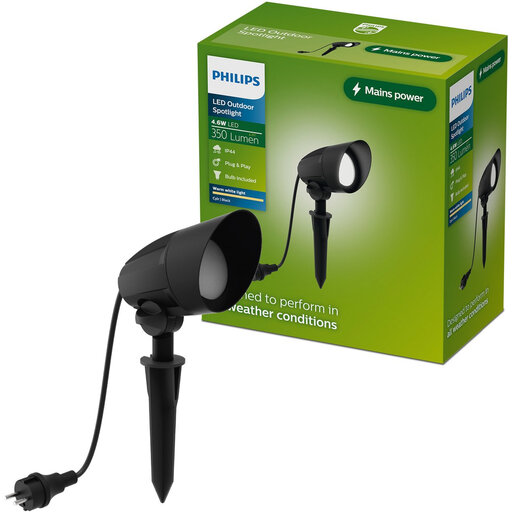
Why it suits this profile: This outdoor ground spotlight is designed to highlight shrubs, trees, a garden path or an architectural feature without permanent wall mounting.
The specification states IP44 and warns against immersion and direct water jets. Position the spotlight securely and use a suitable outdoor socket.
Includes a GU10 LED spotlight, 350 lumens, 2700 K and a 150 cm cable according to the product details.
We have put together a complete, up-to-date list of products that fully meet these strict selection criteria and the applicable European safety regulations.
Position an outdoor wall light so that the sensor is not constantly triggered by moving branches, traffic or pets. Do not point a powerful LED outdoor light directly at windows or at eye level. For a GU10 outdoor light on 230V, installation by a qualified electrician is advisable and may be required under local regulations.
Clean solar panels and sensor windows regularly with a soft, dry cloth. Check the fittings after stormy weather. Do not use aggressive cleaning products, and do not connect an IP44 light in a location where water collects.
For a balcony or front door, around 100 to 400 lumens is often sufficient. For a driveway or larger patio, 400 to 1000 lumens may be more practical. Large areas may require several fittings or a floodlight with a higher light output.
It can be, but performance depends on direct sunlight, battery capacity and the selected lighting mode. Short, cloudy winter days provide less energy for charging. Position the panel as unobstructed as possible and choose a light with an energy-efficient sensor mode.
IP44 protects against splashing water and is mainly suitable for sheltered outdoor locations. IP65 also provides protection against dust and water jets. Neither classification means, without additional information, that the light is suitable for immersion.
