
Vandaag of morgen in huis

Kwaliteit gegarandeerd

Welkomstaanbiedingen ontgrendelen: GRATIS bezorging | Tot 80% korting | Gratis 30 dagen JoyPlus-proefperiode
Download de app
Good outdoor lighting should do more than look attractive. A light by the front door helps you find your way home, path lighting prevents dark spots, and soft garden lighting makes a patio more inviting. Yet many people choose an outdoor lamp based solely on its colour, shape or high lumen rating.
This can result in a lamp that is unsuitable for its location, a light source that is not included, or a fixture that is exposed to more strain than expected in an open, wet area. With these buying tips, you can compare models based on verifiable features and make a more informed choice.
An IP44 outdoor lamp is protected against solid objects larger than 1 millimetre and splashing water from various directions. This does not mean that the lamp is suitable for a location exposed to direct water jets or prolonged heavy rain.
IP65 outdoor lighting offers a higher level of protection against dust and water jets. However, always check the complete product description and installation instructions. A higher IP rating does not automatically make a fixture suitable for underwater installation.
With a GU10 outdoor lamp or E27 outdoor lamp, the socket is not the same as an included bulb. Several models in this category are supplied without a light source. You will then need to purchase a compatible LED bulb separately.
Pay attention to:
A fixture with a replaceable light source gives you greater flexibility. With integrated LED, the light source is built into the lamp and cannot always be replaced separately.
A high light output is not necessary for every location. For a facade or patio, 270 to 800 lumens may be sufficient for atmospheric or practical lighting. A driveway or large section of the garden may require more light. The direction of the beam is at least as important.
A downward-facing outdoor wall lamp mainly illuminates the wall and its immediate surroundings. An adjustable spotlight can highlight a tree, flower bed or pathway more precisely. An outdoor lamp with motion sensor is useful when you only need light when movement is detected, but less suitable if you want consistent ambient lighting throughout the evening.
First consider where the lamp will be mounted or placed:
LED lamps generally use little power relative to their light output. However, do not compare wattage alone. Also consider lumens, colour temperature and operating time.
Warm white light around 2700K creates a softer atmosphere on a patio or at an entrance. 5000K appears cooler and brighter, which can be practical for security or functional lighting. According to Philips product information, the Zyren solar outdoor lamp delivers 4000 lumens at a specified power consumption of 24.5 watts. This is a model for anyone who wants to illuminate a large area brightly, not for those looking for subtle accent lighting.
With a solar outdoor lamp, sunlight, panel positioning and battery capacity are important. Shade from a fence or tree can affect charging time and operating duration.
A 230-volt mains-powered lamp must be connected safely. For several wall lamps, the product information states that installation by a qualified electrician is required. Switch off the power before installation or maintenance and use mounting hardware suitable for the wall.
Clean fixtures with a soft, dry cloth. With solar outdoor lighting, it is also important to keep the panel free from dirt. After installation, check that cables, seals and connection points have been fitted according to the instructions.
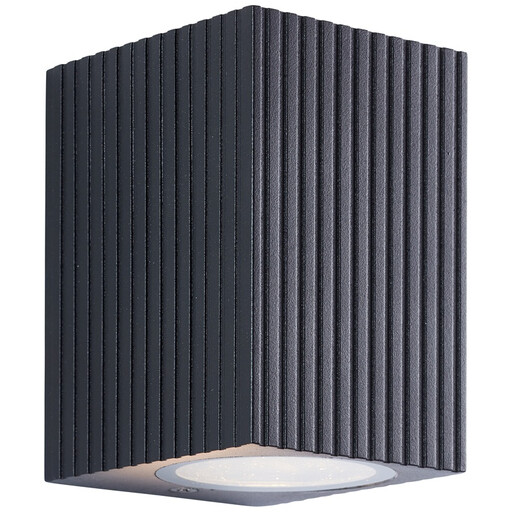
Why it’s a good fit: This compact black outdoor wall lamp is suitable for an entrance, fence or sheltered patio. The GU10 socket lets you choose a compatible LED light source yourself.
The product information clearly states that the light source is not included. IP44 makes this model suitable for sheltered outdoor locations, but not for direct water jets.
Aluminium, glass and plastic construction; dimensions of approximately 10 × 6.9 × 7.8 cm; maximum 10 watts with the GU10 socket.

Why it’s a good fit: A practical choice for a driveway, backyard or dark passage where there is no existing wiring and bright light on movement is desirable.
The solar panel must receive direct sunlight. The stated detection range, lighting modes and operating time are taken from Philips product information.
IP65, integrated LED, 5000K, 4000 lumens and a PIR sensor according to the listed product specifications.
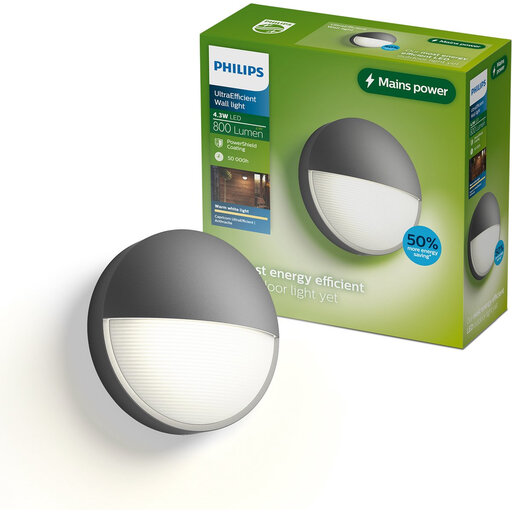
Why it’s a good fit: This integrated LED lamp suits a fixed entrance, balcony or facade where you do not want to replace a separate light source.
The LED light source is integrated and, according to the product information, cannot be replaced. This is important to consider when choosing a permanent fixture.
4.3 watts, 800 lumens and 2700K warm white light; the stated lifespan of up to 50,000 hours is taken from Philips product information.
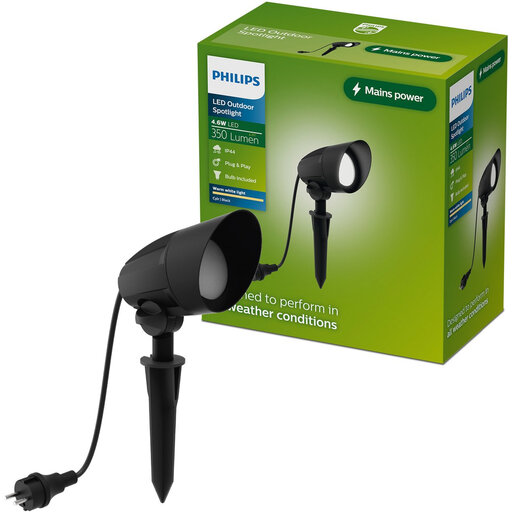
Why it’s a good fit: This adjustable spotlight is designed to accentuate a tree, shrub, facade detail or section of a driveway without permanent recessed installation.
The lamp has an IP44 rating and is splash-proof according to the product description. Do not place it where it is exposed to direct high-pressure jets or standing water.
Includes GU10 LED light source, 350 lumens, warm white 2700K, 4.6 watts and a 1.5-metre cable.
Browse a current selection of outdoor lighting and compare models by IP protection, socket, light output and installation.
IP44 may be suitable for a sheltered location. For an open, more exposed area, a higher rating such as IP65 may be more appropriate. Always check the placement instructions and ensure that connections are properly protected.
A solar outdoor lamp does not use mains electricity during normal operation. However, its performance depends on sufficient daylight, the position of the panel and the battery. In a shaded garden, the lighting duration may be shorter than stated in the product information.
Lifespan varies by model and operating conditions. Some manufacturers state an estimated lifespan, such as Philips for certain LED models. Treat these figures as brand-provided product specifications and also compare the warranty, replaceability of the light source and maintenance requirements.
