
Vandaag of morgen in huis

Kwaliteit gegarandeerd

Welkomstaanbiedingen ontgrendelen: GRATIS bezorging | Tot 80% korting | Gratis 30 dagen JoyPlus-proefperiode
Download de app
Good outdoor lighting needs to do more than look attractive. A lamp by the front door must withstand changeable weather, while patio lighting mainly needs to provide pleasant light and easy operation. For a driveway or garden path, light distribution, installation and safety are more important.
The product information on packaging and sales pages is not always directly comparable. So before buying an outdoor lamp, watch out for these common pitfalls:
The IP code consists of two digits. The first digit refers to protection against solid particles, while the second refers to water.
Also check the installation instructions. An IP rating does not make a fitting suitable for immersion. For example, do not install an IP44 wall lamp where rainwater flows directly onto the housing.
An integrated LED outdoor lamp is ready to use straight away, but the light source is often not replaceable. With a fitting using a GU10 fitting or E27 fitting, you can choose a suitable bulb yourself. This gives you greater flexibility when it comes to colour temperature, dimming and replacement.
Pay attention to the difference between wattage and lumens. Wattage indicates energy consumption, while lumens indicate the amount of light produced. Thanks to efficient LED technology, a lower-wattage lamp can still provide sufficient light.
A cordless solar outdoor lamp or rechargeable lamp is convenient when there is no power point available. However, its performance depends on sunlight, battery capacity and the selected light setting. For example, the Atmosphera Kiara runs on a rechargeable lithium-ion battery and comes with a USB cable.
Fixed exterior wall lighting often requires an electrical cable to be connected. Have this carried out by a qualified electrician in accordance with the product specifications. A ground spotlight with a plug requires a suitable, protected outdoor socket. Also check that cables do not create a trip hazard.
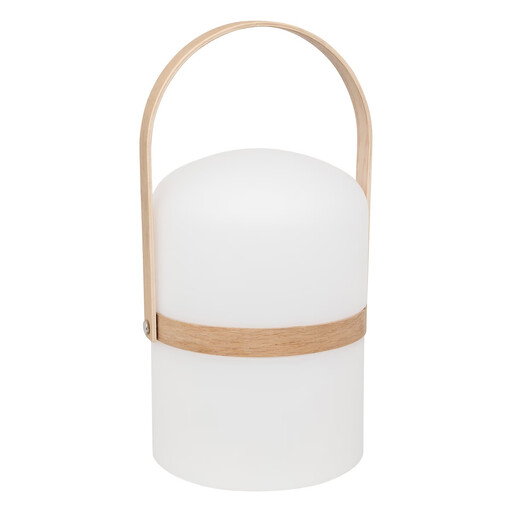
Why it suits this profile: This portable lamp is suitable for a patio or balcony table when you do not want to use a fixed connection. It has three light levels and is charged via USB.
The light source, brightness and battery details are clearly stated: 270 lumens, warm white light and IP44. Take account of the stated operating time for each setting and a charging time of approximately 7 to 8.5 hours.
Rechargeable battery, dimming function, carrying handle and 12 LEDs. The specifications state a height of 36 cm and a diameter of 18 cm.
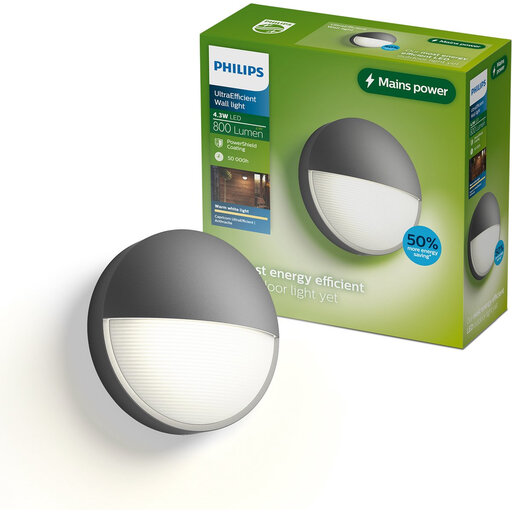
Why it suits this profile: This fixed wall lamp is ideal for anyone looking for a compact fitting for exterior wall, garden or balcony lighting with integrated LED lighting.
The colour temperature and light output are stated: 2700K and 800 lumens. The IP44 rating makes it clear that installation in a sheltered location is advisable.
Integrated LED, 4.3 W per light point, aluminium construction and a stated lifespan of up to 50,000 hours. Mains-powered installation must be carried out by a qualified electrician.

Why it suits this profile: This solar outdoor lamp is designed for an exterior wall, driveway or entrance where automatic lighting is desirable. According to the product description, the model has a PIR sensor and a dusk sensor.
According to the product specifications, the lamp has an IP65 rating. However, its installation still depends on sufficient direct sunlight reaching the solar panel. Check the sensor ranges and two light settings in advance.
Integrated LED, 4000 lumens, 5000K and a stated sensor range of up to 8 metres when approached directly. The lamp works without fixed wiring.
We have put together a complete, up-to-date list of products that fully meet these strict selection criteria and the applicable European safety regulations.
IP44 may be suitable for a sheltered wall or covered area. For an exposed ground spotlight or a location with more rain and dust, IP65 is generally the better choice. Always check the installation instructions and avoid direct contact with water jets or immersion where this is not permitted.
Consumption depends on the wattage and the number of hours the lamp is switched on. According to their stated specifications, LED lamps often use relatively little power for the amount of light they produce. A lamp with a sensor or timer can also operate for fewer hours. With solar lighting, you do not pay for mains electricity, but performance depends on sunlight and battery capacity.
This varies depending on the light source, battery, materials and conditions of use. Some manufacturers state an estimated lifespan, such as up to 15,000 or 50,000 hours for certain LED models. This is a product specification, not a guarantee for every situation. Also check whether the light source is replaceable: with integrated LED lighting, the entire fitting will usually need to be replaced when the light source reaches the end of its lifespan.
