
Vandaag of morgen in huis

Kwaliteit gegarandeerd

Welkomstaanbiedingen ontgrendelen: GRATIS bezorging | Tot 80% korting | Gratis 30 dagen JoyPlus-proefperiode
Download de app
Good outdoor lighting makes a garden, balcony, driveway or entrance more usable once it gets dark. However, the packaging does not always make it immediately clear what you are buying. For example, a high light output may come with a cool, harsh light that creates little atmosphere. And a light with an IP rating is not automatically suitable for every outdoor location.
In this guide, you’ll learn what to look for in solar outdoor lighting, a solar wall light, an outdoor light with a motion sensor or a fixed LED outdoor light. We’ll then highlight some popular options for different situations.
Lumens indicate how much light a lamp produces according to its product specifications. However, this figure does not tell you everything about how the light will feel in practice. A 3000-lumen lamp is mainly suitable for a driveway, garage or large grounds. For a balcony or patio, warm light of between 180 and 400 lumens may be more pleasant.
Also pay attention to the colour temperature:
Also check whether the brightness can be adjusted. With some lamps, the maximum lumen output is only achieved in a particular lighting mode.
The IP code consists of two digits. The first digit relates to protection against solid particles, while the second refers to water. IP44 effectively means protection against splashing water. A waterproof outdoor light IP44 is therefore mainly suitable for a sheltered wall, veranda or covered patio. The term ‘waterproof’ is sometimes used broadly in product titles; submersion or a direct, powerful jet of water is not intended.
IP65 provides greater protection against dust and water jets. This makes a waterproof outdoor light IP65 more suitable for an open garden, fence or driveway. IP65 still does not mean that you can place the lamp in water. Always follow the manufacturer’s safety information.
A solar-powered garden light needs direct sunlight during the day to charge its built-in battery. In the shade, beneath a canopy or on a north-facing wall, the operating time may be shorter. Trees, dirt and leaves covering the solar panel have the same effect.
When choosing a solar wall light, pay attention to:
The stated operating time depends on the amount of sunlight, season, temperature and selected mode.
Solar outdoor lighting is convenient when you do not want to run a cable. A motion sensor can help prevent the battery from being used continuously. For fixed lighting with a constant brightness, mains power is more practical, but installation of many wall lights must be carried out by a qualified electrician.
A portable lamp with a USB-rechargeable battery sits somewhere between the two. You do not need to run a cable to the wall, but you will need to recharge the lamp regularly.
A motion sensor switches the lamp on when movement is detected. Where available, check the detection range and detection angle. An outdoor light with a motion sensor is practical by a front door, garage or garden path, but position the lamp so that passing traffic or moving branches do not trigger it unnecessarily.
A dusk or daylight sensor determines when the lamp becomes active automatically. With solar wall lights, these functions often work together with an automatic mode.
An integrated LED does not require a separate bulb. This makes installation simple, but the light source is generally not intended to be replaced by the user. With a GU10 outdoor light or an outdoor wall light with an E27 fitting, you can choose a suitable LED bulb yourself. Always check the maximum wattage, fitting and whether the chosen light source is suitable for outdoor use.
A replaceable bulb gives you more freedom when it comes to light colour and dimming. An integrated LED is often more compact and ready to use straight away.

Why it suits this profile: This solar wall light works without mains power and features an automatic mode, an on mode and a motion sensor. The product specifications state that it provides warm white light at 2700 K and 400 lumens per light point.
The product information specifies both the light colour and the light output. With IP44, the lamp is intended for splashing water, not submersion or direct water jets.
Solar power, motion sensor, two lighting modes and a compact size of approximately 9,5 × 17,7 × 10,9 cm.

Why it suits this profile: This solar outdoor light is designed for anyone looking for a higher light output by an entrance, garage or driveway. According to the product description, the lamp delivers 1000 lumens at 3000 K and features dusk and motion sensors.
The stated 1000 lumens makes it clear that this is functional lighting rather than subtle patio lighting. IP44 limits installation to locations where protection against splashing water is provided.
1000 lumens, warm white light at 3000 K, two lighting modes and installation without a mains connection.

Why it suits this profile: For a large garden, driveway or garage area, a broad spread of light is more important than atmosphere alone. This model has three adjustable heads, three modes and a stated light output of 3000 lumens according to the product specifications.
The combination of IP65, a motion sensor and a wide angle is better suited to open outdoor locations than a lamp specified only for sheltered areas.
302 LEDs according to the product specifications, three lighting modes, a 180° detection angle and three adjustable light heads.
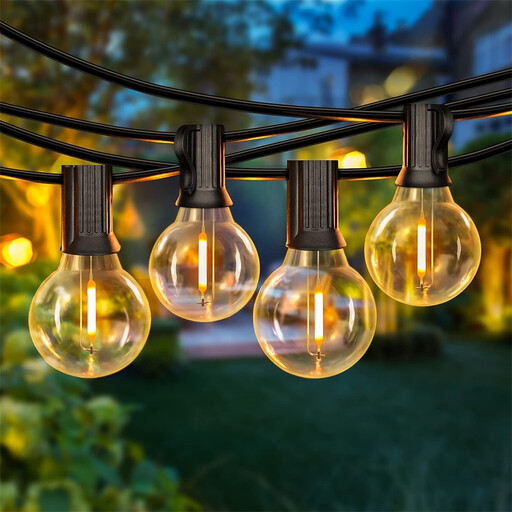
Why it suits this profile: This 30-metre LED string light is designed for decorative garden lighting, patio lighting, balconies and special occasions. The lights are mains-powered and, according to the product information, dimmable and replaceable.
As this is mains-powered lighting, you are not dependent on sunlight. However, keep connections away from standing water and unplug the light before carrying out maintenance.
30-metre length, 50+2 LEDs, dimming function, multiple lighting settings and replaceable G40 bulbs.
Mount an outdoor wall light on a sturdy, level surface. For fixed models running at 220–240 volts, such as some E27 and GU10 outdoor lights, connection must be carried out by a qualified electrician. Switch off the power before carrying out maintenance.
For wireless lights, the following points are important:
A solar outdoor light may operate for less time in winter because the days are shorter and there is less sunlight. With an LED lamp featuring an integrated light source, replacement is usually not предусмотрed. Therefore, check the warranty conditions and availability of replacement parts in advance.
We have put together a complete, up-to-date list of products that fully meet these strict selection criteria and the applicable European safety regulations.
For a sheltered wall or covered area, IP44 may be suitable, as this rating provides protection against splashing water. For a more exposed location with rain and dust, IP65 is a more appropriate choice. Always check the installation instructions and never use a lamp underwater.
Solar outdoor lighting does not use mains electricity while operating. However, the lamp must receive enough sunlight, and the battery is a wear component. The actual operating time depends on the season, temperature, charge level and lighting mode.
For a pleasant atmosphere, 2700 K to 3000 K is usually chosen. This warm white shade suits a patio, balcony or entrance. For a driveway or functional lighting, a higher light output may be more important than an especially warm colour.
