
Vandaag of morgen in huis

Kwaliteit gegarandeerd

Welkomstaanbiedingen ontgrendelen: GRATIS bezorging | Tot 80% korting | Gratis 30 dagen JoyPlus-proefperiode
Download de app
Buying an outdoor lamp seems simple, until you discover that not every outdoor light is suitable for rain, wind or a dark driveway. A low price says little about light output, and “solar” does not automatically mean that a lamp will stay lit all night.
Three common pitfalls come up time and again:
The right choice therefore starts not with the shape, but with the location, the light you want and the technical specifications.
There are various solutions for a garden path, patio or exterior wall:
A lamp with 2700 to 3000 kelvin produces warm white outdoor lighting. This suits a patio or garden where ambience is important. 5000 kelvin looks much cooler and brighter, making it a better choice for a driveway or functional security lighting.
The IP code indicates how well a product is protected against solid particles and water. IP44 includes protection against splashing water; do not place a lamp with this rating where it may be exposed to high-pressure water or submerged. IP65 offers greater protection against dust and water jets, but correct installation remains important.
According to the product information, the Philips Cylr ground spotlight has IP44. The lamp is intended for general outdoor use, but it should be placed on a stable surface and connected to a suitable outdoor power socket. According to the product specifications, the Philips Zyren models have IP65, making them suitable for locations where the housing is more exposed to the elements.
Lumens indicate the amount of light, not how it is distributed. An adjustable spotlight can effectively highlight a tree or exterior wall with fewer lumens. For a motion sensor, the detection range and activation duration are also important.
Check whether the lamp:
According to Philips product information, the Zyren has a PIR detection range of 8 metres when approached directly and 16 metres when approached laterally. This is a stated product specification, not a guarantee that every garden will provide the same detection experience. Installation height, obstacles and the direction of movement all affect performance.
Solar outdoor lighting eliminates the need for a mains connection, but it does require sufficient sunlight. Clean the panel regularly with a soft cloth. For a fixed lamp with a plug, the outdoor socket must be suitable for outdoor use. A wireless table lamp with USB-C is more flexible on a balcony or table, but it needs charging and is not automatically suitable for submersion.
With integrated LEDs, also check the stated lifespan. The Philips Diara, for example, specifies 25,000 hours for the light source. This is a manufacturer’s specification; the actual lifespan depends, among other things, on usage, temperature and operating conditions.
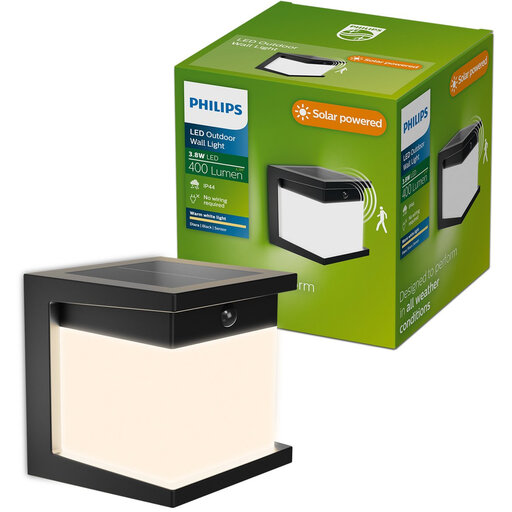
Why it suits this profile: This compact solar wall light works without fixed wiring and produces warm white light at 2700 K. This makes it suitable for a balcony, small garden or exterior wall where easy installation is important.
The product specifications state IP44, 400 lumens and two lighting modes. This makes the key usage limitations clearer than with a lamp that has no IP rating.
Solar power, motion sensor, 2700 K and a compact size of approximately 12 × 11 × 12 cm.
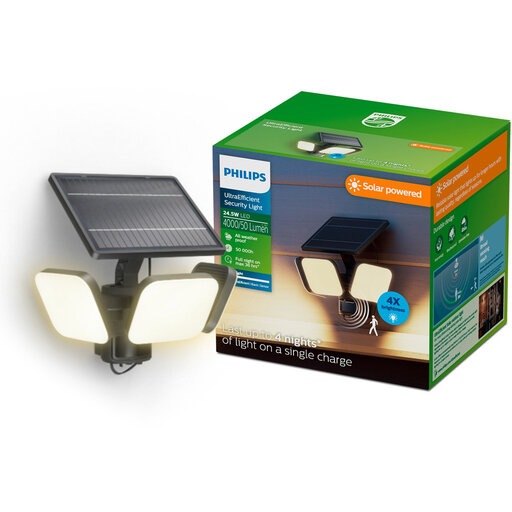
Why it suits this profile: This solar outdoor light is designed for a driveway, rear path or larger exterior wall where high light output and a wide detection range are important.
The lamp is rated IP65, produces 4000 lumens and offers motion detection from 8 to 16 metres. These specifications provide useful guidance when choosing functional security lighting.
5000 K, integrated LED, two lighting modes, adjustable lamp head and a stated battery life of up to four nights when fully charged.
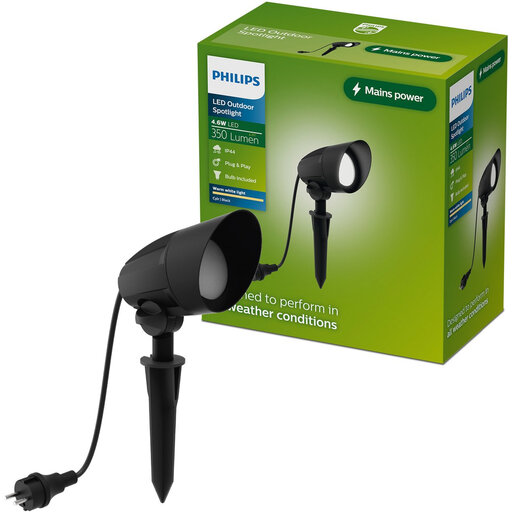
Why it suits this profile: This outdoor ground spotlight is designed to illuminate a tree, shrub, driveway or entrance gate. The plug allows flexible placement when a suitable outdoor socket is available.
IP44 makes it clear that the lamp is splash-resistant, not suitable for submersion. The supplied GU10 LED and instructions help you check the connection in advance.
350 lumens, 2700 K, adjustable spotlight, aluminium and glass construction, 4.6 watts and a 150 cm cable.
We have put together a complete, up-to-date list of products that fully meet these strict selection criteria and the applicable European safety regulations.
Solar outdoor lighting and rechargeable wireless lamps work without a fixed connection. Solar lighting must receive direct daylight to charge the battery. A wireless table lamp uses an internal battery and needs to be recharged periodically via USB-C.
That depends on the location. For a sheltered exterior wall or patio, IP44 may be suitable if the lamp is protected from splashing water. For a more exposed location, a higher rating such as IP65 can offer greater protection. Always check the installation instructions and avoid submersion unless the manufacturer explicitly allows it.
Does solar lighting use no electricity at all?
During normal use, a solar lamp draws energy from sunlight and does not use electricity from the mains. This does not mean that the lamp requires no maintenance: a clean panel, sufficient daylight and a properly functioning battery remain important. In dark winter periods, the lighting duration may also decrease.
For added ambience, you can combine functional lighting with an LED outdoor lamp, warm white string lights or a decorative indoor lamp, such as a Star Wars lamp for a desk or entertainment area. Do take care: an LED ceiling lamp with IP20 is intended solely for dry indoor spaces and should not be installed outdoors.
