
Vandaag of morgen in huis

Kwaliteit gegarandeerd

Welkomstaanbiedingen ontgrendelen: GRATIS bezorging | Tot 80% korting | Gratis 30 dagen JoyPlus-proefperiode
Download de app
Good outdoor lighting should suit the location, the weather and the purpose. Do you want to light up a dark driveway, make your patio feel more welcoming or simply mark out a path? Looks and price aren’t the only things to consider. The power source, IP rating, brightness and installation all affect how well a light works in practice.
A light with a high lumen output isn’t automatically suitable for every use. A bright light can be useful by a garage or driveway, but may feel harsh on a small balcony. For atmospheric garden lighting, warm-white LEDs of around 2700 to 3000 K are often more suitable. Functional lighting can be more neutral or brighter.
IP44 outdoor lighting is protected against solid objects larger than 1 millimetre and splashing water. This makes IP44 suitable for many sheltered patios, entrances and balconies, but not for immersion or direct jets of water.
IP65 outdoor lighting offers greater protection against dust and jets of water. Also check where you’ll install it: a light beneath a canopy is less exposed to the elements than a fitting fully exposed to rain and wind.
A solar garden light depends on sunlight. Beneath dense foliage, against a north-facing wall or behind a tall fence, its battery may not charge fully. This reduces how long the light stays on, especially during the darker winter months. So check where the solar panel will sit, not just the light’s design.
Use the IP rating as your first filter:
Brightness is usually measured in lumens (lm). A modest light output is often enough for path lighting or decorative solar lights. A wall light with a motion sensor or a floodlight for the driveway will generally need to be brighter.
Colour temperature is measured in kelvin (K):
Also consider how the light is directed. An outdoor ground spotlight works differently from a wall light: the former usually shines upwards onto a tree or wall, while a wall light often illuminates an entrance or path.
Choose between:
Also check whether a bulb is included. Some outdoor wall lights with a GU10 or E27 fitting are supplied without a bulb. This lets you choose the colour temperature and wattage, within the stated limit.
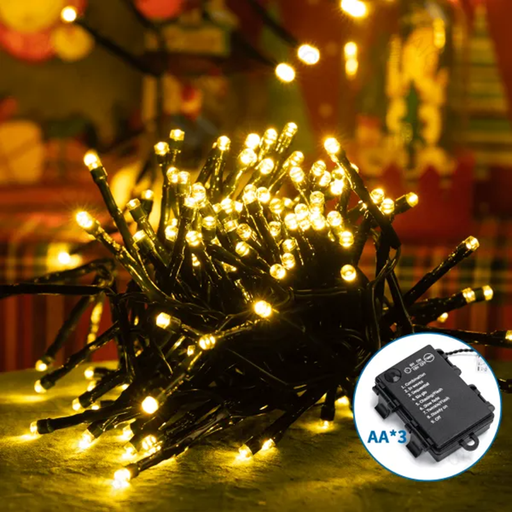
Why it suits this profile: These outdoor string lights run on 3 AA batteries and are easy to use on a balcony, table or small patio.
The IP44 rating indicates protection against splashing water. Place the string lights in a sheltered spot and keep them out of standing water.
5-metre length, 200 LEDs, 8 lighting modes, timer and memory function.
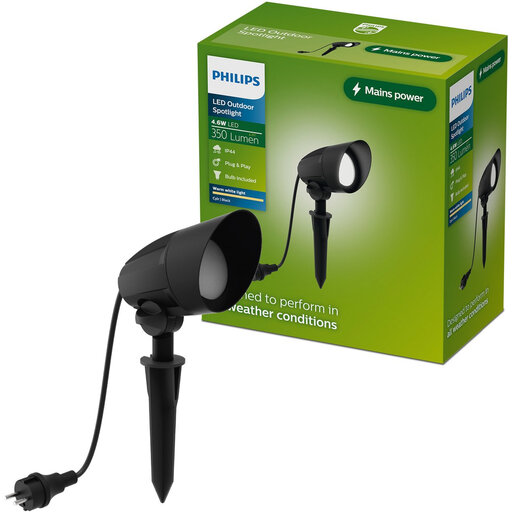
Why it suits this profile: This outdoor ground spotlight is designed for driveways, gates and lawns, and for highlighting a tree or shrub.
The specifications state IP44 and recommend protecting the light from direct jets of water. This helps you avoid installing it in an unsuitable location.
350 lumens, warm white 2700 K, adjustable spotlight and included GU10 LED bulb.

Why it suits this profile: This solar outdoor light is designed for driveways, garages, gardens and larger outdoor areas where motion detection is useful.
The IP65 rating makes it a better choice for exposed locations than IP44. For it to work well, it still needs direct exposure to sunlight.
302 LEDs, stated light output of 3000 lumens, three lighting modes and a sensor range of 60 feet with a 180° detection angle.
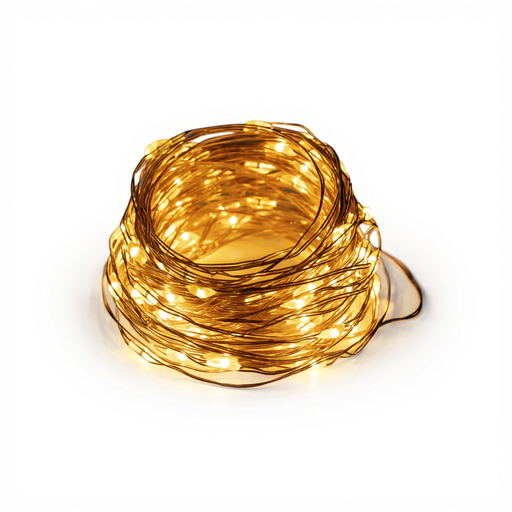
Why it suits this profile: Wireless string lights for planters, balcony railings, fences and adding a decorative touch to an outdoor dinner.
The solar panel is adjustable and the product information gives an IP65 rating. Position the panel where it won’t be shaded for more consistent charging.
10-metre length, 160 LEDs, warm light, 8 modes and a stated maximum operating time of 12 hours.
We’ve put together a complete, up-to-date list of products that meet these strict selection criteria and the applicable European safety regulations.
A battery-powered or USB light, a solar garden light or a compact string of lights are practical choices for a balcony. Consider how much sunlight is available, how the light will be fitted and its IP rating. IP44 may be sufficient on a covered balcony, as long as the light isn’t exposed to direct jets of water.
That depends on the wattage and how long the light is on. LED outdoor lighting generally uses little energy. Solar lighting doesn’t use mains electricity during normal operation, but how well it works depends on how much it charges during the day. For mains-powered lights, you can estimate consumption using: wattage × hours of use ÷ 1000 = kilowatt-hours.
Lifespan varies by model and conditions of use. Some product information, for example, gives a stated light source lifespan of 15,000 hours. With integrated LEDs, the light source isn’t always replaceable. Before buying, check whether you can replace a separate GU10 or E27 bulb, and make sure the warranty and product terms are clear.
