
Vandaag of morgen in huis

Kwaliteit gegarandeerd

Welkomstaanbiedingen ontgrendelen: GRATIS bezorging | Tot 80% korting | Gratis 30 dagen JoyPlus-proefperiode
Download de app
Good outdoor lighting needs to suit the location, purpose and available power supply. Yet many people choose a light based only on its appearance or a high lumen rating. They then find that the beam is too bright, a solar outdoor light barely charges, or an IP44 fitting isn’t suitable for an exposed wall.
Watch out for these three common pitfalls:
The IP rating indicates how well a fitting is protected against solid particles and moisture.
An outdoor wall light on a covered balcony has different requirements from a light above an open driveway. As well as checking the IP rating, consider how the light is fitted and where the cables or connections will be located.
With LED outdoor lighting, it’s important to know whether the light source is integrated or replaceable.
A GU10 outdoor light uses a GU10 spotlight. The Brilliant Jelani and Philips Fylx are supplied without a bulb. This means you can choose the brightness and colour temperature yourself, but you’ll need to check that the LED bulb you choose stays within the maximum wattage.
An E27 outdoor light, such as the Philips Juli or Brilliant Newport, uses a larger screw fitting. These fittings are also supplied without a bulb. Make sure you:
For an entrance or façade, 2700–3000 K is often a practical choice. For functional lighting on a driveway, a higher light output may be more useful.
A solar outdoor light doesn’t need a fixed power connection, but its performance depends on where you place it. A panel that’s in the shade for much of the day may store less energy. Place it away from trees, roof edges and other obstructions.
A mains-powered light provides a constant power supply, but it needs to be connected safely. Have a fixed outdoor wall light installed by a qualified electrician. Portable models with USB charging are more flexible, but need to be recharged regularly.
Decorative lighting calls for a different approach. An outdoor string light or meteor shower light is ideal for creating ambience, but won’t replace lighting for steps, paths or a driveway.
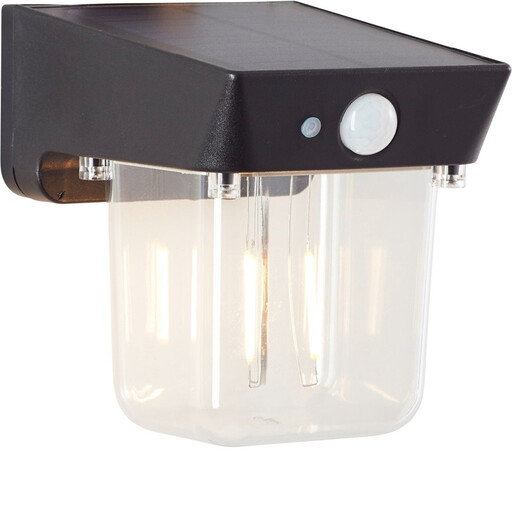
Why it suits this need: This compact solar outdoor light is designed for a wall, patio or entrance without fixed wiring. The motion sensor switches it on when needed.
The product description clearly lists the integrated battery, solar power and IP44 rating. It still needs to be placed in a sheltered spot; IP44 isn’t designed for immersion.
180 lm, 2700 K warm white light, integrated LED, solar power and motion sensor.
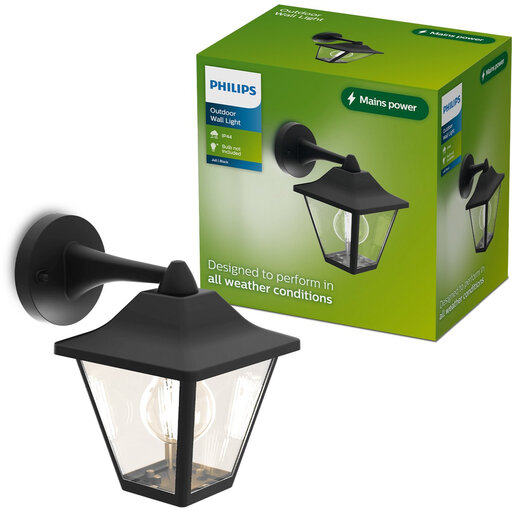
Why it suits this need: Its classic shape works well by an entrance, veranda or façade, where the fitting is a visible part of the design. The E27 fitting gives you the flexibility to choose your own LED bulb.
The fitting and IP44 rating are specified. You can also see in advance that the E27 bulb isn’t included, so you can budget for one.
E27 fitting, aluminium housing, IP44 rating and dimensions of approx. 15 × 21,7 × 22,2 cm.

Why it suits this need: This light is designed for larger areas such as a driveway, garage, garden or yard. Its three adjustable heads and wide spread of light are practical when a single small light isn’t enough.
The product specifications list IP65, three lighting modes and a sensor range of 60 feet. However, check that this powerful lighting suits your neighbours and the ambience you want to create.
302 LEDs, stated output of 3000 lm, three light heads, 270° coverage and IP65 protection.
We’ve put together a complete, up-to-date list of products that meet these strict selection criteria and the applicable European safety regulations.
For a patio, balcony or pergola, a decorative option may be all you need. The VIVREAL G40 string light is 30 metres long, has 50 + 2 LED bulbs and plugs into a socket. The bulbs are replaceable and, according to the product information, the string has several lighting modes, a timer and a dimmer function. Hang it out of reach of puddles and unplug it before cleaning.
The M.TK Meteor Shower Lights have 192 coloured LEDs, eight hanging points and cover an area of 5 × 0,3 metres. With an IP44 rating, they’re designed for splashes and festive use indoors or outdoors. Don’t use them as the main lighting for walkways.
It depends on the location. IP44 is suitable for splashing water and a sheltered outdoor spot, such as a covered patio. For a completely exposed location, a higher rating such as IP65 may be more suitable. Always check the fitting instructions.
How long it lasts each night depends on the battery, the amount of sunlight, the lighting mode you choose and the outdoor temperature. Keep the panel clean and place it somewhere that gets as much direct daylight as possible. A motion sensor can help reduce energy use by ensuring the light isn’t on all the time.
An LED bulb generally uses less power than traditional light sources with a similar light output. Actual usage depends on the wattage and how many hours it’s switched on. A solar outdoor light doesn’t use mains electricity, but its performance still depends on sunlight and battery capacity.
