
Vandaag of morgen in huis

Kwaliteit gegarandeerd

Welkomstaanbiedingen ontgrendelen: GRATIS bezorging | Tot 80% korting | Gratis 30 dagen JoyPlus-proefperiode
Download de app
Good outdoor lighting should suit the location, weather and intended use. A lamp for a sheltered balcony has different requirements from driveway lighting or a lamp above an open garden path. Yet many products are mainly promoted with terms such as “extra bright”, “waterproof” or “energy-efficient”. Without checking the technical specifications, you may end up paying for features that offer little benefit in your situation.
The number of lumens indicates how much light a lamp produces, but not how large an area it illuminates. A powerful lamp with a narrow beam may be less practical than a softer lamp with a wide spread. So, as well as lumens, pay attention to the beam angle, the number of light sources and their positioning.
For atmospheric patio lighting, 170 to 300 lumens is often suitable. A dark driveway or large section of the garden may require more light. A bright lamp is not automatically suitable if it shines into the living room, bedroom or street.
Always check the IP rating. An IP44 outdoor lamp is protected against splashing water and solid objects larger than 1 millimetre. This makes it suitable for many sheltered façades, balconies and patios, but not for immersion or direct jets of water.
An IP65 outdoor lamp generally offers greater protection against dust and water jets. This is relevant for an exposed façade, garage or location where rain falls directly on the lamp. Also check the installation instructions: IP protection only applies when the lamp has been installed correctly.
Solar outdoor lighting does not require a fixed power connection, but the panel must receive sufficient light during the day. In a shady garden, beneath a canopy or on a north-facing wall, the operating time may be disappointing. Trees, walls and dirt on the panel can also have an effect.
So check the position of the solar panel, the battery capacity and the lighting mode. A motion sensor that only switches the lamp on when movement is detected generally uses less energy than a lamp that remains lit all evening.
Colour temperature is measured in kelvin. 2700K to 3000K produces warm white light for a patio, entrance or garden. Around 4000K, the light appears more neutral and is suitable, for example, for functional lighting. A higher colour temperature can appear cooler.
Compare lumens within the same usage scenario. An LED outdoor lamp with 180 lumens is suitable for accent or entrance lighting, while 500 lumens provides more functional light. For a large area, a wide light spread may be more important than a higher lumen count.
An outdoor lamp with a motion sensor is practical by a front door, shed or driveway. Check:
The UME lamp specifies a detection distance of 60 feet, approximately 18 metres, and an angle of 180 degrees. Position a lamp like this so that passers-by or moving branches do not trigger the sensor unnecessarily.
A solar wall lamp or portable lamp can be installed without fixed wiring. A wired wall lamp with a GU10 or E27 fitting, on the other hand, must be connected to a suitable power supply. Have work involving 230 volts carried out by a qualified installer.
For table lamps, consider stability, charging method and cable. A USB-charged lamp is useful in cloudy weather, while an integrated battery cannot always be replaced by the user.
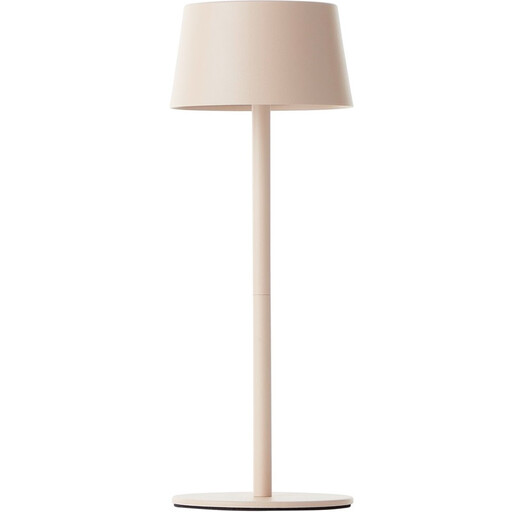
Why it suits this profile: This compact garden lamp is suitable for a balcony, table or sheltered patio. Solar and USB charging provide two ways to recharge the integrated battery.
The specifications state 170 lumens, IP44 and three dimming settings. This makes it clear that it is primarily mood lighting, not an area light.
170 lumens, 3000K, three dimming settings, solar and USB charging, IP44.

Why it suits this profile: This solar wall lamp is designed for entrances, façades or patios and features a daylight and motion sensor.
The IP44 rating clearly indicates its limits: it is suitable for splashing water, but not for immersion.
Two lighting modes, integrated LED, motion sensor and IP44 housing.

Why it suits this profile: This solar outdoor lighting is designed for garages, large gardens, patios and driveways where broad light coverage is preferred.
The product information mentions three adjustable heads, 270-degree coverage and three lighting modes. This gives you more control than a single fixed beam.
302 LEDs, stated light output of 3000 lumens, IP65, motion detection up to 60 feet.
We have put together a complete, up-to-date list of products that fully meet these strict selection criteria and the applicable European safety regulations.
For mood lighting on a patio or balcony, 170 to 300 lumens may be sufficient. An entrance, garden path or driveway will often require more light. The right choice also depends on the distance, beam angle and number of lamps.
Solar outdoor lighting can be practical in the Netherlands, but its performance depends on the amount of daylight available. In winter and on cloudy days, the battery may not charge as fully. A model with a USB charging option provides an additional charging method.
An IP44 outdoor lamp is protected against splashing water and solid objects larger than 1 millimetre. An IP65 outdoor lamp also offers greater protection against dust and water jets. Neither rating automatically means that a lamp can be placed underwater.
