
Vandaag of morgen in huis

Kwaliteit gegarandeerd

Welkomstaanbiedingen ontgrendelen: GRATIS bezorging | Tot 80% korting | Gratis 30 dagen JoyPlus-proefperiode
Download de app
Good outdoor lighting needs to suit the location, the purpose and the British weather. A lamp for creating ambience on a balcony has different requirements to a bright outdoor light with a sensor for the driveway. Yet many products are mainly promoted with terms like “waterproof”, “energy-efficient” or “powerful lighting”, without it being clear what the specifications actually mean.
So look out for these common pitfalls before you buy:
The IP code consists of two digits. The first digit indicates protection against solid particles, the second against moisture and water.
A higher IP rating does not automatically make a lamp suitable for submersion or every extreme situation. Follow the manufacturer’s installation instructions.
Lumens indicate how much light a lamp emits. For ambient garden lighting, a softer light output is usually sufficient. For an entrance, garage or driveway, more light may be desirable.
Colour temperature is expressed in kelvin:
Also consider the direction of the light. An LED garden light with a downward beam can mark a path without unnecessary light spill onto neighbours. Wall lights can accentuate walls, while wide floodlights illuminate larger areas.
Solar lights for outdoors work with a solar panel and a rechargeable battery. Check the stated charging time and burn time, but treat these as product specifications under certain conditions. Cloud cover, shade and the angle of the panel all affect performance.
An outdoor light with a sensor can switch on automatically when movement is detected. Pay attention to:
For fixed 230V lighting, such as some outdoor wall lights with a GU10 or E27 fitting, installation by a qualified electrician is required. Also check whether the light source is included. With a GU10 lamp, the choice of LED bulb determines the colour and light output.
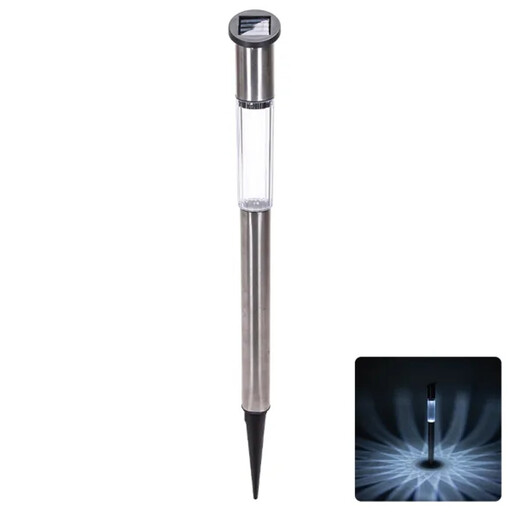
Why this fits the profile: This compact stake light is designed for anyone who wants to mark out a garden path, border or planter without wiring. The light is 55 cm tall and runs on solar power.
The product information states outdoor use, IP44, a charging time of 4–6 hours and a stated battery life of 8–12 hours. Place the light in a sunny spot.
Stainless steel construction, polycrystalline solar panel and 6500 K light colour; installation without cables.
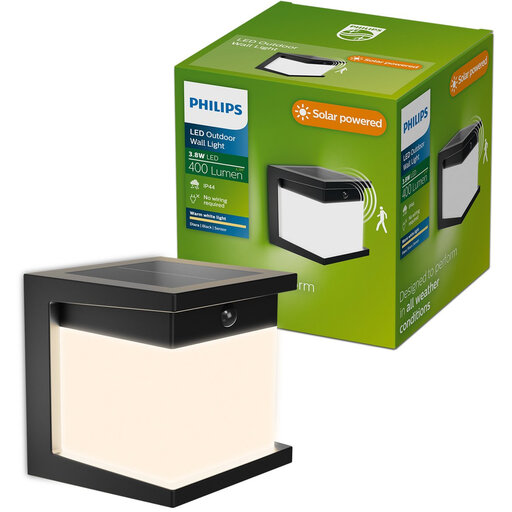
Why this fits the profile: This solar outdoor wall light is ideal for an entrance, balcony or patio where warm light and automatic switching are desired.
The specifications state IP44 and 400 lumens. This makes it clear that the light is suitable for splashing water, but not for submersion. The solar cell needs direct daylight.
2700 K warm white light, two light modes and an integrated motion sensor.

Why this fits the profile: This solar floodlight is aimed at driveways, garages, patios and larger areas where wide, powerful lighting is needed.
The stated IP65 rating is clearly more suitable for an exposed location than IP44. Mount the light so that the solar panel receives direct light.
302 LEDs, stated 3000 lumens, three light modes, three adjustable light heads and a motion sensor with a stated angle of 180 degrees.
First, check where the light will be placed. A path light needs clear space around the stake and must not create a trip hazard. For wall mounting, the surface must be sturdy enough. Keep the solar panel free of leaves, dust and branches. Regular cleaning with a soft, damp cloth can help keep the panel clear.
For ambience, you can choose warm white light, for example with a standalone LED garden light or a light with multiple modes. The Atmosphera Zack Outdoor Floor Lamp has, according to the product information, a height of 108 cm, IP44 protection, battery power and three modes: multicolour, flame effect and white light. This is a portable option for a balcony or patio, but not a replacement for bright security lighting.
Also note the difference between outdoor and indoor products. The Atmosphera LED string light with 20 bulbs has an IP20 rating and, according to the product information, is offered exclusively for indoor use. So do not use it as patio lighting in all weathers.
We have compiled a full, up-to-date list of products that fully meet these strict selection criteria and current European safety regulations.
Choose garden path lighting with a stable ground spike, a visible but not dazzling light beam and an appropriate IP rating. Solar garden lighting is handy when you don’t want to lay a cable. Place the lights in spots with plenty of sunlight and keep an even distance between them for a calm light pattern.
The run time per evening depends on sunlight, battery capacity, temperature and the selected light mode. Manufacturers often give a number of burn hours under specific conditions. Treat this as an indication, not a fixed guarantee for every night. Also check whether the battery is replaceable and clean the panel regularly.
A solar outdoor light with a sensor does not use mains electricity, but relies on the energy stored during the day. A wired LED light with a sensor only switches on when needed. The actual consumption depends on the wattage and how often the sensor is triggered. So alongside the light output, also look at the power rating and the burn time per activation.
