
Vandaag of morgen in huis

Kwaliteit gegarandeerd

Welkomstaanbiedingen ontgrendelen: GRATIS bezorging | Tot 80% korting | Gratis 30 dagen JoyPlus-proefperiode
Download de app
Good outdoor lighting needs to do more than look attractive. On a patio, you want inviting light; by the front door, practical lighting is the priority; and along a driveway, you need a sturdy, well-positioned light source. Yet many buyers focus mainly on design or a low price. This often leads to the same problems: a light doesn’t provide enough illumination, isn’t suitable for the chosen location or requires more installation work than expected.
IP44 outdoor lighting is protected against splashes of water from different directions. This makes a light suitable for many sheltered or standard outdoor locations, but not for immersion or direct jets of water at high pressure. So don’t place an IP44 outdoor light where rainwater collects or where a garden hose could spray directly onto its housing.
Wattage mainly tells you about energy consumption, not how much light a product gives off. When choosing an LED outdoor light, check the number of lumens. A 350-lumen light serves a different purpose from an 840-lumen one. Lower light output is often enough for decorative garden lighting; by an entrance, path or driveway, a more focused light may be more useful.
An outdoor light connected to mains electricity must be wired to a suitable outdoor socket or fixed wiring. Some wall lights need to be installed by a qualified electrician. Solar garden lighting is easier to position, but works most reliably in a spot that gets plenty of daylight. Also check whether the light source is included. An outdoor GU10 light may come with a fitting but no bulb.
Warm white outdoor lighting of around 2700K to 3000K creates a soft look on a patio, balcony or by an entrance. A light colour of around 4000K looks more neutral and can work well for a driveway or functional garden lighting. At around 6500K, the light is noticeably cooler and whiter, which may not suit every garden or exterior.
Aluminium, glass, plastic and metal are all commonly used for garden lighting. Look beyond the material to the finish, dimensions and stability. An outdoor ground spotlight needs to stand firmly and mustn’t create a trip hazard. An outdoor wall light should be fixed to a stable surface. If you’re choosing a garden spike light, check that the ground is suitable for the spike.
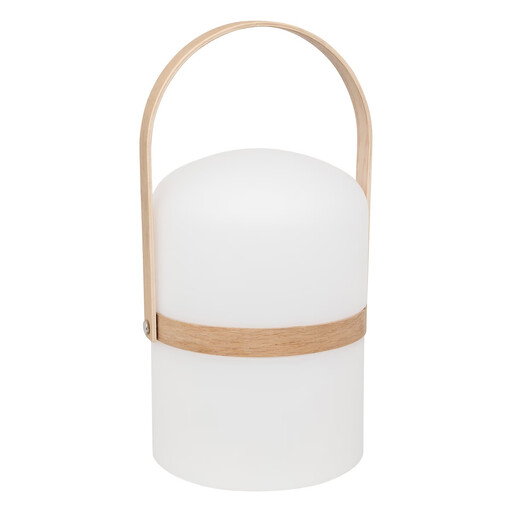
Why it suits this buyer: This portable light runs on a rechargeable battery, so you can use it on a table, balcony or patio without a fixed connection. Its three light levels let you adjust the brightness.
The product specifications state 270 lumens, three light settings and an IP44 rating. So you’ll know in advance that this is mainly a mood light, not a powerful driveway light.
Rechargeable lithium-ion battery, handle, three light levels and a stated run time of 4 hours at full power and up to 60 hours on the low setting.
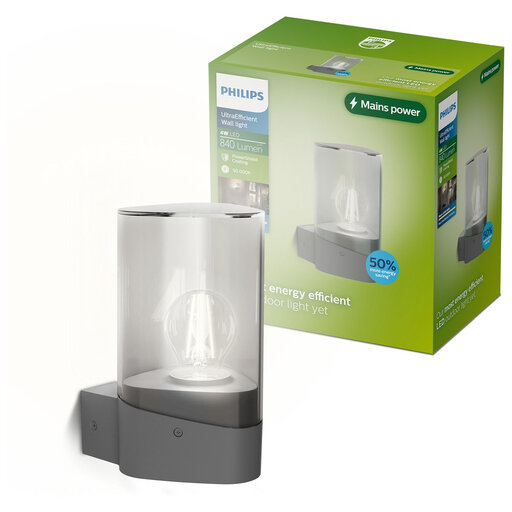
Why it suits this buyer: This fixed wall light is a good fit for an exterior wall, entrance or covered patio where you want a clear source of light. The E27 fitting gives you the flexibility to choose a suitable LED bulb.
Its IP44 rating isn’t mistaken for complete waterproofing: ideally, position the light in a sheltered spot and avoid direct jets of water. Also check whether a light source is included and review the installation requirements.
E27 fitting, 2700K warm white light according to the product information, 840 lumens and an aluminium and plastic housing.
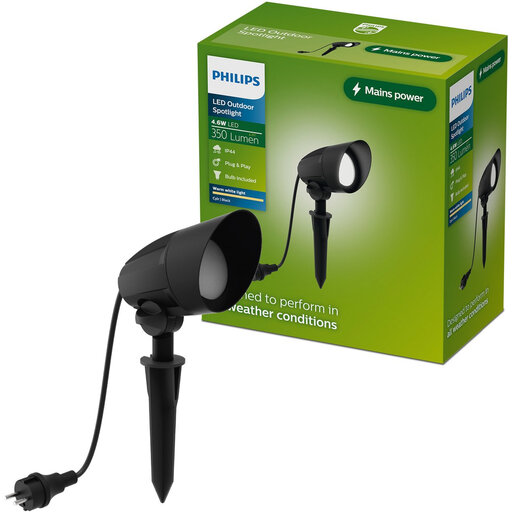
Why it suits this buyer: This adjustable ground spotlight is designed to illuminate a shrub, tree, lawn, gate or driveway. The included GU10 LED bulb and plug mean fewer separate parts to buy.
The specifications list 350 lumens, 2700K and IP44. This helps you see in advance that the light provides a warm, focused beam, but isn’t designed to illuminate a large area.
Adjustable spotlight, GU10 LED bulb included, aluminium and glass construction, 150 cm cable and a stated light-source lifespan of 15,000 hours.
We’ve put together a complete, up-to-date list of products that meet these strict selection criteria and the applicable European safety regulations.
It depends on where you’ll place the light. IP44 protects against splashing water and is suitable for many sheltered outdoor locations. A higher level of protection may be appropriate for an exposed spot or one that gets a lot of rain. Always check the full product information, and don’t place an IP44 light in water or where it will be hit by a direct jet of water.
A lower light output may be enough for decorative garden lighting. By an entrance, path or driveway, you’ll often want more focused light. So compare the lumen count with how you plan to use the light. A 270-lumen light is best suited to creating atmosphere and illuminating a small area, while 840 lumens can light a larger or more functional space.
Solar garden lighting doesn’t use mains electricity while it’s on, but how long it stays lit depends on sunlight, battery capacity and the conditions it’s used in. In winter or in a shady spot, the run time may be shorter. For consistent lighting throughout the evening, a mains-powered light or a rechargeable model with a known run time may be more practical.
