
Vandaag of morgen in huis

Kwaliteit gegarandeerd

Welkomstaanbiedingen ontgrendelen: GRATIS bezorging | Tot 80% korting | Gratis 30 dagen JoyPlus-proefperiode
Download de app
Good outdoor lighting helps with orientation, makes your entrance easier to use and can create a more welcoming atmosphere in a garden, on a balcony or on a patio. However, an attractive product photo does not guarantee that an outdoor light will work well in your location. For example, a solar wall light in the shade will only charge to a limited extent, while an IP44 outdoor light is not automatically suitable for a completely exposed façade.
The following points will help you turn marketing claims into practical choices.
The number of lumens indicates the total luminous flux, but not how widely or narrowly the light is distributed. A compact outdoor wall light with 180 lumens may be sufficient beside a front door, while a driveway or large garden requires more light and broader coverage. So also look at the beam angle, the number of light heads and the installation height.
A solar outdoor light is easy to install because you do not need to run a cable to the mains. However, its performance depends on direct sunlight, the position of the panel, the season and the battery capacity. Do not install a solar wall light under a canopy or on a north-facing wall without first checking how much sunlight the panel receives.
The IP code consists of two digits. The first indicates protection against solid particles; the second refers to water. IP44 outdoor lighting is protected against splashing water and is generally suitable for sheltered entrances, balconies and covered patios. IP65 outdoor lighting offers greater protection against dust and water jets, making it the more logical choice for a more exposed location. Neither classification means that you can place a light underwater.
An integrated LED outdoor light is compact and does not require a separate bulb. However, check whether the light source can be replaced. If an integrated LED fails, the complete fitting often needs to be replaced.
A GU10 outdoor light comes with a fitting into which you install a suitable GU10 LED spotlight yourself. This gives you more flexibility when it comes to colour temperature, beam and optional smart features. An E27 outdoor light uses a larger standard fitting. Always check the maximum wattage and whether the light source is included.
For a relaxing atmosphere, values around 2700 to 3000 K provide warm white light. Higher values produce cooler light. Product information may sometimes use different wording, so pay particular attention to the stated colour temperature in kelvin.
An outdoor light with a motion sensor switches on when movement is detected. Check the detection distance, detection angle, activation time and whether the sensor can be adjusted. Do not point the sensor directly towards a busy road or moving branches, as this can cause unnecessary activation.
A motion sensor is suitable for an entrance, garage path or driveway. For continuous orientation on a patio, a light with manual control or a dusk function may be more practical.
Solar and battery-powered lighting is generally suitable for rented homes or locations where you do not want to drill or install wiring. A fixed outdoor wall light connected to 230 volts must be wired safely. Have work on the mains carried out in accordance with local regulations, and by a qualified electrician if in doubt.
Also check:

Why it suits this profile: This compact solar outdoor light is designed for an entrance, balcony, patio or garden wall where installation without fixed wiring is preferred.
The specifications state 180 lumens, 2700 K, a motion sensor and IP44. This makes it clearer that the model is intended for nearby lighting and sheltered locations, rather than for illuminating a driveway over a wide area.
Integrated LED, solar power, dimming function and motion sensor in a fitting measuring 11.5 cm in height.
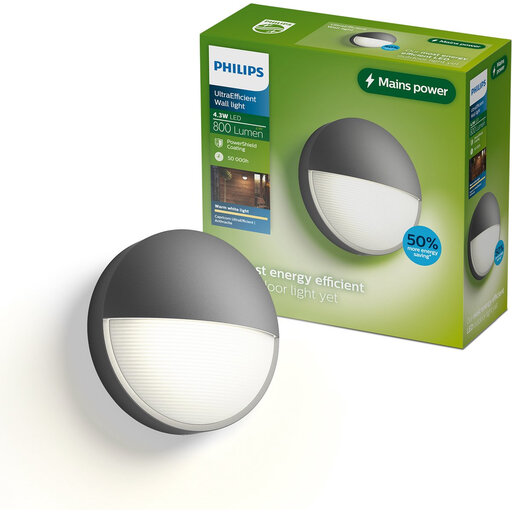
Why it suits this profile: A fixed outdoor wall light is a good choice for homeowners looking for façade lighting with a permanent light point and a modern aluminium housing.
The fixed connection and professional installation requirements are clearly stated. This prevents you from expecting a plug-and-play light when wiring is actually required.
Stated output of 800 lumens, integrated LED, 2700 K and aluminium with a protective coating. IP44 makes the model suitable for splashing water.

Why it suits this profile: For a driveway, garage, large garden or rear path, the wide coverage provided by three adjustable light heads may be more practical than a small outdoor light.
The product description states a detection angle of 180°, a range of 60 feet, three lighting modes and IP65. Before installation, however, check that the location receives enough sunlight.
According to the stated product specifications: 302 LEDs, 3000 lumens, three light heads, a 1800 mAh solar battery and IP65 protection.
We have put together a complete, up-to-date list of products that fully meet these strict selection criteria and the applicable European safety regulations.
Clean the solar panel and sensor regularly with a soft, slightly damp cloth. Dirt can affect light output or detection. With fixed LED lighting, the stated wattage is more important than the lumen figure alone when estimating energy consumption.
A 4-watt light that is on for 1,000 hours uses approximately 4 kWh. A motion sensor or dusk switch can limit the amount of time the light is on. With smart garden lighting, you should also check whether a bridge, Wi-Fi connection or app account is required. For example, the Brilliant Kamara 3-piece set lists Tuya control, RGB, adjustable colour temperature and dimming; app installation and a connection are required for the smart functions.
IP44 may be suitable for a sheltered façade, balcony or covered veranda. For a location that is more frequently exposed to dust or water jets, IP65 offers greater protection. Also check the installation instructions and avoid submerging the light, even if it has a higher IP rating.
The operating time per night depends on sunlight, battery capacity, temperature, lighting mode and how often the sensor is activated. A product description may state the lifespan of the LED or battery, but this does not guarantee the same operating time in all Dutch weather conditions. Positioning the light in a sunny spot and cleaning the panel will help maintain its performance.
LED lights generally use little power, but total consumption depends on the wattage and the number of hours they are on. Solar lighting does not use mains electricity during normal operation. With fixed garden lighting, you can reduce consumption by using a motion sensor, timer, dusk sensor or smart schedule.
