
Vandaag of morgen in huis

Kwaliteit gegarandeerd

Welkomstaanbiedingen ontgrendelen: GRATIS bezorging | Tot 80% korting | Gratis 30 dagen JoyPlus-proefperiode
Download de app
Good outdoor lighting needs to do more than simply look attractive. By your front door, you need enough light to find the lock. On a balcony, you may mainly be looking for atmospheric outdoor lighting. Along a driveway, a reliable motion sensor is often more important than a decorative design.
However, there are a few common pitfalls:
The IP code consists of two digits. The first digit refers to protection against solid particles, while the second refers to protection against water.
Neither classification automatically means that a light can be used underwater. Also check that the cables, connection points and wall mounting are suitable for the chosen location.
Light output is measured in lumens. A low light output may be sufficient for a small balcony or decorative planter. More focused light is practical for a back door or driveway.
Colour temperature is measured in kelvin:
Also consider the light distribution. A light with a wide beam illuminates a larger area, while a compact wall spotlight mainly highlights a narrow zone.
A solar outdoor light does not need to be connected to the mains, but its performance depends on sunlight, panel direction and battery capacity. Keep the panel clear of leaves and dirt.
An outdoor light with a motion sensor is practical by a front door, shed or driveway. Check the detection range and see whether the light has several modes. A sensor that is too sensitive may be triggered by passing animals or moving branches.
A wired outdoor wall light with a 230V connection must be installed by a qualified electrician. A light with a USB-rechargeable battery or magnetic mounting is more flexible, but needs to be recharged regularly and mounted securely.

Why it suits this profile: This solar wall light works without wiring and offers a choice between Auto and On modes. That makes installation straightforward for a first application by a shed, terrace or entrance.
The product details state that it has an integrated motion sensor, daylight sensor and IP44 rating. However, place the light in a sheltered location with direct sunlight.
According to the product description: warm white light at 2,700K, 400 lumens per light point, two lighting modes and a housing made from UV-resistant black plastic.
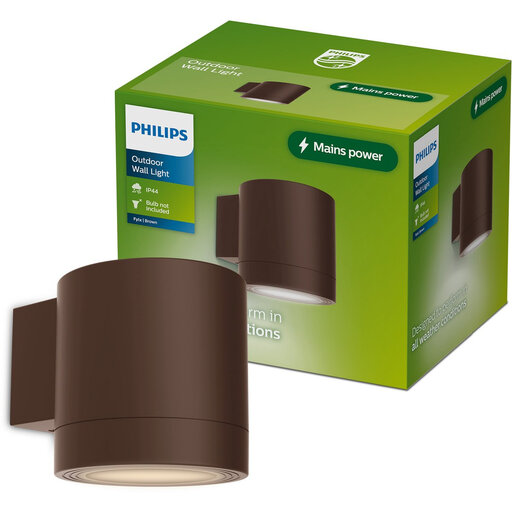
Why it suits this profile: If you want to choose the bulb yourself, this outdoor wall light features a GU10 fitting. You can therefore match the colour temperature and light output to your exterior wall, veranda or entrance.
The light is supplied without a GU10 bulb. This is clearly stated in the product information, so you can factor in the additional purchase and installation.
Aluminium housing, GU10 fitting, removable bulb and IP44 protection according to the stated product specifications.

Why it suits this profile: This solar floodlight is designed for larger areas such as a driveway, garage or large garden. Its three adjustable heads provide broader coverage than a compact wall light.
The stated specifications include IP65, three lighting modes, a 180° detection angle and a detection range of 60 feet. Before installation, check that the chosen location receives enough sunlight.
According to the product listing: 302 LEDs, a stated light output of 3,000 lumens, three adjustable light heads and installation without mains wiring.
We have compiled a complete, up-to-date list of products that fully meet these strict selection criteria and the applicable European safety regulations.
That depends on the purpose. A modest light output is often enough for balcony lighting or decorative terrace lighting. A medium output is practical for an entrance. A driveway or broad garden area may need more lumens, preferably distributed across several fittings to reduce harsh shadows.
IP44 outdoor lighting is suitable for splashing water and can be used in many sheltered outdoor locations, such as a covered terrace, balcony or entrance. The classification does not mean that the light is waterproof for immersion or direct high-pressure jets. Therefore, consider the exact installation location and the product’s safety information.
A solar outdoor light does not use electricity from the mains during normal operation. The battery is charged by the solar panel during the day. Operating time varies depending on the season, sunlight levels, battery condition and selected lighting mode. Clean the panel regularly and expect shorter charging periods on overcast days.
