
Vandaag of morgen in huis

Kwaliteit gegarandeerd

Welkomstaanbiedingen ontgrendelen: GRATIS bezorging | Tot 80% korting | Gratis 30 dagen JoyPlus-proefperiode
Download de app
Buying an outdoor light seems simple, until you discover that it is not bright enough, the solar battery barely charges in the shade, or the fitting is incompatible with your favourite light source. Outdoor lighting is particularly prone to disappointing expectations created by attractive product photos and vague terms such as “weatherproof”.
So be aware of these three common pitfalls:
For a covered balcony, veranda or sheltered exterior wall, IP44 may be suitable. However, check the product information to see whether the light needs to be protected from direct rain. For a completely exposed garden location, a higher IP rating may be more appropriate.
The term “weatherproof outdoor light” does not tell you much on its own. Check the official IP classification, the material and the installation instructions. Even with a light featuring an aluminium housing or plastic housing, proper sealing remains important. With some models, IP44 protection is only maintained when the light is installed correctly and the fitting is properly sealed.
An E27 outdoor light uses a standard large screw fitting. This is practical if you want to choose the light colour, brightness or dimming capability yourself. A GU10 outdoor light is suitable for a compact spotlight and usually directs the light more precisely towards a wall, plant or passageway.
In addition to the fitting, check:
An integrated LED outdoor light is compact, but if the light source fails, it cannot always be replaced separately. With a separate E27 or GU10 fitting, you have more choice. Dimmable outdoor lighting only works when the light, light source and any dimmer are all suitable for dimming.
Solar lighting works without a fixed power cable, but depends on sunlight and battery capacity. A model with a motion sensor can be useful by an entrance or shed. Pay attention to the difference between a light that only comes on when movement is detected and one that can also stay on continuously at a low brightness setting.
For a patio or balcony, freestanding table lamps are often easy to position. A garden spotlight, ground spotlight or garden post requires more attention to stability, cables and the walking route. Mains-powered lighting must be installed in accordance with the applicable local regulations. If in doubt, consult a qualified installer.
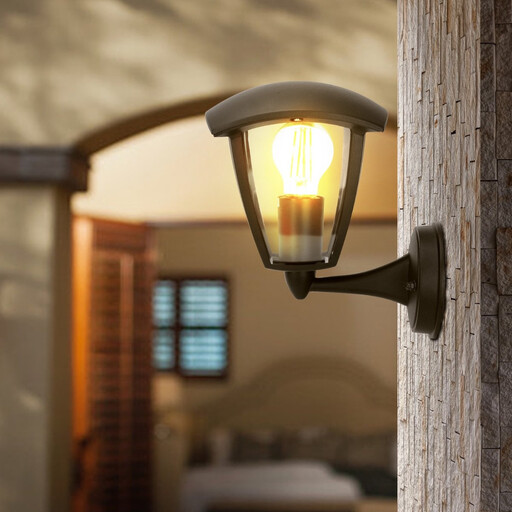
Why it suits this profile: This outdoor wall light has an E27 fitting and is supplied without a light source. You can therefore choose an affordable LED bulb yourself for a balcony, access gallery or covered entrance.
The product information clearly states that the light source is not included, along with a maximum wattage of 60 W and an IP44 classification.
E27 fitting, aluminium and PMMA, dimensions of 215 × 170 × 235 mm, and suitable for sheltered outdoor locations.
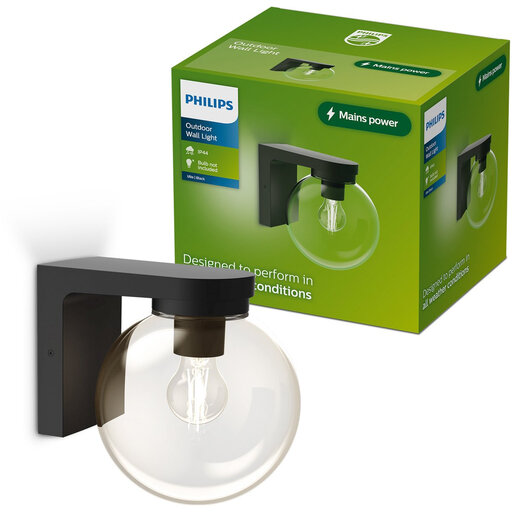
Why it suits this profile: This classic outdoor wall light is ideal for an exterior wall, veranda or patio where appearance and a separate, replaceable light source are important.
The light is supplied without a light source. This makes it clear in advance that you need to choose a suitable E27 LED bulb yourself; IP44 means protection against splashing water, not complete waterproofing.
Aluminium and glass, one light point, diffuse light distribution, and dimensions of 200 × 252 × 227 mm.

Why it suits this profile: This solar outdoor light is designed for entrances, sheds and dark passageways where plenty of light on movement is desirable without a fixed power cable.
The product states that it depends on direct sunlight and features an integrated dusk and motion sensor. The light is IP44 and is therefore not intended for submersion.
1000 lumens, integrated LED, 3000 K warm white light, two lighting modes and installation without fixed wiring.
We have compiled a complete, up-to-date list of products that fully meet these strict selection criteria and the applicable European safety regulations.
For example, a Philips Splay garden post is listed with an integrated LED light source with 2700 K and 4,3 W. The Philips Cylr ground spotlight is supplied with a GU10 LED spotlight producing 350 lumens and has a 1.5-metre cable. Details like these help you decide whether the light is suitable for a garden path, border or patio.
IP44 is often used for sheltered outdoor locations. This classification provides protection against splashing water, but not against submersion or powerful jets of water. If the light is fully exposed to rain or the fitting is positioned close to the ground, also compare models with a higher IP classification.
A solar light does not use electricity from the mains. Its mains electricity running costs are therefore zero, but performance depends on sunlight, battery capacity and temperature. In a Dutch winter or on a shady wall, the operating time may be shorter.
Lifespan varies depending on the model and operating conditions. Manufacturers sometimes state an expected lifespan, such as 15,000, 25,000 or 50,000 hours. Treat this as a product specification rather than a guarantee for every situation. Moisture damage, incorrect installation or an unsuitable power source can affect the lifespan.
