
Vandaag of morgen in huis

Kwaliteit gegarandeerd

Welkomstaanbiedingen ontgrendelen: GRATIS bezorging | Tot 80% korting | Gratis 30 dagen JoyPlus-proefperiode
Download de app
Good outdoor lighting needs to suit the location, the type of light you want and the outdoor conditions. A lamp for a sheltered balcony has different requirements from a powerful light for the driveway. Even so, many buyers focus mainly on appearance or the number of lumens. This can lead to the wrong purchase.
A high number of lumens may sound appealing, but bright light is not always practical. For a patio or balcony, 2700K to 3000K warm white light may be more pleasant than cool, bright light. For a driveway or rear path, a higher light output combined with a motion sensor can be particularly useful.
Also consider how the light is distributed. An adjustable lamp head or multiple light points can illuminate a larger area than a single fixed LED, even when the difference in lumens is limited.
A product with IP44 is protected against splashing water, but is not designed for direct jets of water or immersion. Ideally, position this type of outdoor lighting under a canopy or on a sheltered exterior wall. For a more exposed location, IP65 is the more logical choice: this classification provides greater protection against dust and water jets.
Also check the adapter, plug and connections. The lamp’s IP rating does not automatically mean that every part of the power supply has the same level of protection.
Solar outdoor lighting needs direct sunlight to charge its battery. Shade from a roof edge, tree or fence can affect how long the light stays on. In winter and during overcast weather, the available charging energy is also lower.
A solar wall light is therefore convenient because it requires no wiring, but it is not always suitable as constant main lighting. Check that the panel can face the sky unobstructed and that the light will still be accessible for maintenance after installation.
Also check the installation advice. An IP44 outdoor wall light can work perfectly well by an entrance, provided that water does not collect on or around the electrical connection.
Lumens indicate the amount of visible light. For atmospheric garden lighting, a few hundred lumens are often sufficient. Functional lighting around a driveway or garage will generally require more light.
Colour temperature is measured in Kelvin:
An outdoor light with a sensor only switches on when movement or a change in ambient light is detected. Therefore, check the detection range, activation time and available lighting modes. A sensor prevents unnecessary use, but an incorrect installation height can limit its range.
Solar and USB lights are generally easy to install. A fixed outdoor wall light with an E27 or GU10 fitting usually needs to be connected to the mains. Have work on 230V installations carried out by a qualified installer.
Check whether the light source is included. The Brilliant Newport outdoor light and Philips Juli outdoor wall light have an E27 fitting, but are supplied without a bulb. Philips Fylx requires a GU10 bulb. This gives you freedom to choose the colour temperature and dimming capability, but it also means that the total purchase consists of both the fitting and the light source.
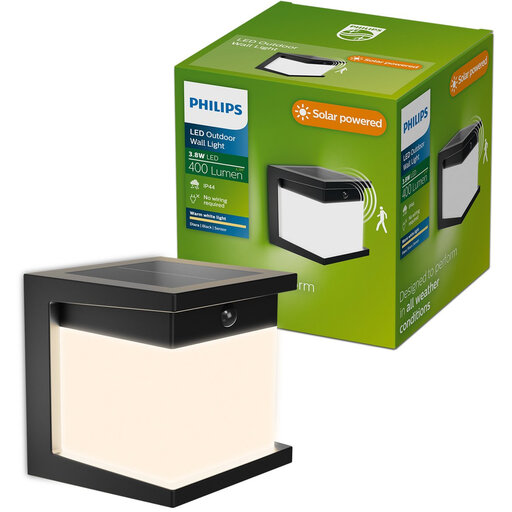
Why it suits this profile: This compact solar wall light requires no fixed wiring and offers two lighting modes, a motion sensor and 400 lumens of warm 2700K light.
The specifications clearly state IP44 and the need for direct sunlight. This makes the installation limitation clear from the outset.
No mains connection required; integrated LED; two lighting modes; 2700K warm white light.

Why it suits this profile: This solar outdoor light is designed to provide broad, powerful illumination around a driveway, garage or large garden.
The product information specifies 4000 lumens, IP65, an adjustable light head and a detection range of up to 8 metres when approached directly.
IP65 rating; adjustable head; integrated LED; motion and dusk sensor.

Why it suits this profile: The three adjustable light heads and broad coverage are ideal for larger gardens, patios, garages and driveways.
The IP65 rating is more specific than a general claim such as “waterproof”. Three lighting modes and a motion sensor are also specified.
302 LEDs; stated light output of 3000 lumens; three adjustable heads; IP65.
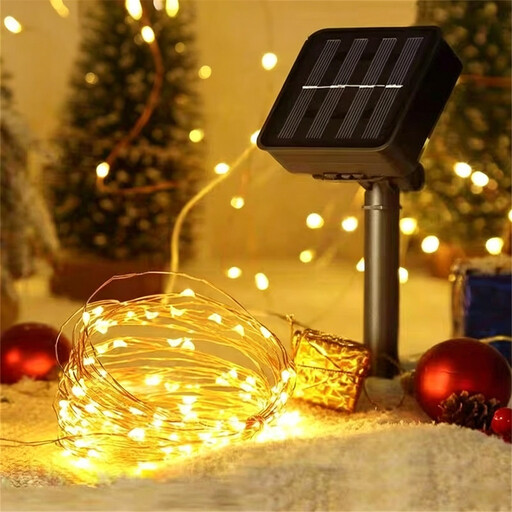
Why it suits this profile: Two 49-foot strings with warm white light are suitable for trees, balcony edges, pergolas and patios.
The stated charging time, operating time and eight lighting modes make it clear what to expect from this decorative solar garden lighting. The panel must be placed outdoors in direct sunlight.
Two strings; 75 LEDs per string; eight lighting modes; warm white light; memory function.
We have put together a complete, up-to-date list of products that fully meet these strict selection criteria and the applicable European safety regulations.
It depends on the purpose. For a patio, balcony or decorative garden lighting, a modest light output is often enough. For a driveway, garage or rear path, more light is preferable. In addition to lumens, consider the beam angle and the height at which the lamp is installed.
Yes, IP44 outdoor lighting is designed to protect against splashing water and can be used in sheltered locations. Do not place an IP44 lamp where it will be exposed to direct water jets for extended periods or where water can collect.
While in use, a solar lamp does not consume electricity from the mains. Its performance does depend on sunlight, battery capacity, temperature and maintenance. In a shady garden, a lamp may stay on for less time or produce less light than it would on a sunny exterior wall.
