
Vandaag of morgen in huis

Kwaliteit gegarandeerd

Welkomstaanbiedingen ontgrendelen: GRATIS bezorging | Tot 80% korting | Gratis 30 dagen JoyPlus-proefperiode
Download de app
Good outdoor lighting needs to do more than look attractive. A light by the front door should provide good visibility, while patio lighting can focus more on creating atmosphere. On a balcony, size and installation matter more than high light output. If you focus only on design or a low price, you could end up with disappointing performance, complicated installation or an unsuitable IP rating.
An IP44 outdoor light is protected against solid objects and splashing water. That doesn’t mean the light is waterproof or suitable for a spot where rain falls directly on the casing and connections. According to their product descriptions, many IP44 models are intended for sheltered or covered outdoor locations.
An IP65 outdoor light offers greater protection against dust and water jets. This can be more practical for an open driveway, shed or exterior wall exposed to heavy rain. Always check the full installation instructions, though. The IP rating applies to the light as a whole when installed in accordance with the specified conditions.
A GU10 outdoor light or E27 outdoor light is often supplied without a bulb. This gives you more choice, but also means extra costs and a compatibility check. Look out for:
For example, the Philips Fylx outdoor wall light has a GU10 fitting and, according to the product information, doesn’t include a GU10 spotlight bulb. The Brilliant Newport outdoor light uses an E27 fitting and has a maximum power rating of 60 W per light point.
A solar outdoor light won’t necessarily stay at the same brightness all night. Charging depends on direct sunlight, the position of the panel, the season and the condition of the battery. As a result, a light under a shelter or beside a tall fence may not stay on for as long as expected.
Position the solar panel where it will get as little shade as possible during the day. Models with a separate cable, such as some solar floodlights, let you position the panel separately from the light.
Use an IP44 outdoor light by an entrance under a canopy, on a covered patio or on a sheltered balcony. For an exposed exterior wall, driveway or garden path, IP65 can offer greater protection. Also check how the light is powered. A mains-powered light must be installed and connected correctly; fixed wiring must be installed by a qualified electrician.
Lumens indicate how much light a product emits according to its specifications. For a cosy atmosphere on the patio, warm white light around 2700 to 3000 K is often a good choice. A higher light output may be more useful for a driveway or practical exterior lighting.
Also consider the direction of the light. A downlight mainly illuminates the area beneath it. An outdoor wall light with a diffuser spreads the light more widely. For a large area, a model with several light heads may be more useful than a compact outdoor wall light.
Mains power is suitable when you need consistent light for long periods. Solar lighting is a good option if you don’t want to run a cable. An outdoor light with a motion sensor only switches on when it detects movement, but check the detection angle, range and adjustable settings.
With integrated LED outdoor lighting, the light source is built into the fitting. This means you don’t need to replace a separate bulb, but it also means you’ll usually need to replace the whole fitting when it reaches the end of its life. With GU10 and E27 fittings, you can replace the bulb separately.
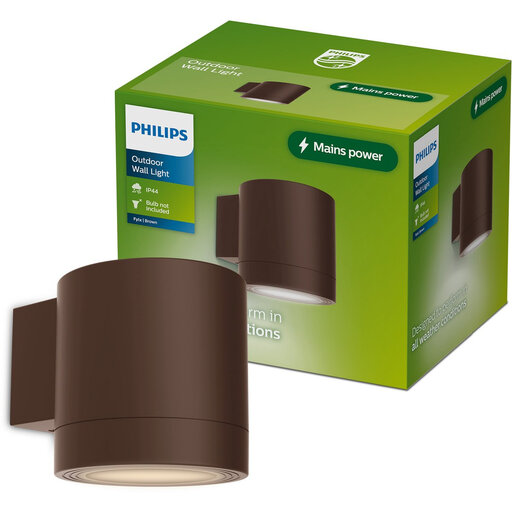
Why it suits this profile: This compact outdoor wall light has a GU10 fitting, so you can choose a suitable LED spotlight yourself. Measuring around 9 × 11,6 × 9 cm, it’s a good fit for an entrance, balcony or small exterior wall.
The product information clearly states that the GU10 spotlight bulb isn’t included. It also has an IP44 rating, so you know not to treat it as completely waterproof.
Aluminium casing, replaceable GU10 bulb, and a choice of different light colours and brightness levels.
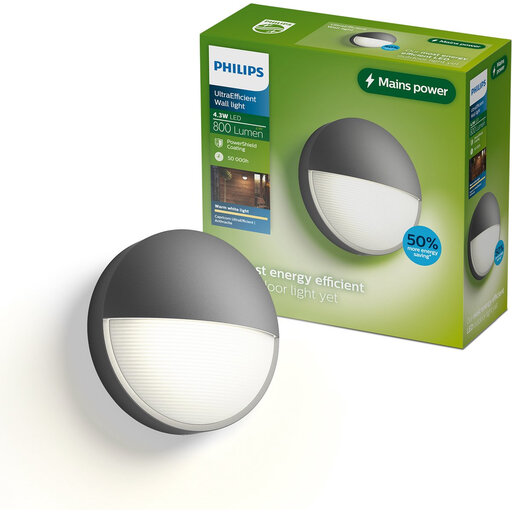
Why it suits this profile: This fixed exterior light combines an aluminium and plastic casing with integrated LED, 800 lumens and warm white light at 2700 K. It’s a good choice for an entrance or patio where you want a permanent lighting solution.
The specifications state 4,3 W per light point and IP44. The integrated LED isn’t replaceable, and this is clearly stated upfront.
800 lumens, 2700 K, an aluminium casing and a stated lifespan of up to 50.000 hours, according to the product information.

Why it suits this profile: This solar outdoor light with three heads is designed for a driveway, garage, garden or larger outdoor area. The product details state that it has 302 LEDs, three settings and a wide beam spread.
The stated IP65 rating and need for direct sunlight make it clear where this model will and won’t work well. The panel and sensor will also need regular cleaning.
302 LEDs, three lighting modes, motion detection up to 60 feet according to the product information, and a stated light output of 3000 lumens.
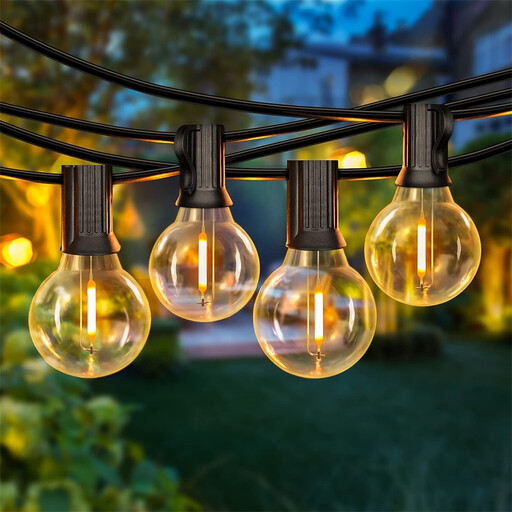
Why it suits this profile: This 30-metre string of lights with 50+2 LEDs is designed for decorative lighting on patios, balconies and in gardens, as well as for events. The plug-in power supply is handy when you want light for long periods.
The product information states that the bulbs must not be submerged and that connections should be kept out of standing water. This helps you avoid assuming it can be used outdoors in all conditions.
Dimmable, replaceable G40 bulbs, a timer and multiple lighting modes, according to the product description.
We’ve put together a full, up-to-date list of products that meet these strict selection criteria and current European safety regulations.
Before you buy, check the following:
IP44 is often suitable for a sheltered spot, provided the light is installed according to the instructions. For a location more exposed to rain and dust, IP65 can offer greater protection. Always check the product specifications and installation requirements.
A solar outdoor light doesn’t use mains electricity while it’s in use. The solar panel charges the integrated battery during the day. How long the light stays on depends on sunlight, the season, shade, temperature and the selected lighting mode.
Lifespan varies from product to product. For integrated LED lights, a stated operating life is sometimes provided, such as up to 50.000 hours for a particular Philips model. This is a product specification, not a guarantee that the light will last exactly that long in all conditions. Replaceable GU10 or E27 bulbs offer more flexibility if you need to change the light source later.
