
Vandaag of morgen in huis

Kwaliteit gegarandeerd

Welkomstaanbiedingen ontgrendelen: GRATIS bezorging | Tot 80% korting | Gratis 30 dagen JoyPlus-proefperiode
Download de app
An outdoor light needs to do more than look good. In the Netherlands, outdoor lighting has to cope with rain, wind, dirt and changing temperatures. Yet it is often only after installation that you discover whether a light is suitable for its location. An outdoor wall light beneath a canopy, for example, has different requirements from a garden light along an exposed path.
The most common buying pitfalls:
The IP rating indicates how well a fitting is protected against dust and water. An IP44 outdoor light is splash-resistant and is often suitable for a covered entrance, balcony, veranda or patio. It is best not to place this type of light where rainwater constantly falls directly onto the fitting.
An IP65 outdoor light generally offers greater protection against dust and water jets. Always check the official product specifications and installation instructions. A higher IP rating does not automatically make an incorrect connection or unsuitable cable safe.
A GU10 outdoor light usually uses a compact spotlight. This often allows you to choose the colour temperature and brightness yourself. Check the maximum wattage and make sure the GU10 bulb is suitable for outdoor use.
An E27 outdoor light uses a larger, widely used screw fitting. The Brilliant Newport, for example, has one E27 fitting for up to 60 W and is supplied without a light source. This means you can choose between warm white light, a decorative filament bulb or a dimmable LED bulb.
With an integrated LED outdoor light, the light source is built in. This often makes installation easier, but replacement works differently than with a separate GU10 or E27 bulb. Before ordering, check the colour temperature, light output and stated lifespan.
For an entrance or patio, an outdoor light with warm white light is often considered pleasant. A colour temperature of around 2700 K creates a warm atmosphere. For a driveway or garden path, a directional spotlight may be more practical than diffuse light.
Also consider:
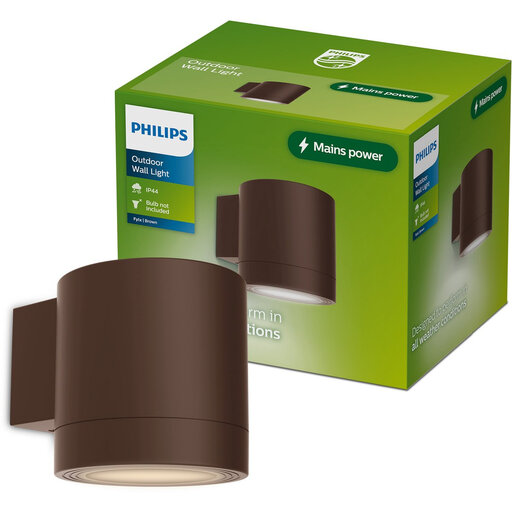
Why it suits this profile: This compact outdoor wall light has a GU10 fitting, allowing you to choose a suitable LED spotlight and colour temperature. Its dimensions are approximately 8.9 × 11.6 × 9 cm.
The product information clearly states that the GU10 light source is not included. You can therefore budget for both the fitting and the bulb in advance.
GU10 fitting, aluminium housing, one light point and IP44 rating.
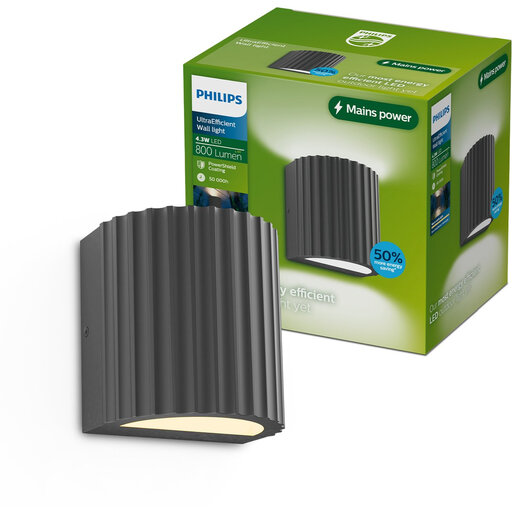
Why it suits this profile: According to the product specifications, the integrated LED produces warm white light at 2700 K in two directions. This makes it suitable for illuminating the exterior around a front door or along a garden path.
The colour temperature, light output of 800 lm and IP44 rating are clearly specified. You do not have to rely solely on an atmospheric product photo.
Integrated LED, 2700 K, two-way light distribution and aluminium housing.
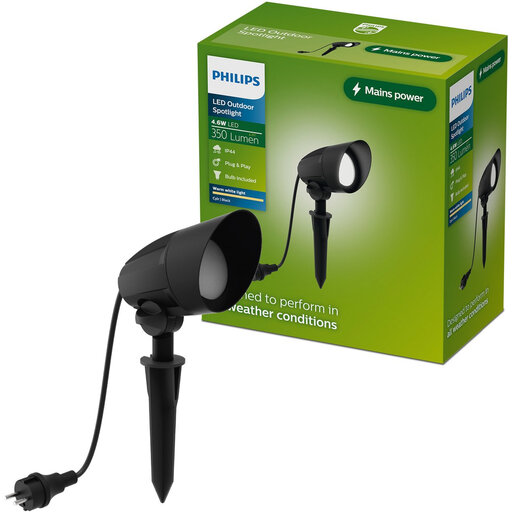
Why it suits this profile: This outdoor ground spotlight is designed for shrubs, trees, driveways and gates. The spotlight can be rotated, is installed in the ground and has a 150 cm cable.
The included GU10 LED means you do not need to search for a suitable light source after installation. However, IP44 means it must not be immersed or exposed to high-pressure water.
350 lm, 2700 K, 4.6 W, rotatable spotlight and plug-in connection.
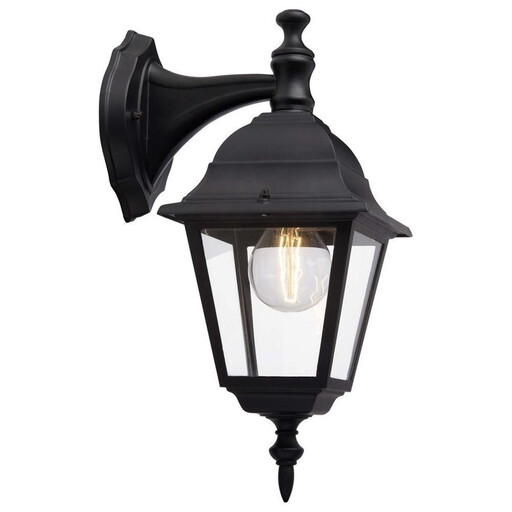
Why it suits this profile: The 34 cm-high, hanging square design suits a classic entrance, veranda or patio. The E27 fitting leaves room for a range of decorative bulbs.
The maximum load of 60 W and the fact that no light source is included are clearly specified. IP44 makes the light particularly suitable for sheltered locations.
E27 fitting, metal housing, glass elements and external dimming with a suitable bulb and dimmer.
We have put together a complete, up-to-date list of products that fully meet these strict selection criteria and the applicable European safety regulations.
Switch off the power before connecting, cleaning or replacing a light source. According to the product information, a wired outdoor wall light should be installed by a qualified electrician. With a plug-in garden light, only use a suitable outdoor socket with the appropriate protection.
Clean the fitting with a soft, dry cloth. Do not spray cleaning products directly onto the light and do not use water near an open fitting. After installation, check that the seals are properly fitted and ensure that cables are not left in puddles or creating a trip hazard.
That depends on the location. An IP44 outdoor light is protected against splashing water and is often suitable beneath a canopy, beside a sheltered front door or on a balcony. For a completely open and heavily exposed location, a higher level of protection may be more suitable. Always check the installation instructions.
Consumption depends on the wattage and the number of hours the light is on. A 4.3 W light used for five hours a day consumes approximately 0.0215 kWh per day. Multiply this by your electricity tariff for an indication of the cost. An integrated LED light or separate LED light source can help limit consumption, but check the stated wattage rather than relying solely on the term “LED”.
Replacing a separate light source is usually possible once the power has been switched off and the bulb has cooled down. Connecting a new 230V wall light is a different matter. Have a fixed connection installed by a qualified electrician and follow local regulations.
