
Vandaag of morgen in huis

Kwaliteit gegarandeerd

Welkomstaanbiedingen ontgrendelen: GRATIS bezorging | Tot 80% korting | Gratis 30 dagen JoyPlus-proefperiode
Download de app
An outdoor light needs to do more than look good in a product photo. In the Netherlands, light fittings have to cope with rain, wind, dirt and changing temperatures. Yet when buying one, people often focus mainly on colour and shape. As a result, a light may not provide enough illumination, be installed in the wrong place or wear out sooner than expected.
Three common pitfalls:
The IP code consists of two digits. The first indicates protection against solid particles, while the second refers to water.
Check more than just the IP number and read the installation instructions too. An IP44 outdoor light can be a sensible choice for a covered entrance, while a fully exposed location may call for a higher protection rating.
Lumens indicate how much light a lamp produces. For atmospheric façade lighting, 180 to 400 lumens may be enough. For a driveway or security-focused application, a higher light output is more practical. The Philips UltraEfficient Zyren models, for example, specify 4,000 lumens.
Colour temperature is expressed in kelvin:
Pay attention to the direction of the light as well. A path light that spreads light downwards helps illuminate a garden path without unnecessarily lighting up the façade or windows. A wall light that shines in two directions creates a more distinctive decorative effect on the façade.
A solar outdoor light does not need a fixed electrical connection. This makes installation on a balcony, fence or detached garden shed easier. However, its performance depends on direct sunlight. Do not place the solar panel under a solid canopy or on a wall that is permanently in the shade.
A 230-volt LED outdoor light provides a stable power supply, but when permanently connected it must be installed in accordance with the applicable regulations. If in doubt, have hardwired wall lights connected by a qualified installer.
For a light with a replaceable E27 or GU10 fitting, check whether the bulb is included. With various models, the bulb is not supplied. An integrated LED is easier to use, but the light source is generally not designed to be replaced separately.
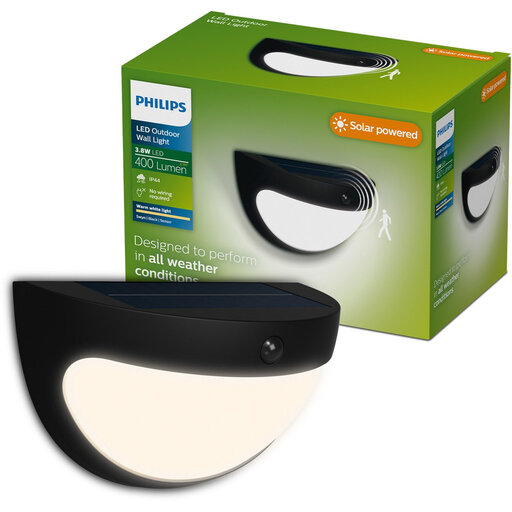
Why it suits this profile: This solar outdoor light is ideal when you want to illuminate a wall, balcony or entrance without wiring. The model has a motion sensor, two lighting modes and an integrated LED with 400 lumens per light point.
The product specification states IP44, making it clear that this means protection against splashing water rather than immersion. Do not place the light where water can collect.
No mains connection required; Auto and On modes; motion sensor and warm white light.
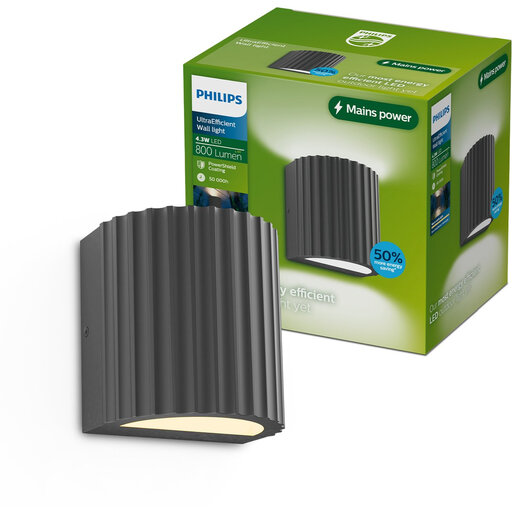
Why it suits this profile: If you want permanent façade lighting with a clean, understated look, this integrated LED wall light offers 800 lumens, 2,700 K and light projection in two directions.
The colour temperature and light distribution are specified in advance, so you do not have to rely solely on lifestyle photographs. However, the IP44 rating means that the light needs to be installed in a sheltered location.
800 lumens; integrated LED; warm white light and two-way light distribution.
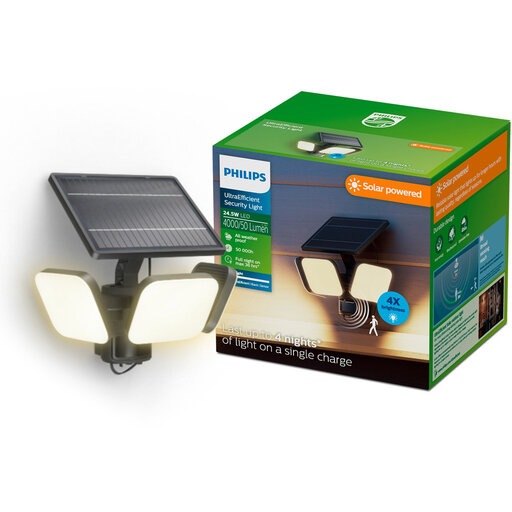
Why it suits this profile: For a driveway, side wall or large area, a high light output is more important than soft ambient lighting. This solar model specifies 4,000 lumens, IP65, a motion sensor and 5,000 K.
The IP65 specification is clearly more suitable for an exposed location than IP44. The stated detection range is 8 metres for a direct approach and 16 metres for sideways movement; check this against your own installation position.
IP65; 4,000 lumens; adjustable light head and solar operation.
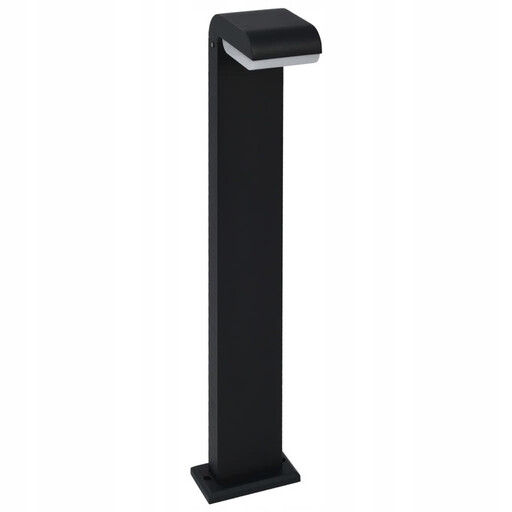
Why it suits this profile: This freestanding outdoor light made from cast aluminium is 80 cm high and spreads 550 lumens downwards. It is well suited to a garden path, patio edge or entrance where wall mounting is not wanted.
The dimensions, light output and IP54 rating are clearly stated. Measure the available space beforehand and allow for the required fixing in the ground.
9 W integrated LED; 550 lumens; downward light beam and IP54.
We have put together a complete, up-to-date list of products that fully meet these strict selection criteria and the applicable European safety regulations.
First decide what the light needs to illuminate: a keyhole, a walkway, a patio or an entire driveway. Do not install a motion sensor directly in a location where traffic or street lighting could affect its operation. Point the sensor in the direction of travel and check the recommended height in the manual.
For solar lighting, an unobstructed position with direct sunlight is important. Clean the panel regularly with a soft cloth. With fixed 230V lighting, the power should be switched off during installation. Use fixings suitable for brick, concrete, wood or cladding.
That depends on the location. IP44 protects against splashing water and is often suitable for a sheltered façade, balcony or entrance. For a completely open and heavily exposed location, IP65 may be the more sensible choice. No IP rating automatically means that a light can be placed underwater.
A solar outdoor light uses a built-in battery during the day, charged via the solar panel. It does not need to be connected to the mains. Operating time can vary depending on the season, cloud cover, shade, battery capacity and selected lighting mode.
Lifespan varies by model and operating conditions. Some product descriptions, for example, state 25,000 or 50,000 hours of operation. Treat this as a quoted product specification rather than a guarantee of a fixed service life. With an integrated LED, the complete light fitting will generally need to be replaced when the light source reaches the end of its lifespan.
