
Vandaag of morgen in huis

Kwaliteit gegarandeerd

Welkomstaanbiedingen ontgrendelen: GRATIS bezorging | Tot 80% korting | Gratis 30 dagen JoyPlus-proefperiode
Download de app
A light that only comes on when someone walks past is useful by the front door, garage, shed, driveway or garden path. However, not every outdoor light with a motion sensor is suitable for every situation. A solar outdoor light works differently from a fixed outdoor wall light, and a high lumen output does not automatically mean it is right for your location or how long you need it to stay on.
Keep these points in mind to avoid a disappointing purchase and choose the right solar wall light, LED outdoor light or outdoor security light for your needs.
Lumens indicate how much light a lamp produces according to its product specifications. For a small balcony or entrance, 400 to 800 lumens may be enough. A higher light output may be more practical for a wide driveway or a dark side wall.
Also consider the colour temperature:
A lamp with a high lumen output can be unnecessarily bright if its sensor is aimed at a busy footpath or a road.
An IP44 outdoor light is protected against solid objects larger than 1 millimetre and water splashes. This makes IP44 suitable for many sheltered walls, balconies and entrances, but not for locations where the light is exposed to powerful jets of water.
An IP65 outdoor light offers protection against dust and water jets according to its IP rating. This does not mean the light can be submerged. Also check whether the mounting location is sheltered and follow the manufacturer’s installation instructions.
A solar-powered outdoor light is wireless and does not need to be connected to the mains. This makes installation easier, but the solar panel still needs enough direct daylight. Under a canopy, on a north-facing wall or beneath dense trees, the battery may not charge as efficiently.
So check in advance:
Claims about how long a light stays on come from the product information or the brand’s own research. Actual performance may vary depending on the season, cloud cover, mounting angle and use of the motion sensor.
A motion sensor switches the light on when it detects movement. A dusk sensor or daylight sensor determines when automatic lighting becomes active. This combination prevents the light from switching on unnecessarily during the day.
Check the detection range and direction. A sensor that mainly detects movement directly in front of it works differently from one that also picks up movement to the sides. Mount the light on a stable surface and avoid pointing the sensor directly at a busy road, moving branches or reflective surfaces.
A solar outdoor light is handy for rented homes, garden paths and places without a power point. It does not need cables to the mains, but how long it stays on depends on the battery and the amount of sunlight it receives.
A fixed outdoor wall light, such as a model with an integrated LED or an E27 fitting, provides a more consistent power supply. A 230V light must be installed in accordance with local regulations. If in doubt, have the electrical connection carried out by a qualified installer.
Plastic is often lightweight and suitable for wireless installation. Aluminium or metal may offer a different look and construction, but always check the stated IP rating and maintenance instructions.
An integrated LED light does not need a separate bulb. With an E27 light, you can choose a suitable LED bulb yourself, but check the maximum wattage. Clean solar panels and light covers with a soft cloth, and regularly check the fixings, housing and cables.

Why it suits this profile: This wireless solar wall light is suitable for an entrance, shed or balcony without a mains connection. The product specifications list 1000 lumens, 3000K, two light settings, and motion and dusk sensors.
The IP44 rating makes its limitations clear: it is suitable for exposure to water splashes, but not for submersion or powerful water jets.
Solar-powered with no fixed wiring, an integrated LED and warm white 3000K light.
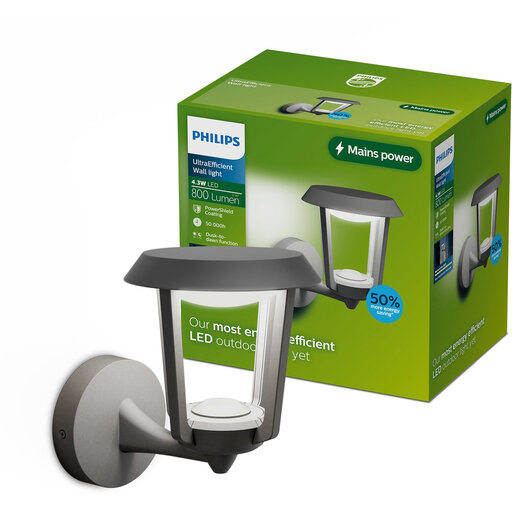
Why it suits this profile: This fixed LED outdoor light is a good fit for a wall, balcony or garden with a 230V connection. It has an integrated LED, 800 lumens, 2700K and an aluminium housing.
The fixed connection means it does not depend on sunlight. The IP44 rating also clearly indicates its level of protection against water.
Integrated LED, 4,3W power, 800 lumens and a warmer 2700K colour temperature.

Why it suits this profile: For a wide driveway, side wall or dark area of the garden, this solar model offers 4000 lumens, an adjustable lamp head and a detection range of 8 metres straight ahead and 16 metres to the sides, according to the product specifications.
The IP65 rating makes it more suitable for a less sheltered location than an IP44 light, as long as it is not submerged and is installed correctly.
Solar-powered, with motion and dusk sensors, a 5000K colour temperature and, according to the product information, up to four nights of light from a fully charged battery.
We’ve put together a full, up-to-date list of products that meet these strict selection criteria and the applicable European safety regulations.
Choose a spot where the solar panel gets direct daylight during the day. Avoid deep shade from a roof edge, tree or neighbouring building. Point the motion sensor towards the route people take and check that the light is securely fixed to the wall or post.
This depends on the type of light, the battery, the material and the conditions in which it is used. With solar lighting, charging time, temperature and cloud cover all play a part. Product information for fixed LED lights sometimes gives an estimated lifespan, but this is not a guarantee of the total lifespan of the housing or sensor.
A solar outdoor light does not use electricity from the mains. A fixed LED outdoor light only uses electricity when it is on; the exact cost depends on its wattage, how long it is switched on and your electricity tariff. A motion or dusk sensor can help prevent the light from staying on unnecessarily, provided it is set up correctly.
