
Vandaag of morgen in huis

Kwaliteit gegarandeerd

Welkomstaanbiedingen ontgrendelen: GRATIS bezorging | Tot 80% korting | Gratis 30 dagen JoyPlus-proefperiode
Download de app
An outdoor light with a motion sensor can be useful by your front door, driveway, shed, balcony or patio. It switches on when it detects movement, providing practical exterior wall lighting or garden lighting without you having to search for a switch every time.
However, not every solar-powered outdoor light is suitable for every location. Three common pitfalls are worth watching out for:
Also consider the difference between an integrated LED and a replaceable light source. With an integrated LED, you usually can’t replace the bulb separately. An outdoor wall light with a GU10 fitting gives you more flexibility, but often requires a fixed connection.
An IP rating consists of two digits. The first indicates protection against solid particles, while the second indicates protection against water.
No rating automatically means that a light can be placed underwater. Always check the installation instructions and mount the light securely on a suitable surface.
Lumens indicate the amount of light. For an entrance or balcony, 300 to 500 lumens may be enough. A driveway or larger garden often needs a higher light output or several light sources.
Colour temperature is measured in kelvins:
Also check the detection range and angle. A sensor with a wide range isn’t always useful in a narrow passage: the light may also switch on in response to movement on the pavement or road.
A solar-powered outdoor light doesn’t need a fixed mains connection, but its panel needs plenty of direct daylight. A rechargeable outdoor light with a USB connection is more flexible if the installation location gets little sun.
Also check:
A light with a motion sensor isn’t the same as one that stays on continuously. Check whether the sensor can be adjusted separately and how long the light stays on after detecting movement.

Why it suits this profile: This compact black outdoor light runs on an integrated rechargeable battery and charges via USB-C. Its magnetic mounting is practical for a balcony, patio or rented home where you’d rather not install fixed wiring.
You don’t have to rely on a sunny wall: the light can be recharged via USB-C. However, its IP44 rating means you’ll need to choose a sheltered location.
300 lumens, 3000 K, motion sensor, magnetic mounting and integrated Li-ion battery.
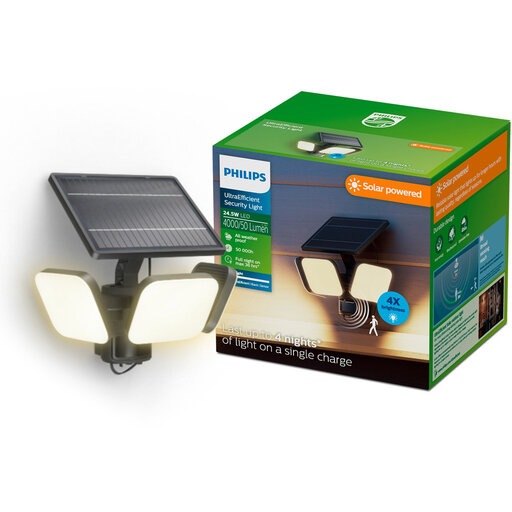
Why it suits this profile: For a larger driveway, garage or wide exterior wall, the combination of 4000 lumens, IP65 protection and a motion sensor is appealing. According to the product description, the detection range is 8 metres when approached directly and 16 metres for sideways movement.
Its IP65 rating is clearly stated, making this light a more logical choice for a more exposed installation location than an IP44 outdoor light.
4000 lumens, 3000 K, integrated solar power, two sensors according to the product description, and an adjustable lamp head.

Why it suits this profile: The three adjustable heads and wide light coverage make it a good fit for a garden, backyard, garage or driveway where one small light source isn’t enough.
The light heads are adjustable, so you can direct the beam rather than relying on a high lumen count alone. According to the product description, the range is 60 feet and the angle is 180°.
302 LEDs according to the product description, three lighting modes, solar power and IP65 protection.
We’ve put together a complete, up-to-date list of products that meet these strict selection criteria and the applicable European safety regulations.
Mount the solar panel somewhere it will get as much direct daylight as possible. Point the sensor towards the area where you expect movement, and keep branches, busy roads and moving flags out of its detection area. Test the light after mounting it, before tightening all the screws fully.
That depends on the light source, battery, usage time and weather conditions. For an integrated LED, the manufacturer may state an estimated lifespan. This is a product specification, not a guarantee for every use case. The battery in a solar outdoor light may hold less charge over time as a result of charging cycles and cold weather.
A solar-powered outdoor light doesn’t use electricity from the mains while it’s on. However, how well it works in practice depends on sunlight, battery capacity and how often the motion sensor is triggered. A light that switches on briefly only when it detects movement will generally use less energy than one that stays on all evening.
