
Vandaag of morgen in huis

Kwaliteit gegarandeerd

Welkomstaanbiedingen ontgrendelen: GRATIS bezorging | Tot 80% korting | Gratis 30 dagen JoyPlus-proefperiode
Download de app
An outdoor light with a motion sensor can be useful by your front door, garage, driveway, in the garden or on the patio. It switches on when it detects movement, so you don’t have to fumble for a switch. However, not every model is suited to the same needs. A light for a balcony, for example, has different requirements from an outdoor security light for a long driveway.
As a Joybuy Product Recommendation Officer, I’ve filtered out the most important product specifications and listed the most common purchasing mistakes. This way, you can compare models based on verifiable features rather than marketing claims alone.
A product with a high lumen count can illuminate a large area, but that doesn’t automatically mean the light is distributed pleasantly or efficiently. Also consider the beam spread, the number of light heads and whether you can adjust the direction of the light.
A model with several adjustable heads may be more practical for a garden or driveway. For a front door or balcony, a more compact wall light with a lower light output is often sufficient.
Check the IP rating. In practice, IP44 means protection against solid objects larger than 1 mm and water splashes. This type of light is suitable for general outdoor use, but not for submersion or direct jets of water.
IP65 offers greater protection against dust and water jets. Even then, correct installation is important. Fit the light according to the instructions and make sure water doesn’t collect around connections or openings for long periods.
A solar outdoor light with a motion sensor needs direct daylight to charge its built-in battery. It may produce less power under a canopy, beside a tall fence or on a north-facing wall. Operating time can also decrease in winter and cloudy weather.
So check where the solar panel will be positioned. A rechargeable motion-sensor light with a USB connection may be more suitable for a shaded spot.
Check the distance and angle covered by the motion sensor. A range of, for example, 3 to 5 metres is suitable for a hallway, bedroom or small entrance. A longer range is more practical for a driveway or spacious garden. The UME Solar Outdoor Lights has a stated detection distance of 60 feet, or about 18 metres, with a detection angle of 180 degrees.
Also check the angle over which the light is distributed. The UME model has three adjustable light heads and a stated coverage angle of 270 degrees. This can be useful if you want to illuminate several areas of a wall, garden or patio.
Lumens indicate the amount of visible light. A light producing 180 to 500 lumens is often suitable for an entrance, balcony or path. A higher light output may be preferable for a wide driveway or as an outdoor security light.
Colour temperature affects the look of the light:
Check the light modes too. Some models only switch on and off automatically, while others offer a constant-on mode or several sensor settings. A motion-sensor night light for a hallway usually needs different settings from LED outdoor lighting by the garage.
Solar lighting works without mains electricity or wiring. This makes installation relatively straightforward, but positioning it in relation to the sun is important. Battery-powered models are flexible, but need to be replaced or recharged periodically. A model with USB charging can be useful indoors or in sheltered spots.
For fixed 230V wall lights, you’ll need to consider professional installation. Also check whether the light comes with a bulb, fixings and charging cable.
Clean solar panels and sensor windows regularly with a soft, slightly damp cloth. Don’t use excessive moisture on indoor electrical models. This helps the sensor respond reliably and allows the solar panel to absorb enough light.
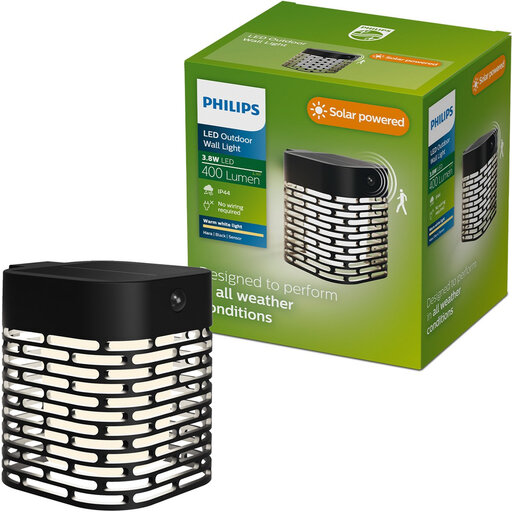
Why it suits this profile: This compact solar wall light works without mains electricity and offers two light modes. That makes it suitable for an entrance, small patio or garden wall.
The product information clearly states an IP44 rating and 400 lumens. So expect splash resistance, not protection against direct jets of water.
Solar-powered, warm white light at 2700K, two modes and no wiring required.

Why it suits this profile: This model combines a solar-powered design with 1000 lumens, a motion sensor and a dusk sensor. It’s suitable for a front door, exterior wall or driveway where you need more light.
The specifications state 1000 lumens, 3000K and IP44. This lets you compare the light output and protection rating with other models before you buy.
1000 lumens, two light modes, solar power and automatic operation via dusk and motion sensors.

Why it suits this profile: This model is designed for larger outdoor spaces, such as a garage, spacious garden, driveway or patio, where broad light coverage is important.
The product listing specifies 302 LEDs, 3000 lumens, three modes, a detection angle of 180 degrees and IP65. This gives you the key details you need to compare it with other models.
Three adjustable light heads, 3000 lumens, three light modes and a stated IP65 rating.
We’ve put together a complete, up-to-date list of products that meet these strict selection criteria and current European safety regulations.
Always follow the manufacturer’s installation instructions. In general, mount a wall light high enough to prevent damage or accidental contact, but not so high that the sensor misses movement on the ground. Point the sensor towards the area where people walk, and keep branches, fluttering flags and busy roads out of its detection zone.
How long it operates each night depends on sunlight, battery capacity, the light mode and how often the sensor is triggered. Manufacturers may also state a theoretical lifespan for the LED components. Philips states that some models offer long operating times, but actual performance depends on usage and conditions. Keep the panel clean and check the battery if the light starts to run for less time.
A solar outdoor light doesn’t use mains electricity during normal operation. A wired model only uses electricity when it’s on, depending on its wattage. A motion sensor can help reduce energy use because the light isn’t on all the time. When buying, check the wattage, how long the light stays on and whether it has a constant-on mode.
