
Vandaag of morgen in huis

Kwaliteit gegarandeerd

Welkomstaanbiedingen ontgrendelen: GRATIS bezorging | Tot 80% korting | Gratis 30 dagen JoyPlus-proefperiode
Download de app
A light that switches on automatically by your driveway, front door or shed is practical. However, not every outdoor light with a motion sensor is suitable for the spot where you want to install it. A low price tells you little about the detection range, while a high light output does not automatically mean your garden will be lit evenly.
Use these points to compare an outdoor solar light, wall light or security light based on verifiable product specifications.
A high lumen count can be useful for a driveway or garage, but bright white light can feel uncomfortable on a balcony or at an entrance. So check the colour temperature too:
A light with several adjustable heads can cover a wider area than a compact model with a single fixed light source.
Marketing copy sometimes uses the word waterproof even when the official level of protection is lower. Always check the IP rating:
So IP65 outdoor lighting is not automatically necessary for every situation, but it can give you more flexibility over where you install it.
A sensor only works well when its detection area covers the route people take. Before buying, check:
An outdoor solar light with a motion sensor also needs direct sunlight to charge its battery during the day. Shade from a roof edge, tree or neighbouring building can reduce how long it operates.
An outdoor solar light is useful in places without a power cable. You avoid wiring and don’t need to plan for the light’s electricity consumption. However, its performance depends on sunlight, panel orientation, the season and dirt on the panel.
A fixed outdoor wall light with a sensor connected to 230V provides a constant power supply, but it must be installed in line with the product specifications and local regulations. The Brilliant Todd model must be installed by a qualified electrician.
Lumens indicate the amount of light produced. A few hundred lumens may be enough for a small path. A higher stated lumen count may make more sense for a wide driveway or as a solar security light. The overall effect also depends on the beam, installation height and any obstacles.
Look out for conflicting descriptions. Check the product’s technical specifications rather than relying on its marketing name alone. For example, the Philips Zyren models are listed as producing 4000 lumens, with a choice of 3000K or 5000K, depending on the version.
For solar lighting, the battery capacity and sensor range are useful details to check. The UME light lists an 1800mAh lithium-ion battery, a detection distance of around 60 feet and a detection angle of 180 degrees. Philips Zyren product information lists detection up to 8 metres when approached directly and 16 metres when approached from the side.
These are product specifications; actual performance depends on installation, temperature, movement and the amount of sunlight available. Clean the solar panel and sensor window regularly with a soft, slightly damp cloth.
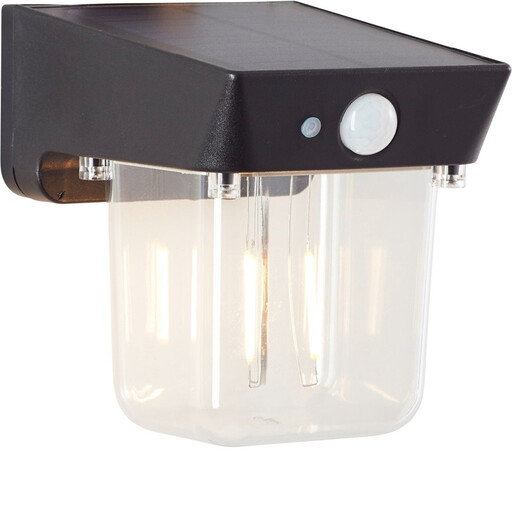
Why it suits this profile: This compact solar model is designed for an entrance, small patio or garden path where there is no wiring. Its stated light output is 180 lumens at 2700K.
The specifications clearly state its IP44 protection, making it clear that it is protected against splashing water, not direct water jets.
Solar-powered, with a motion sensor and integrated LED, in a relatively compact size of 11,5 x 10 x 11 cm.
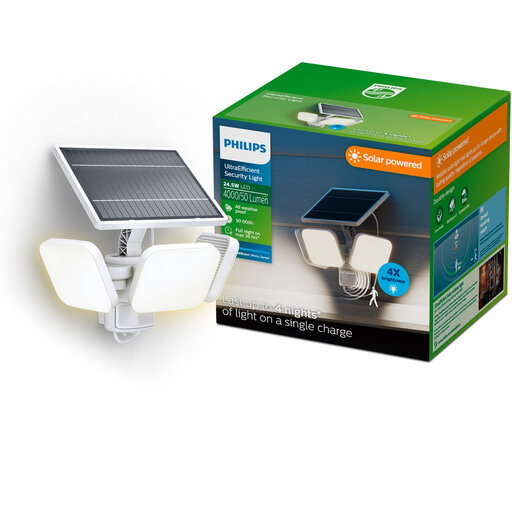
Why it suits this profile: This solar security light is suited to a driveway, garage or larger wall where a wide detection range and powerful lighting are useful.
The product information lists IP65 protection, an adjustable light head and several detection directions. Do check that the installation spot receives direct sunlight.
According to Philips product information: 4000 lumens, detection up to 8 metres straight ahead and 16 metres from the side, plus two lighting modes.

Why it suits this profile: The three light heads and wide coverage are designed for larger areas such as a spacious garden, garage area, patio or driveway.
The description lists the detection range, detection angle, three lighting modes and IP65 protection. This makes it easier to compare the light on more than just its lumen count.
According to the product information: 302 LEDs, 3000 lumens, three adjustable heads, coverage of up to 270 degrees and three modes.
We’ve put together a full, up-to-date list of products that meet these strict selection criteria and current European safety regulations.
An outdoor solar light uses solar energy stored during the day. It normally does not need to be connected to the mains. Charging performance depends on sunlight, panel orientation, the season and dirt on the panel. In practice, the light may stay on for less time or switch on less often when there is little sunshine.
Lifespan varies depending on the model, battery, LED module and conditions of use. Product information may give an estimated LED lifespan, for example, but that is not a guarantee for the lifespan of the entire light. Also check whether the battery can be replaced, the warranty terms, the IP rating and the maintenance instructions.
Choose a spot where the light crosses the route people take and the beam won’t shine directly into windows. A wider range and broader spread are often useful for a driveway. A more compact light with a warmer colour temperature is usually enough by the front door. Always check that the surface is solid and that a solar model will receive enough direct sunlight.
