
Vandaag of morgen in huis

Kwaliteit gegarandeerd

Welkomstaanbiedingen ontgrendelen: GRATIS bezorging | Tot 80% korting | Gratis 30 dagen JoyPlus-proefperiode
Download de app
An outdoor light with a motion sensor can make an entrance, garden path, balcony or driveway more practical. The light switches on when it detects movement, so you don’t have to search for your keys in the dark. However, not every model is right for every location.
Most poor purchases come down to three simple mistakes:
Check the intended location, sensor and protection level before you buy, and you’re less likely to find that your light is too dim, impractical or incorrectly installed after a few weeks.
Light output is measured in lumens (lm). A few hundred lumens is often enough for an entrance or balcony. A larger driveway or back garden may benefit from more light.
Pay attention to the colour temperature too:
An LED outdoor light with an integrated light source often has a low stated wattage. So don’t compare wattage alone: look at the lumens, light colour and direction of the beam.
The IP rating indicates how well the casing protects against solid particles and moisture. IP44 is a practical starting point for many sheltered walls and balconies. This rating means the light is protected against splashing water from different directions.
That doesn’t mean it’s waterproof. So don’t install a water-resistant IP44 outdoor light somewhere that’s regularly exposed to a strong jet of water. For an exposed wall, a low mounting position or a spot that gets a lot of rain, a higher rating such as IP65 may be more suitable.
Also check whether the instructions recommend installing the light under a canopy. The IP rating doesn’t replace correct installation.
A motion sensor has a detection angle and range. Its exact performance depends on the mounting height, direction of movement, temperature and any obstacles. If possible, point the sensor towards the path people use, rather than a busy road or moving branches.
Consider the power source too:
A dusk sensor can make the light respond only when it’s dark. Some models offer several modes, such as switching on automatically when movement is detected or staying on continuously.
The options below are based on verifiable product specifications such as lumens, IP rating, colour temperature, power source and installation method. Claims about performance and durability are based on information provided by the relevant brand.

Why it suits this buyer: This compact solar wall light is designed for an exterior wall, patio, balcony or entrance where there’s no power cable. Its stated light output is 180 lumens at 2700 K.
Solar power means you won’t need to arrange wiring just to meet a modest lighting need. The IP44 rating makes clear that the light is protected against splashing water, not completely waterproof.
Solar power, integrated LED, motion sensor, two lighting modes and a compact height of 11.5 cm.
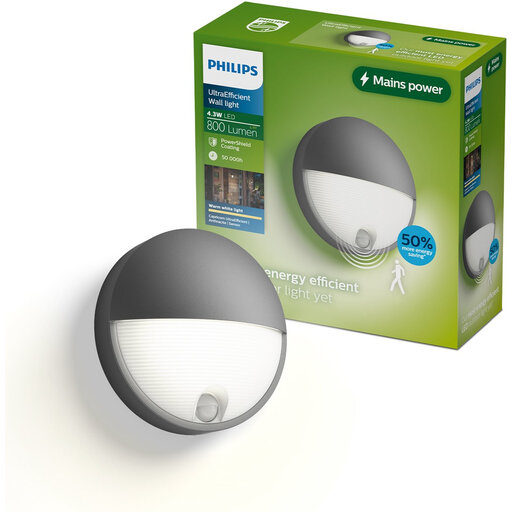
Why it suits this buyer: A fixed outdoor wall light with mains power, an integrated LED and a gentle warm light. According to the product information, it produces 800 lumens at 4.3 W.
The specifications list both a motion sensor and a dusk sensor, so you don’t have to rely on a manual switch alone. However, IP44 has its limits when the light is exposed to direct water.
Integrated 800-lumen LED, 2700 K, aluminium casing, anthracite finish and a stated IP44 rating.

Why it suits this buyer: This solar-powered outdoor security light is designed to illuminate a wide area, such as a driveway, garden, garage or yard. The product information lists 3000 lumens, three lighting modes and three adjustable light heads.
The stated IP65 rating is better suited to a more exposed location than IP44. Make sure the solar panel gets direct daylight, and check that 3000 lumens won’t be too bright for your neighbours or patio.
IP65 according to the product information, 180° detection angle, three lighting modes, three light heads and a stated range of 60 feet.
We’ve put together a complete, up-to-date list of products that meet these strict selection criteria and the applicable European safety regulations.
Before installation, check that the wall can support the light’s weight and that there are no cables or pipes in the drilling area. Mains-powered lights must be installed in accordance with the product instructions and local regulations. If you’re unsure, ask a qualified electrician to do the work.
For solar lights, keep these points in mind:
For IP44 lights, choose a sheltered installation spot if the wall is exposed to heavy rain. Clean the casing, sensor window and solar panel with a soft cloth. An integrated LED or battery module usually isn’t designed to be replaced by the user, so check the product information first.
It depends on the power source, wattage and how often the sensor is activated. An integrated LED light with a low wattage generally uses less energy per hour of use than a more powerful light source. Solar models don’t use mains electricity, but rely on sunlight and the capacity of the built-in battery.
The number of hours it stays on each night varies depending on the season, amount of daylight, battery condition and number of activations. The light may stay on for less time in winter or in a shady spot. Rather than relying on a general lifespan claim, check the battery details, lighting modes and maintenance instructions.
IP44 is suitable for many sheltered outdoor locations and means the light is protected against splashing water. It doesn’t protect against submersion or direct jets of water. A higher IP rating may be more suitable for a completely exposed location. Always check the installation instructions for the specific model.
