
Vandaag of morgen in huis

Kwaliteit gegarandeerd

Welkomstaanbiedingen ontgrendelen: GRATIS bezorging | Tot 80% korting | Gratis 30 dagen JoyPlus-proefperiode
Download de app
An outdoor light with a motion sensor can automatically illuminate an entrance, driveway, patio or garden path. However, choosing the right one is not always straightforward. Products often look similar, while the differences in power supply, installation, brightness and weather resistance can be significant.
Pay particular attention to these common pitfalls:
The IP rating consists of two digits. The first digit relates to protection against solid particles, while the second refers to water.
A waterproof outdoor light IP44 is, in practice, splash-resistant. This is suitable for many sheltered façades, balconies and entrances, provided the lamp is not exposed to direct water jets. For an exposed spot by a driveway or in a garden, where rain and dust have more impact, an IP65 solar floodlight may be more practical. According to the product classification, IP65 indicates protection against dust and water jets.
Also check whether the supplier states that the lamp is suitable for outdoor use. Look for warnings about immersion, direct exposure to rain and maintenance.
Brightness is usually expressed in lumens (lm). A compact wall light for an entrance has different lighting requirements from a lamp for a wide driveway.
The colour temperature determines the appearance of the light. 2,700 to 3,000 K produces warm white light, while 4,000 K looks more neutral. A higher colour temperature can appear brighter and more functional. Also check whether the lamp has a single light source, uses several heads, or distributes light downwards and to the sides.
An outdoor solar light does not require a permanent power connection, but it does need a suitable location with sufficient daylight. Clean the solar panel regularly and bear in mind that charging opportunities are reduced during dark or overcast periods.
A rechargeable wall light works independently of a socket, but needs to be charged manually or via USB. This is convenient on a balcony, in a rented property or in a location where drilling and wiring are undesirable.
A wired outdoor wall light with a sensor is less dependent on sunlight and battery condition. However, installation on 230 V must be carried out by a qualified electrician in accordance with the product information. If the fitting has an E27 socket, also check whether the light source is included. With some models, you need to fit a suitable LED bulb yourself.
The recommendations below are based on verifiable information from the product descriptions, such as IP rating, light output, power source, dimensions and sensor function.
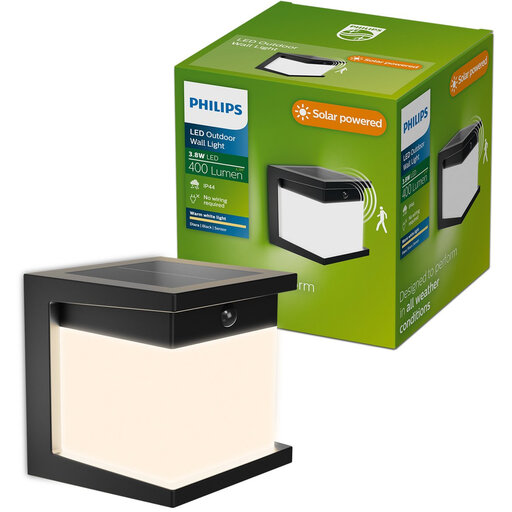
Why it suits this profile: This compact solar outdoor light is designed for a façade, balcony, garden or entrance without permanent wiring. The stated light output is 400 lm at 2,700 K.
The product information clearly states the solar power supply, two light modes, motion sensor and IP44 rating. Positioning in direct sunlight remains essential.
Integrated LED, 400 lm, 2,700 K, motion and darkness sensor, plus a stated statutory guarantee of at least two years.

Why it suits this profile: This model is aimed at users looking for a permanent wall-mounted solution with two light modes and automatic operation.
The stated IP44 rating is not presented as suitable for immersion. The supplier recommends keeping the solar panel free from dirt and away from direct water jets.
400 lumens per light source, integrated LED, warm white light at 2,700 K, automatic and on modes, plus a motion sensor.

Why it suits this profile: The version with three adjustable heads is designed to provide broad lighting for a driveway, garden, garage or patio.
The product listing specifies an IP65 rating, a 180° detection angle and three lighting modes. This makes the key usage limitations clear in advance.
302 LEDs, a stated light output of 3,000 lumens, three adjustable light heads, three modes and a sensor range of 60 feet according to the product description.

Why it suits this profile: This black lamp runs on an integrated battery, has magnetic mounting and can be used indoors or outdoors in locations without a permanent connection.
There is no need to install 230 V wiring. However, the magnetic mounting plate must be secured firmly and the battery needs to be charged regularly via USB-C.
300 lumens, 3,000 K, integrated motion sensor, USB-C charging, magnetic mounting and IP44 splash protection.
For an LED sensor light to work effectively, do not position the sensor directly towards a busy road or moving shrub. Aim it at the route people take and check that the lamp does not shine directly into anyone’s eyes or a bedroom window.
The following steps can help with solar lighting:
For indoor use, a cabinet light with a motion sensor, Yeelight sensor light or USB-rechargeable lamp can be practical. Pay attention to the dimensions: a 30 cm model fits inside a narrow cabinet, while 40 cm can illuminate more of a worktop or shelf. These lamps are not automatically suitable for damp outdoor areas.
We have put together a complete, up-to-date list of products that fully meet these strict selection criteria and the applicable European safety regulations.
Yes, but charging capacity may be lower because of shorter days, cloudy weather and the lower position of the sun. Position the panel as openly as possible and keep it clean. A lamp with a battery or permanent connection is more suitable if you want to be less dependent on sunlight.
Lifespan varies by product and usage conditions. Check the stated LED lifespan, battery capacity and guarantee. With integrated LED lighting, the light source is often not replaceable by the user. A fitting with an E27 socket gives you more flexibility to replace it with a suitable light source later.
According to the product description, a solar lamp does not use mains electricity. A rechargeable wall light uses energy while charging via USB. A wired LED lamp mainly uses electricity when it is on; the sensor can limit how long it stays lit. For a fair comparison, look at the wattage, operating time and number of activations per day.
