
Vandaag of morgen in huis

Kwaliteit gegarandeerd

Welkomstaanbiedingen ontgrendelen: GRATIS bezorging | Tot 80% korting | Gratis 30 dagen JoyPlus-proefperiode
Download de app
An outdoor light with a motion sensor can be useful by the front door, garage, driveway, shed or patio. The light switches on when movement is detected, so you do not have to search for a switch every time. However, not every model is suitable for every location. A light that works perfectly on a sheltered balcony wall may be less suitable for an open driveway.
The biggest buying mistakes are usually caused by three misconceptions:
Light output is measured in lumens (lm). For a small entrance or balcony, 180 to 400 lumens may be sufficient for orientation and ambience. For a garage, large garden or driveway, a model with a higher light output may be more practical.
Also pay attention to the colour temperature:
An LED outdoor light uses either an integrated light source or a replaceable LED bulb. With an integrated LED, it is often not possible to replace the light source alone. With a GU10 or E27 fitting, you can choose a suitable bulb yourself later, although you may sometimes need to purchase it separately.
Do not just check whether a product has a sensor, but also look at:
A sensor aimed directly at a path may detect movement more effectively than one positioned at right angles to the direction of travel. A wide angle is useful for a large garden or driveway. For example, the UME light states a detection distance of 60 feet, an angle of 180 degrees and three lighting modes. Use such figures as a practical indication, but take the mounting height, obstacles and temperature into account.
The IP code provides information about protection against solid particles and moisture. IP44 outdoor lighting is splash-resistant and is particularly suitable for sheltered façades, balconies, covered areas and entrances. An IP65 outdoor light offers, according to its classification, greater protection against dust and water jets, making it potentially more suitable for a more exposed location.
Also consider the mounting hardware. An outdoor light without wiring may seem straightforward to install, but the wall must be strong enough. With a magnetic light, the mounting plate must be securely fixed and suitable for the weight. A mains-powered light, such as a fixed outdoor wall light, must be connected by a qualified installer.
A solar outdoor light is useful when you do not want to run a cable. A solar wall light works most reliably when its panel receives several hours of direct daylight. Clean the panel regularly and check during the darker months that the light still has sufficient charging capacity.
For a rented property, a compact rechargeable LED light or a model with magnetic mounting is often practical. If you are mainly looking for ambience, consider a warm colour temperature and dimming function. For a driveway or garage, detection range, light coverage and a higher IP rating are more important than a decorative design.

Why it suits this profile: This solar wall light works without fixed wiring and offers two lighting modes, a motion sensor and 400 lumens per light point. This makes it practical for an entrance, balcony or sheltered garden wall.
The specifications clearly state IP44, so you can allow for splash exposure and avoid mounting the light in a completely exposed location.
Solar power, two modes, 2700K warm white light and installation without a mains cable.
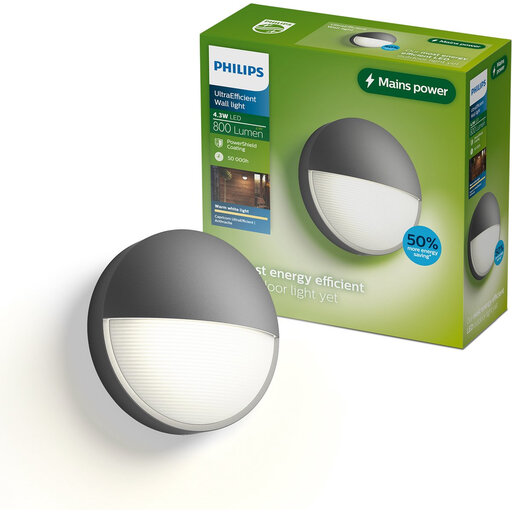
Why it suits this profile: This fixed outdoor wall light combines aluminium and plastic with integrated LED lighting delivering 800 lumens and warm white light at 2700K. It is suitable for a façade, garden wall or balcony where a power connection is already available.
The product information states that professional installation and fixed wiring are required. This prevents you from expecting a solar or plug-and-play solution.
800 lumens, 2700K, aluminium housing and IP44 for sheltered outdoor locations.

Why it suits this profile: This model is designed for a larger garden, garage or driveway. According to the product specification, it has 302 LEDs, 3000 lumens, three adjustable heads and an IP65 rating.
The high light output is combined with a wide 270-degree lighting angle. However, check beforehand that this intensity is suitable for your neighbours and immediate surroundings.
IP65, 3000 lumens, 180-degree sensor angle and three lighting modes according to the product information.

Why it suits this profile: This compact light has a rechargeable battery, USB-C connection and magnetic mounting. It is ideal for a balcony, storage area, patio or rented property where you do not want to install fixed wiring.
The IP44 rating makes it clear that the light is splash-resistant, but not suitable for direct water jets. Choose a sheltered mounting location.
300 lumens, 3000K, motion sensor and wireless positioning with USB-C charging.
We have put together a complete, up-to-date list of products that fully meet these strict selection criteria and the applicable European safety regulations.
Yes, but operating time may decrease when the days are shorter or the panel receives less direct sunlight. Position the light away from shade, keep the panel clean and check that the battery has sufficient capacity. A solar outdoor light is not automatically suitable for every wall orientation.
Its lifespan depends on the LED, battery, sensor and exposure to the weather. Product information may state an expected LED lifespan, but this is not a guarantee of the light’s total lifespan. With models featuring an integrated LED, the entire fitting is generally replaced when the light source reaches the end of its service life.
A solar outdoor light does not use mains electricity during normal operation. A fixed LED outdoor light generally uses little energy, particularly when the sensor only switches the light on when movement is detected. As well as the wattage, check how long the light remains on each time it is activated. This gives a more realistic picture of energy consumption than the maximum power rating alone.
