
Vandaag of morgen in huis

Kwaliteit gegarandeerd

Welkomstaanbiedingen ontgrendelen: GRATIS bezorging | Tot 80% korting | Gratis 30 dagen JoyPlus-proefperiode
Download de app
A light that only comes on when someone approaches the driveway, garden or front door is convenient and can help prevent unnecessary energy use. However, not every outdoor light with a motion sensor is suitable for every location. For example, a cheap light may not provide enough illumination, while a model with a small battery can run out quickly in winter.
So don’t just focus on the number of LEDs or a high lumen claim. Pay particular attention to the power supply, IP rating, detection angle and installation method. This will help you avoid buying the wrong light for your façade, shed, entrance, balcony or patio.
A high lumen count tells you how much light a lamp produces, but not how long it will provide it. With a solar outdoor light, hours of sunlight, panel size and battery capacity all play an important role. In winter or on a shaded façade, the light may therefore work for less time than expected.
Check whether the product information states the battery type, capacity or operating time. With a USB-rechargeable wireless outdoor light, it is also useful to check the charging time and connection type.
A water-resistant outdoor light needs an IP rating. IP44 generally means protection against solid particles larger than 1 mm and water splashes. This is suitable under a canopy, on a façade or in a sheltered location, but it is not the same as protection against powerful water jets or immersion.
For a more exposed location, a higher rating such as IP65 is more practical. Also check the installation instructions: proper sealing and a stable surface remain important.
A sensor may be too sensitive, have too small a detection area or react to traffic, branches and pets. Pay attention to the stated detection distance, viewing angle and whether the sensor only works in the dark.
A range of a few metres is often sufficient for a front door. For a driveway or large garden, you may need a wider detection angle or a more powerful fitting. Do not position the sensor directly on a light that could dazzle it.
Lumens (lm) indicate the light output. A compact wall light producing around 180 to 400 lm is suitable for an entrance, balcony or patio. For a driveway or as a security light with sensor, a higher output may be preferable. Philips Fyns, for example, is listed at 1000 lm, while Philips Zyren is listed at 4000 lm.
The colour temperature determines the appearance of the light:
High light output is not automatically more comfortable. Angle powerful lighting away from neighbours’ windows and public roads.
A solar-powered garden light works without a permanent cable, but it needs enough direct sunlight. Do not position the solar panel beneath a balcony edge or behind dense plants. Keep the panel free from dirt.
A USB-rechargeable light is more flexible in shaded locations. One example is the Brilliant Iseo, with an integrated battery, USB-C connection and magnetic mounting. Mains electricity may be suitable for a permanent light on the façade, but according to the product information, a 230V model must be connected by a qualified electrician.
As well as the IP rating, check the mounting system. A magnet is convenient for a wireless outdoor light, but only when the mounting plate is firmly attached to a flat, suitable surface. With a heavier model, pay extra attention to the risk of it falling.
A light attached with adhesive tape is mainly suitable for smooth, dry surfaces and light-duty applications. For a brick façade or exposed driveway, screw mounting is usually the more sensible option.
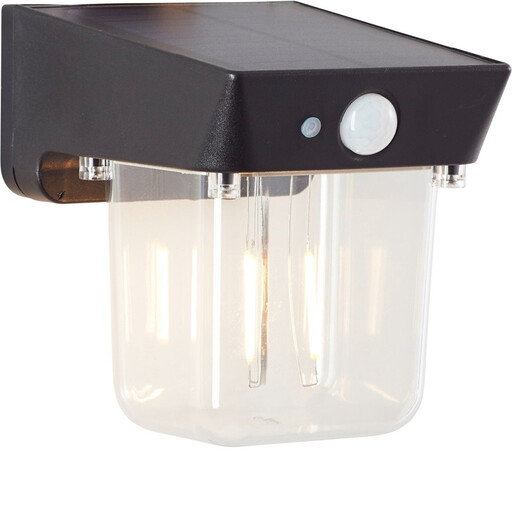
Why it suits this profile: This solar outdoor light is suitable for an entrance, balcony or small garden without a power socket. The light is listed at 180 lm and 2700 K, with an integrated 18650 battery and IP44 protection.
The specifications state both the light output and the IP rating. This makes it clear in advance that this model is intended for basic lighting and splash protection, not for a large, completely exposed driveway.
Solar-powered, with a motion sensor and an integrated 2700 K LED light source.

Why it suits this profile: For anyone wanting a clearly illuminated path, patio or entrance, this model is listed at 1000 lm and offers warm white 3000 K light, two lighting modes and an integrated motion sensor.
The product information explicitly states IP44 and recommends positioning the light in direct sunlight. This makes the limitations of solar power clearer than a general claim that it can be used in all weather conditions.
1000 lm, 3000 K, automatic dusk and motion detection, and installation without permanent wiring.

Why it suits this profile: This model is designed for larger areas such as a wide driveway, garage or back garden. The listed specifications include 4000 lm, 5000 K, IP65 and an adjustable light head.
The higher IP65 rating is clearly specified. According to Philips’ product information, the sensor has a range of up to 8 metres when approached directly and up to 16 metres from the side; check how it performs in the actual position on your property.
4000 lm, IP65, two lighting modes and a wide-angle sensor according to the listed product specifications.
We have compiled a complete, up-to-date list of products that fully meet these strict selection criteria and the applicable European safety regulations.
That depends on the power supply and operating time. A sensor light only comes on when movement is detected, so it may run for less time than a light that stays on continuously. A solar outdoor light does not use mains electricity, but its performance depends on sunlight and battery charge. With a USB model, you pay for charging through the socket or device used.
The lifespan varies depending on the battery, LED module, exposure to the weather and charging cycle. An integrated LED is often not easy to replace. Therefore, check whether the product information states an expected lifespan, battery type and warranty. Keep the panel clean and avoid prolonged shade to help maintain performance.
Only when the manufacturer states that it can and the IP rating is suitable for the location. A sensor light for indoor and outdoor use with IP44 may, for example, be suitable for a sheltered balcony or covered entrance, but not automatically for an unprotected location exposed to direct water jets. For a cupboard, hall or bedroom, you can also choose a USB-rechargeable LED light; these are generally not intended for outdoor use.
