
Vandaag of morgen in huis

Kwaliteit gegarandeerd

Welkomstaanbiedingen ontgrendelen: GRATIS bezorging | Tot 80% korting | Gratis 30 dagen JoyPlus-proefperiode
Download de app
A light that only comes on when someone approaches your drive, garden or entrance is practical and can help make dark areas more visible. However, not every outdoor light with a motion sensor is suitable for every home. Solar outdoor lights, in particular, can lead to unrealistic expectations about how long they stay lit, their water resistance and their detection range.
So don’t just look at the number of LEDs or a high lumen rating. Consider where the light will be installed, its IP rating, how it charges and the sensor settings.
A light with a high lumen rating can illuminate a large area, but that doesn’t automatically mean the light will be distributed evenly and comfortably. For example, a narrow beam might be bright near the wall while leaving part of the drive in darkness. Adjustable light heads or multiple heads can therefore be useful for wide areas.
A lower light output may be enough for a balcony, front door or garden path. An outdoor security light for a spacious drive will usually need a wider range and a suitable mounting height.
A solar-powered outdoor light doesn’t need a mains connection, but its solar panel does need enough direct daylight. Shade from a canopy, tree or neighbouring property reduces charging efficiency. In the dark Dutch winter, the light may also stay on for less time than it does on sunny days.
Clean the panel regularly and don’t choose where to install the light based on appearance alone. Check that both the sensor and the panel have an unobstructed view.
An IP44 outdoor light is protected against splashes, but isn’t designed to be submerged or exposed to powerful jets of water. IP44 may be suitable for a sheltered entrance. For an exposed wall or a driveway, IP65 outdoor lighting is often a better choice. IP65 offers protection against dust and water jets under certain conditions.
According to its product specifications, the TP-Link Tapo C425 has an IP66 rating. This makes its housing suitable for outdoor use, but correct installation is still important. Don’t install a device somewhere where water can collect around it for long periods.
Light output is measured in lumens. Products in this selection range from 180 to 4000 lumens. A 3000- or 4000-lumen light is more suited to a spacious drive or a large garden than a small balcony.
Colour temperature determines the look of the light:
According to the product description, the Philips Fyns delivers 1000 lumens at 3000 K. The Philips Diara, Hara and Swyn are listed at 400 lumens, with warmer colour temperatures of 2700 K.
As well as the detection range, check the detection angle. A sensor with a wide angle works better when people approach from the side. The UME Solar Outdoor Lights specify a detection range of 60 feet, or around 18 metres, with a 180-degree angle. The Brilliant Magua specifies a detection angle of 120 degrees.
Look out for obstacles such as fences, drainpipes and shrubs. Point the sensor towards the route people take rather than directly at a busy road, so the light is less likely to switch on unnecessarily.
Solar outdoor wall lights have a built-in battery. Check whether the battery is replaceable and what runtime the manufacturer gives. Claims such as “several nights” depend on sunlight, temperature and how often the sensor is triggered. According to the product information, Philips states that the Zyren can provide light for up to four nights when its battery is fully charged.
There are also wireless lights with a rechargeable battery and a USB connection. The Brilliant Iseo, for example, uses a magnetic mounting system and charges via USB-C. This is handy in places with little sunlight, but it does need to be recharged periodically.
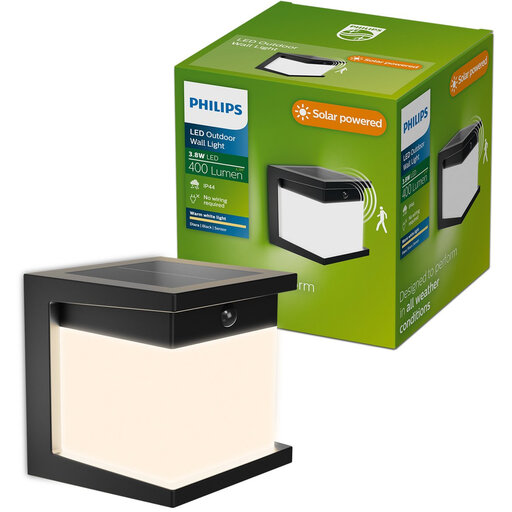
Why it suits this type of buyer: This compact solar wall light works without wiring and, according to its product specifications, is suitable for gardens and balconies.
The product information lists 400 lumens, 2700 K and IP44. This makes it clearer what the light is designed for: atmospheric, practical lighting in a sheltered spot, rather than illuminating a large outdoor area.
Two lighting modes, an integrated LED and a built-in motion sensor. The light runs on solar power and doesn’t need a mains connection.
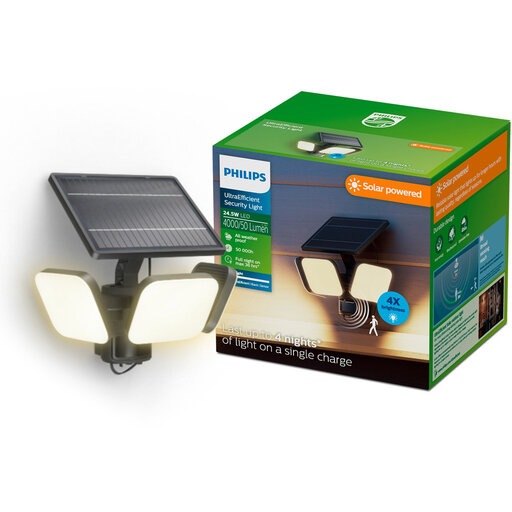
Why it suits this type of buyer: For anyone who wants to light a large area and values a high stated light output and a robust IP rating.
The technical specifications list 4000 lumens, IP65 and a detection range of 8 metres when approached directly and 16 metres from the side. Check in advance that the installation spot gets enough sunlight.
Adjustable light head, dusk sensor and two lighting modes. Philips says the light can provide illumination for up to four nights when the battery is fully charged.

Why it suits this type of buyer: This solar security light is designed to illuminate a wide area, such as a drive, garden, garage or larger property.
The three adjustable light heads help spread the light over a larger area. Its stated IP65 rating makes it better suited to a more exposed outdoor location than IP44.
The product specifications list 302 LEDs, 3000 lumens, three lighting modes and a 180-degree detection angle. It can be installed without electrical wiring.
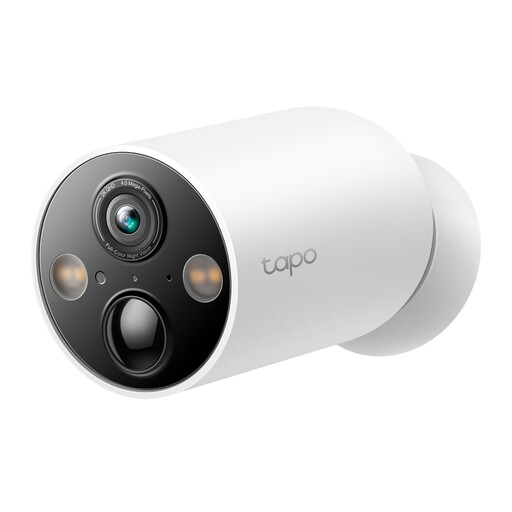
Why it suits this type of buyer: For an entrance, back garden or business premises where you want camera footage as well as motion detection.
This isn’t a light, but an additional security solution. Its IP66-rated housing, wireless installation and motion alerts make its purpose clearer than that of a standard outdoor light with a sensor.
2K QHD resolution of 2560 × 1440 pixels, a 150-degree viewing angle and night vision up to 15 metres, according to the product specifications. Footage can be stored on a microSD card or with a paid cloud service.
We’ve put together a complete, up-to-date list of products that meet these strict selection criteria and the applicable European safety regulations.
Yes, but charging capacity may be lower because of shorter days, cloudy weather and the sun being lower in the sky. Position the panel somewhere as unobstructed as possible and keep it clean. A light with USB charging may be more practical in a shady spot.
Runtime between charges depends on the battery, light output, switch-on time and how often the sensor is triggered. A stated lifespan of, for example, 25,000 lighting hours usually refers to the integrated LED, not necessarily the battery or the entire light.
A solar security light doesn’t use mains electricity during normal use. A wired light only uses energy while it’s on, but the total cost depends on its wattage and how long it’s set to stay lit. A sensor can reduce unnecessary energy use by ensuring the light doesn’t have to stay on continuously.
