
Vandaag of morgen in huis

Kwaliteit gegarandeerd

Welkomstaanbiedingen ontgrendelen: GRATIS bezorging | Tot 80% korting | Gratis 30 dagen JoyPlus-proefperiode
Download de app
An outdoor light with a motion sensor can be useful by the front door, on the driveway, in the shed, on the patio or along a dark garden path. The light comes on when movement is detected, so you do not have to keep searching for a switch. However, not every model is suitable for every location.
Marketing copy often focuses on high lumen output, a wide detection range or “waterproof” properties. In practice, the key differences are often found in the installation, power supply and protection rating. Use these checks to avoid making the wrong purchase.
A light with a high lumen output is not automatically suitable for your garden. A powerful solar outdoor light may be useful on a driveway, but it could be too bright next to a front door or balcony. Directional lighting is often sufficient for an entrance, while a large garden or garage needs a wider spread of light.
As well as lumens, consider:
An IP44 outdoor light is protected against solid objects larger than 1 millimetre and splashing water from different directions. This makes this type suitable for many sheltered exterior walls, balconies and patios, but not for immersion or direct jets of water.
An IP65 outdoor light offers greater protection against dust and water jets. This may be relevant for an open driveway, an exposed shed wall or a location where rain falls directly onto the light. Always check the installation instructions too: the IP rating applies to the complete product when installed as intended.
A wireless outdoor light may seem simple, but a built-in battery needs to be recharged regularly. A solar outdoor light requires enough direct sunlight. If the solar panel is installed under a canopy, between tall fences or on a north-facing wall, the operating time may be disappointing.
A wired outdoor wall light does not run on solar power, but it does require a fixed connection. Have work on the 230V installation carried out by a qualified electrician. Also check whether a GU10 outdoor light or E27 model is supplied without a light bulb. In that case, the fitting determines which bulb you still need to buy.
A sensor responds to movement within a specific angle and distance. Manufacturers do not always state this information in the same way. Therefore, do not look only for a “wide detection distance”; consider the combination of detection angle, range, response time and adjustable modes.
A compact sensor is often practical for a front door or balcony. For a wide driveway, a model with multiple light heads or a wider angle may be more suitable. Bear in mind that pets, passing pedestrians and moving branches can trigger the light unnecessarily.
Lumens indicate the total amount of light produced. A model offering 180–300 lumens is more suitable for an entrance, balcony or accent lighting. Around 500–1000 lumens is more appropriate for a driveway or wider exterior wall. A product with 3000 lumens is designed for a large area and may be excessive for a small patio.
With integrated LED lighting, you usually cannot replace the light source. A GU10 outdoor light has a replaceable light source, but check the maximum wattage and the IP rating of the housing.
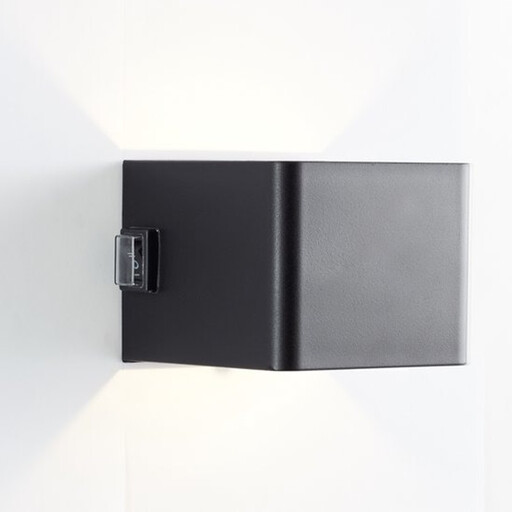
Why it suits this profile: This rechargeable light works wirelessly and features magnetic mounting. That makes it practical for tenants or anyone who does not want to install permanent wiring.
The specifications state 300 lumens, 3000 K, an integrated 4W LED and IP44. This makes it clear that it is primarily a compact light for sheltered locations exposed to splashing water.
Rechargeable 18650 batteries, USB connection, sensor and magnetic mounting. The light is available in a black finish.

Why it suits this profile: This solar outdoor light is aimed at anyone looking for fixed exterior lighting for a garden, patio or entrance without using mains power.
The product details explicitly mention two lighting modes, a dusk and motion sensor, 1000 lumens and IP44. Positioning it where it receives sufficient direct sunlight remains essential.
Integrated LED, warm white light at 3000 K, no permanent wiring and a stated light output of 1000 lumens.

Why it suits this profile: The three adjustable light heads and wide spread of light are well suited to a large driveway, garage, garden or rear yard where broader area lighting is required.
The stated IP65 rating is suitable for a more exposed installation than IP44, but the solar panel still requires direct daylight. The three modes can be adjusted to suit how you use the light.
302 LEDs, three light heads, a stated detection angle of 180 degrees, solar power and a 1800 mAh lithium-ion battery.
We have put together a complete, up-to-date list of products that fully meet these strict selection criteria and the applicable European safety regulations.
Yes, but a solar outdoor light may stay on for less time in winter because the days are shorter and there is less direct sunlight available. A battery-powered model may need to be recharged more often. Daylight levels do not affect mains-powered lights.
Around 180–500 lumens may be sufficient for a small entrance or path. A wide driveway or large yard may require more light or several lights. Also consider the spread: one very powerful light does not always illuminate every corner evenly.
IP44 is generally suitable for splashing water and sheltered outdoor locations, such as a balcony, patio or exterior wall beneath an overhang. For a completely exposed location, a higher protection rating such as IP65 may be more practical. Always check the installation instructions for the specific product.
