
Vandaag of morgen in huis

Kwaliteit gegarandeerd

Welkomstaanbiedingen ontgrendelen: GRATIS bezorging | Tot 80% korting | Gratis 30 dagen JoyPlus-proefperiode
Download de app
A light that switches on automatically when it detects movement is useful by the front door, garage, driveway, shed or garden path. However, not every outdoor light with a motion sensor is suitable for every location. For example, a solar outdoor light may not charge sufficiently in the shade, while a 230V wall light may require professional installation.
As a Joybuy Product Recommendation Officer, I filter product information based on practical considerations. This helps you quickly identify which features are relevant and which marketing claims you should check before placing your order.
A figure such as 3,000 or 4,000 lumens sounds appealing, but it doesn’t tell you how widely the light is distributed. A directional wall light may be sufficient for a front door. For a driveway or a large back garden, you’re more likely to need a wide beam or an adjustable light head.
As well as lumens, check:
A light rated at 2,700–3,000 K generally gives off warmer light than a model rated at 5,000–7,000 K. Bright, cool light can be practical for a driveway, but may be less suitable for a patio.
The IP rating is more important than general terms such as “weatherproof”. IP44 outdoor lighting is protected against solid particles larger than 1 millimetre and splashing water. This makes IP44 suitable for many sheltered façades, balconies and entrances, but not for direct water jets or immersion.
An IP65 outdoor light offers greater protection against dust and water jets. This is a sensible choice for a more exposed façade, garage or open garden. IP65 still doesn’t mean that you can place the light in water. Also check that the mounting points and connections are properly sealed.
An outdoor solar light needs direct daylight to charge its battery. A position under a canopy, next to a high fence or on a north-facing wall can reduce its operating time. In winter and on cloudy days, less charging energy is available too.
Before buying, check:
A solar outdoor light is particularly appealing when you don’t want to install wiring. For consistent lighting when there is little sunshine, wired LED outdoor lighting may be more practical.
A sensor only works well when its detection area matches the direction of travel. Check the detection range and horizontal viewing angle. Product information sometimes gives separate distances for direct and sideways movement. Position the light so that people pass through the sensor’s field rather than walking directly towards it, if the model is less sensitive to that type of movement.
Also consider the activation duration and any available light modes. A permanently low light setting that becomes brighter when movement is detected is different from a light that remains completely off until the sensor registers movement.
An outdoor light without wiring is easy to install, but requires a suitable mounting location and regular charging. Solar models are handy for a garden path, balcony or shed where there is no power outlet. A rechargeable USB light may offer greater flexibility, but will need to be brought indoors and recharged periodically.
A 230V wall light is suitable when you want long-lasting, predictable lighting. The Brilliant Todd, for example, has an E27 fitting and is supplied without a light bulb. According to the product information, this model must be connected by a qualified electrician.
Check that the wall can support the weight and that the supplied fixings are suitable for your surface. Clean solar panels and sensor windows with a soft, slightly damp cloth. With IP44 models, avoid direct water and strong water jets.
With integrated LED lights, the light source is usually not replaceable by the user. Therefore, check the stated lifespan and warranty in advance. Philips products state a minimum statutory warranty of two years. Claims such as a long lifespan come from the brand’s product information and do not guarantee the same performance in every outdoor environment.
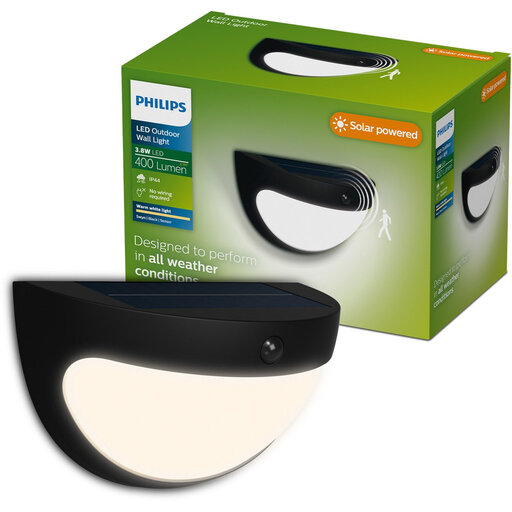
Why it suits this profile: This solar wall light works without mains electricity or wiring. That makes installation at an entrance, balcony or small garden straightforward.
The product information states that it has two light modes and an integrated motion sensor. However, check that the installation location receives enough direct sunlight.
Solar power, 400 lumens, warm white light at 2,700 K and IP44 splash protection.
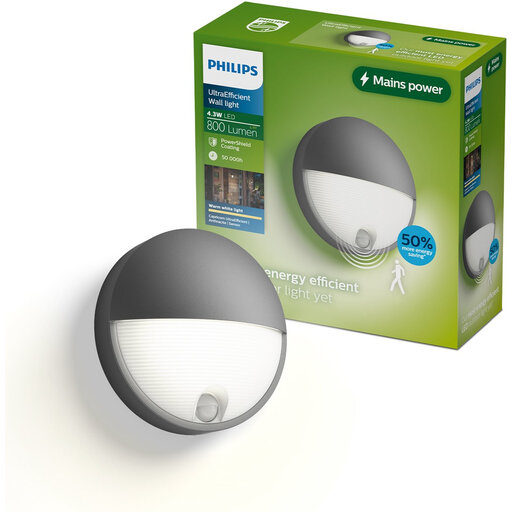
Why it suits this profile: A fixed LED wall light is ideal for a front door or façade where you want predictable lighting and a neat finish.
The specifications mention both a motion sensor and a dusk sensor. The IP44 rating makes it clear that direct water jets should be avoided.
Integrated LED, 800 lumens, 4.3 W, 2,700 K and an aluminium housing with PowerShield coating according to Philips.
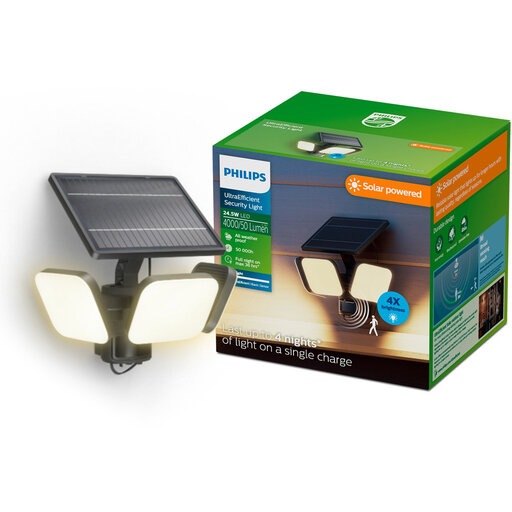
Why it suits this profile: This model is designed for large driveways, garages and larger façades where wide detection and high light output are important.
The product information states a detection range of 8 metres when approached directly and 16 metres sideways, as well as IP65 protection. However, the light must receive direct sunlight.
4,000 lumens, adjustable light head, two light modes and IP65. Available in 3,000 K or 5,000 K, depending on the version.
We’ve put together a complete, up-to-date list of products that fully meet these strict selection criteria and the applicable European safety regulations.
Mount the light on a stable surface and point the sensor towards the area where movement is expected. Avoid branches, shrubs or warm air currents directly in front of the sensor, as these can cause unwanted activation. With solar lighting, the panel should receive as much direct daylight as possible.
The operating time per night depends on sunlight, battery capacity, light intensity and the selected mode. Brand product information may state a specific operating time or lifespan, but actual performance varies according to the season and location. Clean the solar panel regularly and choose a lower light setting when there is little sunlight.
A solar outdoor light doesn’t use mains electricity during normal operation. A 230V LED light generally only uses energy when it is switched on. A motion sensor can limit the number of hours the light is on, but actual consumption depends on the wattage, activation duration and how often movement is detected. Therefore, look at wattage, operating time and any dusk sensor rather than relying solely on advertising claims.
