
Vandaag of morgen in huis

Kwaliteit gegarandeerd

Welkomstaanbiedingen ontgrendelen: GRATIS bezorging | Tot 80% korting | Gratis 30 dagen JoyPlus-proefperiode
Download de app
An outdoor light needs to do more than look good in a product photo. In a Dutch garden, on a balcony or by the front door, lighting has to cope with rain, wind, damp and limited sunlight in winter. Yet important differences are often hidden behind terms such as “waterproof”, “extra bright” or “energy-efficient”.
The three most common pitfalls:
By checking the brightness, protection rating and installation requirements carefully, you can avoid being disappointed by your outdoor lighting after just a few months.
Light output is measured in lumens (lm). For ambient lighting on a garden table, 170 to 400 lumens may be enough. An entrance, shed or pathway often needs more practical light. According to the product specification, a security light for a driveway or large garden may provide 1,000 to 4,000 lumens, for example.
Also pay attention to the colour temperature:
An LED outdoor light generally uses little energy and often has an integrated light source. However, check whether the LED can be replaced. On various models, the light source cannot be replaced by the user.
The IP rating indicates how well a product is protected against solid particles and water. An IP44 outdoor light is protected against splashing water from various directions. This makes IP44 suitable for many sheltered locations, such as a covered balcony, veranda or wall beneath an eaves.
An IP65 outdoor light offers greater protection against dust and water jets. This is a sensible choice for a more exposed location, such as an open driveway or large garden. However, IP65 does not mean that the light may be submerged.
Always check the installation instructions. An outdoor wall light with IP44 is not automatically suitable for a location where water remains in direct contact with it.
A solar outdoor light, or outdoor light powered by solar energy, works without fixed wiring. This is useful for rented properties, fences and locations without a power socket. However, the solar cell must receive enough direct light. Take shade from trees, walls and covered areas into account.
An outdoor light with a motion sensor is practical by a front door, garage or driveway. Pay attention to:
A fixed wall light operating at 220-240V must be connected by a qualified installer, according to the product specification. A wireless outdoor light with a USB-rechargeable battery or magnetic mounting is easier to install, but requires regular charging.
The choices below are linked to verifiable product specifications. Brand information about lifespan, energy consumption or lighting performance is presented as a product claim by the brand, rather than as an independently verified result.
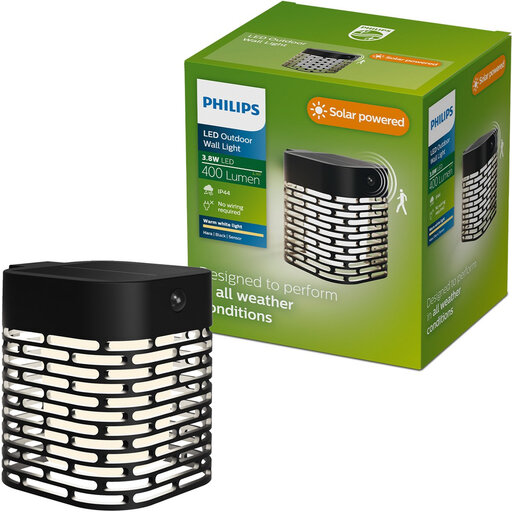
Why it suits this profile: This solar wall light works without mains electricity and offers two lighting modes. With 400 lumens per light point and warm white 2700K light, it is suitable for an entrance, balcony or sheltered garden wall.
The product details explicitly mention solar power, two modes and IP44 splash protection. This means you can see in advance that the light is intended for general use, rather than heavily exposed locations.
No wiring required; 400 lumens; 2700K warm white; two lighting modes; IP44 rating.
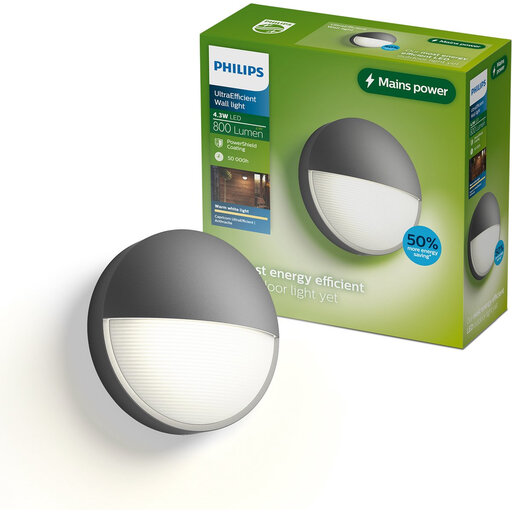
Why it suits this profile: This fixed outdoor wall light combines an aluminium housing with an integrated LED delivering 800 lumens and warm white 2700K light. It is suitable for anyone looking for permanent façade lighting.
The product description clearly states that a fixed connection and professional installation are required. It also specifies IP44, so you will not confuse it with an IP65 outdoor light.
800 lumens; integrated LED; aluminium and plastic; 2700K; suitable for fixed installation.

Why it suits this profile: According to the product specification, this solar security light is designed for large outdoor areas. It delivers 4,000 lumens, has IP65 protection, a motion sensor and an adjustable light head.
The light output, detection details and IP65 rating are listed separately. This allows you to assess whether this powerful light might be too bright for your location.
4,000 lumens; IP65; solar power; motion and dusk sensor; adjustable light head; 5000K according to the product details.
We have put together a complete, up-to-date list of products that fully meet these strict selection criteria and the applicable European safety regulations.
It can be, but performance depends on the amount of direct daylight, the temperature and the battery capacity. In winter, the days are shorter and the sun is lower in the sky. So do not place the light beneath a covered area or in permanent shade. A model with USB charging can be useful as an additional option.
IP44 protects against splashing water and is often suitable for sheltered outdoor locations. IP65 offers greater protection against dust and water jets. Neither rating means that the light can be placed underwater. Choose the rating based on the level of exposure at the installation location.
For ambient lighting on a patio, around 170 to 400 lumens may be sufficient. For an entrance or pathway, 400 to 1,000 lumens is often more practical. Large driveways or security lighting may require more. As well as lumens, consider the light distribution, colour temperature and whether the light has a motion sensor.
