
Vandaag of morgen in huis

Kwaliteit gegarandeerd

Welkomstaanbiedingen ontgrendelen: GRATIS bezorging | Tot 80% korting | Gratis 30 dagen JoyPlus-proefperiode
Download de app
A dark garden, a poorly lit garden path or a terrace lacking atmosphere does not automatically call for the most expensive light. When it comes to outdoor garden lighting, it is mainly about finding the right balance between brightness, protection from the elements, installation and power supply.
Many buyers encounter the same problems. For example, a solar light may spend much of the day in the shade and therefore only stay lit for a short time. A light with a high IP rating is sometimes presented as completely waterproof, even though the exact level of protection varies from product to product. A beautiful lighting design may also provide too little light for a driveway or entrance.
So do not focus solely on appearance. Check the points below before buying.
Solar lights for outdoor use work with a built-in battery that charges during the day. If the panel is positioned under a tree, against a wall or on a balcony with little direct sunlight, the operating time may be shorter. According to the product information for the UME Solar Pathway Lights, 6 to 8 hours of sunlight are needed for a stated operating time of 8 to 12 hours. This is a product specification under the stated conditions, not a guaranteed result for every Dutch garden.
That is why solar-powered lights should be placed where they receive as much direct daylight as possible. Clean the panel occasionally with a soft, damp cloth.
The IP code indicates the influences against which the casing offers protection. IP44 is suitable for splashing water from various directions, but not for immersion or direct high-pressure jets. This is also explicitly stated for various Brilliant products. IP54 additionally offers a higher level of protection against dust. IP65 effectively means a dust-tight casing and protection against water jets; even then, immersion is not intended.
IP44 may be suitable for a sheltered exterior wall or terrace. For an open garden, a low position or a location exposed to heavy rain and dirt, IP65 garden lighting is a practical option to consider.
Wattage mainly tells you about energy consumption, not directly about the amount of light produced. With LED garden lighting, also check the lumen value. For example, a Philips Cylr ground spotlight lists 350 lumens at 4.6 watts. The vidaXL LED outdoor light lists 550 lumens at 9 watts. This makes the light output easier to compare than looking at wattage alone.
A few lumens are often enough for decorative purposes. For a garden path, steps or entrance, an even spread of light is more important than one extremely bright light source.
Colour temperature is expressed in kelvin:
A warm light colour usually works well with decorative garden lighting. For practical orientation, neutral light may be more comfortable. Smart lights with a CCT function offer more adjustment options. However, check whether the light works via Wi-Fi, Bluetooth or a specific app.
Outdoor lights with ground stakes are convenient for borders, lawns and garden paths. They can usually be positioned without permanent wiring. With solar versions, the switch must be set to “on” before first use. An electric set, such as the Brilliant Kamara, uses a cable and plug. Do not lay cables across walkways and make sure the ground is stable.
For a rented property, solar and plug-in solutions are often more practical than permanent installation. If you want long-term lighting in a fixed location, a wired light may be worth considering. In that case, use only a suitable outdoor connection and follow the manufacturer’s installation instructions.
Aluminium can provide a sturdy appearance and some models come with a protective coating. Plastic is often lightweight and suitable for easy repositioning. Stainless steel works well with modern garden designs, but it still requires regular cleaning.
Also check whether the light source can be replaced. With integrated LED lights, the LED unit is often not intended to be replaced by the user. A product with a replaceable light source may offer greater flexibility in the long term.
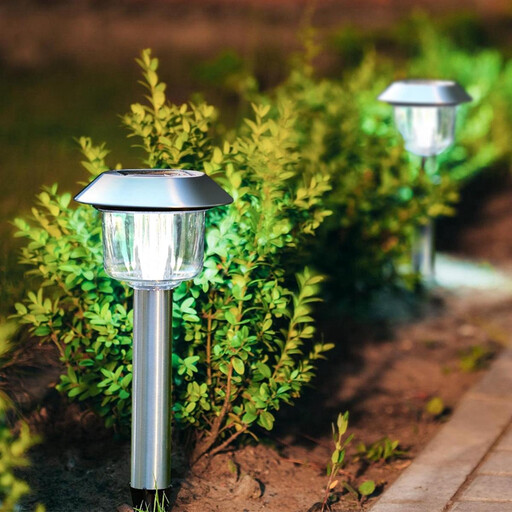
Why it suits this profile: This compact light runs on solar power and is designed for gardens and terraces. This means no permanent power connection is required.
The power supply and dimensions are clearly stated. However, bear in mind the specified height of 36.6cm and place the light in a sunny location.
Solar power, stainless steel and a ground-spike design for easy positioning.
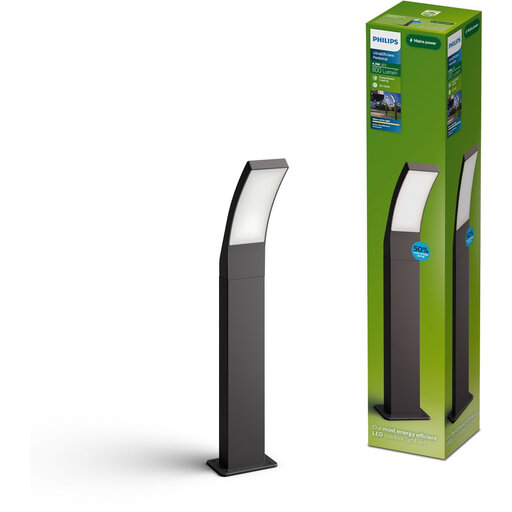
Why it suits this profile: This aluminium garden light combines integrated LED lighting with warm white light at 2700K. It is well suited to a permanent garden border, terrace or balcony.
The IP44 rating is not presented as protection against immersion. Do not place the light in a dip where water can collect.
4.3 watts, integrated LED and, according to Philips’ own information, a stated lifespan of 50,000 hours.
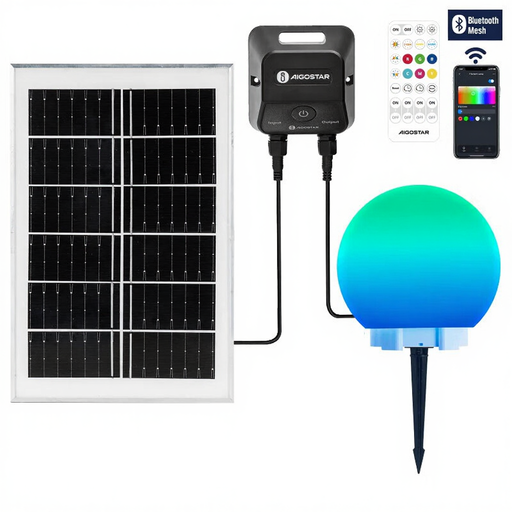
Why it suits this profile: This recessed solar light is aimed at users who want to adjust colour, brightness and control via Bluetooth Mesh.
The light lists both an IP65 rating and a charging time of 4 to 6 hours. Check beforehand that the installation location receives enough sunlight and that the controls are suitable for your home.
RGB plus adjustable white light, 200 lumens and a stated maximum battery life of 24 hours according to the product information.
We have put together a complete, up-to-date list of products that fully meet these strict selection criteria and the applicable European safety regulations.
IP44 may be sufficient for a sheltered location. For open areas with greater exposure to rain and dust, consider IP54 or IP65. Always check the installation instructions and avoid immersion, even with a light rated IP65.
This varies by model, battery, season and amount of sunlight. Product information often gives a range, such as 5 to 8 or 8 to 12 hours. In winter in the Netherlands, short days and cloudy weather can limit charging time. Keep the panel unobstructed and clean it regularly.
LED lights generally use little wattage in relation to their light output. With solar lighting, the energy comes from a rechargeable battery. With electric lights, consumption is mainly determined by the wattage, operating time and number of lights. Therefore, compare watts, lumens and daily use together.
