
Vandaag of morgen in huis

Kwaliteit gegarandeerd

Welkomstaanbiedingen ontgrendelen: GRATIS bezorging | Tot 80% korting | Gratis 30 dagen JoyPlus-proefperiode
Download de app
Good outdoor garden lighting should suit the location, purpose and Dutch weather conditions. A light for a garden path requires different features than an outdoor light with a motion sensor beside the driveway. Yet many buyers focus mainly on lumens, colour or an appealing product image. As a result, important differences between solar garden lights, LED garden lighting and mains-powered outdoor lights are sometimes noticed too late.
A high lumen count may sound appealing, but it does not indicate how broadly or narrowly the light is distributed. A 3,000-lumen light with a wide beam can illuminate a large area, while a garden spotlight with fewer lumens may highlight a tree or border more effectively. Also consider the beam angle, the number of light sources and whether the light can be adjusted.
Check the IP rating rather than relying solely on the marketing copy. An IP44 garden light is protected against splashing water, but it is not designed for immersion or direct water jets. IP65 outdoor lighting offers greater protection against dust and water jets, but this rating still does not make a light suitable for placing in water.
Also pay attention to cables, plugs and connection points. A light may have a specific IP rating, while an inadequately protected connection can still represent a weak point.
Solar-powered garden lighting is easy to install, but its performance depends on the amount of direct sunlight available. In a shaded back garden, beneath a covered patio or during short winter days, the operating time may be reduced. A solar wall light or solar garden light with a separate panel can sometimes offer more flexibility in positioning than a compact model with a panel permanently attached to the light.
Use IP44 in sheltered locations where splashing water is the main concern, such as a covered patio. For a façade, open garden or driveway, IP65 outdoor lighting may be more practical. Always install a light according to the instructions and ensure that cables do not cross walking routes.
LED garden lighting uses either an integrated light source or a replaceable bulb, such as GU10. Check this in advance. With integrated LEDs, the light source is generally not intended to be replaced by the user.
Solar garden lighting requires no fixed electrical connection, but it does need sunlight to charge the battery. Wired lighting offers more consistent performance, but requires a suitable outdoor socket and careful cable routing. Smart garden lighting can be controlled via an app, Bluetooth or a smart-home platform. Check whether an account, Wi-Fi connection or separate bridge is required.
For ambience, RGB garden lighting and adjustable CCT lights are worth considering. CCT stands for adjustable colour temperature, for example from warm white to cooler white. For a driveway or entrance, a motion sensor is usually more useful than colour settings.
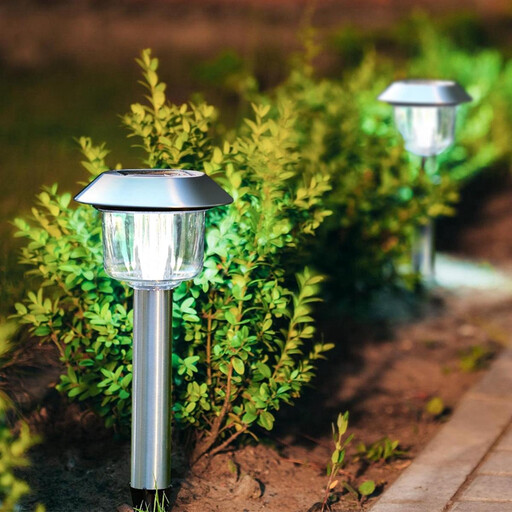
Why it’s a good fit: A straightforward choice for a garden path, border or patio without a fixed power connection.
The intended use and power source are clear: solar power and a compact design. Do not expect broad illumination across a large area.
Solar power, stainless steel construction and a height of 36.6 cm according to the product specifications.

Why it’s a good fit: Ideal for patios, borders and garden paths where app or voice control is preferred.
The IP44 rating makes its limitations clear: suitable for splashing water, but not for immersion or direct water jets.
Set of three, 660 lumens, dimmable, RGB and CCT 3000–6500 K; control via Tuya, Bluetooth and an 8-metre cable.

Why it’s a good fit: Designed for driveways, garages, patios and other areas where lighting is needed when movement is detected.
The solar setup requires sufficient direct sunlight. Do not automatically plan installation on a north-facing or permanently shaded wall.
According to the product description: 302 LEDs, 3,000 lumens, IP65 and three modes with motion detection up to 60 feet and 180 degrees.
Browse a current selection of products and compare light colour, IP rating, installation and control options for your outdoor space.
RGB lights or dimmable LED lights are practical for creating ambience on a patio. Along a path, several small light points are often sufficient for orientation. At an entrance or driveway, a solar wall light with a motion sensor can provide more targeted illumination. If you want to control several lights simultaneously, consider smart garden lighting with Bluetooth Mesh or an app.
Solar garden lighting uses a battery that is charged by the solar panel during the day. This eliminates the need for a fixed power connection. Actual operating time depends on solar exposure, panel size, battery capacity, temperature and the selected light mode. In winter or during extended periods of cloudy weather, the operating time may be reduced.
IP44 may be suitable for sheltered locations, provided the light is not exposed to direct water jets or immersion. According to the classification, IP65 offers greater protection against dust and water jets, making it generally more suitable for exposed façades and gardens. Always check the protection provided for the plug and cable connection as well.
Lifespan varies by model and operating conditions. Some Aigostar lights specify a lifespan of up to 30,000 hours; this is a manufacturer product specification, not a guarantee that every light will reach that exact figure. Batteries in solar lighting may also wear out before the LED light source. For this reason, check the warranty, whether components can be replaced and the maintenance instructions.
