
Vandaag of morgen in huis

Kwaliteit gegarandeerd

Welkomstaanbiedingen ontgrendelen: GRATIS bezorging | Tot 80% korting | Gratis 30 dagen JoyPlus-proefperiode
Download de app
Good outdoor garden lighting needs to suit the location, power supply and British weather. A light that looks appealing in an online shop may provide too little light in practice, be difficult to install or be unsuitable for a completely exposed position.
So do not focus only on design or claims such as “extra bright”. Pay particular attention to verifiable details such as lumens, IP rating, colour temperature, dimensions and how the light is connected.
IP44 outdoor lighting is protected against splashing water, but is not designed to stand in water or be exposed to direct water jets for prolonged periods. IP65 garden lighting offers a higher level of protection against dust and water jets according to the product classification. This makes IP65 suitable for more exposed locations, but the precise installation instructions remain important.
An outdoor wall light beneath a covered area can be perfectly suitable with IP44. For a light along an open garden path or in a position where rain falls directly onto the housing, it is sensible to consider a higher level of protection.
Solar garden lighting does not perform the same way in every location. Shade from a fence, tree or house reduces charging time. So check:
The stated operating time depends on sunlight, the season, temperature and battery condition. Performance may therefore differ in winter compared with a long summer day.
Wattage mainly indicates energy consumption, not automatically the amount of light produced. Lumens are more useful for comparison. Path lighting providing 10 lumens per light may be enough for subtle marking along a border, but is not designed to illuminate a large patio brightly.
Also consider the colour temperature. At around 3000K, warm white light is often suitable for a patio, frontage or atmospheric garden lighting. An adjustable range from warm to cool white offers greater flexibility, but may require dependence on an app or remote control.
Consider the light distribution. Diffused light is pleasant for creating ambience, while directional light works better when you want to highlight a particular plant, wall or passageway.
Solar lights work without a cable to a socket, but depend on sunlight. Wireless LED lights with a rechargeable battery can be positioned flexibly, but need to be charged regularly. Mains-powered lights provide a fixed power source, but require more attention to cables, connections and installation.
A light with a ground stake is generally easy to install. A hardwired outdoor wall light operating at 220–240 V must be connected by a qualified electrician in accordance with the product information. Keep cables away from walkways to reduce the risk of tripping.
With integrated LED garden lighting, the light source often cannot be replaced by the user. Therefore, check the warranty terms and the expected service life stated in the product information. Clean solar panels, covers and housings with a soft cloth whenever dirt reduces the light output.
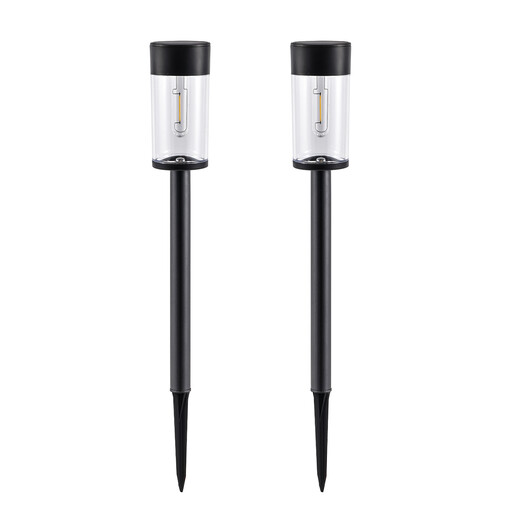
Why it suits this profile: This set is solar-powered and installed using ground stakes. This means no mains connection is needed for a garden path, border or driveway.
The product information states an IP65 rating, automatic dusk operation and a recommended charging location with 6–8 hours of direct sunlight. Check the latter in advance at your chosen location.
2 lights, 3000K warm white light, 10 lumens per light and automatic on/off operation according to the product specifications.
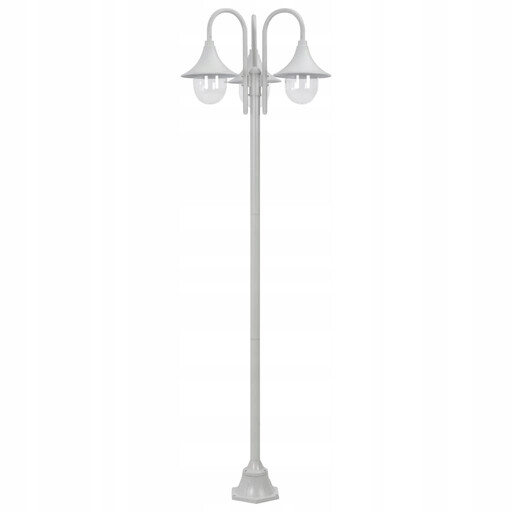
Why it suits this profile: The three 220 cm-high garden posts are intended for anyone looking for a permanent lighting solution for a larger garden, entrance or driveway.
The product details list an aluminium frame, PVC lampshades and three E27 lamp holders. Bulbs are not included, allowing you to choose the colour temperature and brightness yourself.
Set of 3, aluminium construction, three E27 lamp holders and suitable for bulbs up to 60 W per holder according to the product information.

Why it suits this profile: If you want to adjust your lighting regularly, this set offers an adjustable colour temperature, RGB colours and control via the Tuya app.
The product information describes the IP44 rating as protection against splashing. Do not therefore place the light where it will be exposed to direct water jets or submerged.
Integrated LED, 660 lumens, 3000–6500K, dimming function, RGB and control via app or voice assistant according to the stated specifications.

Why it suits this profile: This wireless light with magnetic mounting and a motion sensor is useful beside a door, balcony or patio where a permanent connection is not desired.
The product information lists IP44 as protection against splashing, not as complete waterproofing. Also check that the surface is flat, clean and sufficiently magnetic.
300 lumens, warm white 3000K light, integrated motion sensor, rechargeable battery and USB-C charging according to the product description.
We have put together a complete, up-to-date list of products that fully meet these strict selection criteria and the applicable European safety regulations.
Low garden posts or solar path lighting are practical choices for a garden path. Choose a gentle light level if your main aim is to mark the route. Position several lights at equal intervals and make sure that cables do not run across the path.
This depends on the wattage, the number of lights and the number of hours they are switched on. LED lights generally use less electricity than comparable traditional light sources, but always check the stated wattage. Solar garden lighting does not use mains electricity while operating, but it does depend on charging conditions.
IP44 means protection against splashing water. According to the product information for various lights, this is suitable for sheltered outdoor locations such as a covered patio or entrance. For completely exposed positions with heavy rain, splashing water or direct water jets, a higher IP rating may be more suitable. Always install the light in accordance with the assembly and safety instructions.
