
Vandaag of morgen in huis

Kwaliteit gegarandeerd

Welkomstaanbiedingen ontgrendelen: GRATIS bezorging | Tot 80% korting | Gratis 30 dagen JoyPlus-proefperiode
Download de app
Good outdoor garden lighting needs to suit the location, how you plan to use it and the British weather. A light for a sheltered balcony has different requirements from lighting along a driveway or in an open garden. So don’t focus only on appearance or the number of lighting modes. IP rating, light output, power supply and installation are what really determine whether your purchase works well in practice.
Product descriptions often use terms such as weather-resistant or waterproof. The IP rating gives you a more specific guide. IP44 protects against splashing water, but isn’t designed for immersion or powerful water jets. IP54 also offers protection against dust. IP65 means the product is dust-tight and protected against water jets under certain conditions.
An IP rating doesn’t automatically make a light suitable for every location. For example, it’s best not to place an IP44 light somewhere that rainwater pools for long periods. Also check that the plug, cable and connection are suitable for outdoor use.
Wattage tells you mainly about energy consumption, not directly how much light a product gives off. When comparing LED outdoor lights, look at lumens too. A path light with 10 lumens provides a gentle marker, while a 350- or 550-lumen light offers more practical illumination.
For atmospheric garden lighting, warm white light of around 2700 to 3000 K can be a good choice. For an entrance or driveway, higher light output may matter more than a decorative effect.
A solar-powered outdoor light is easy to install, but its panel needs plenty of daylight. Shade from a fence, tree or covered area can reduce charging time. In winter and on cloudy days, the light may also stay on for less time.
According to UME’s product description, the solar garden lights in question need around 6 to 8 hours of direct sunlight for an operating time of approximately 8 to 12 hours. This is a manufacturer’s product specification, not a guarantee for every garden or weather condition.
Choose the rating to suit the location:
Always follow the installation instructions. An IP65 light isn’t automatically suitable for use underwater.
Use lumens to compare lights more fairly. For a garden path, several soft pools of light are often more pleasant than one very bright light. An outdoor ground spotlight can be used to highlight a tree, wall or flower bed.
Also consider the colour temperature:
Solar garden lights don’t need a mains connection, but the panel does need to be in a suitable spot. Battery-powered lights are easy to move, while plug-in lights are generally better suited to a permanent setup.
An outdoor light with a motion sensor can be useful by an entrance or garage. Check the detection direction and the available settings. For smart garden lighting, check how it’s controlled, such as via Bluetooth, an app or a mesh network. Clean solar panels and light fittings regularly with a soft, damp cloth. This helps stop dirt from affecting light output and charging capacity.
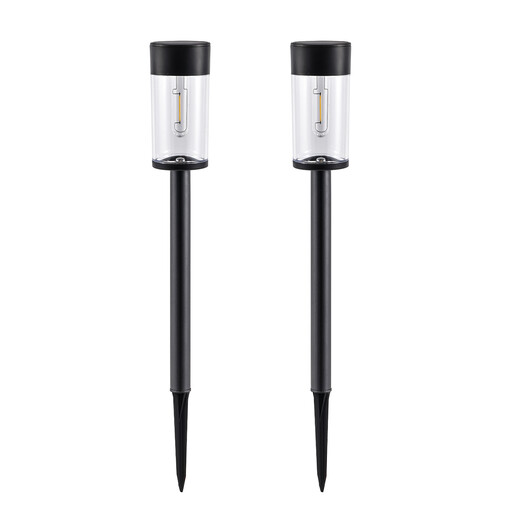
Why it suits this profile: This set includes two lights with ground stakes and automatic on/off switching. That makes them easy to place along a garden path, lawn edge or driveway.
The product information gives clear charging requirements, an IP65 rating and 10 lumens per light. This makes it easier to judge what to expect than a purely decorative description would.
Solar-powered, automatic operation, warm white light at 3000 K and two lights per pack.
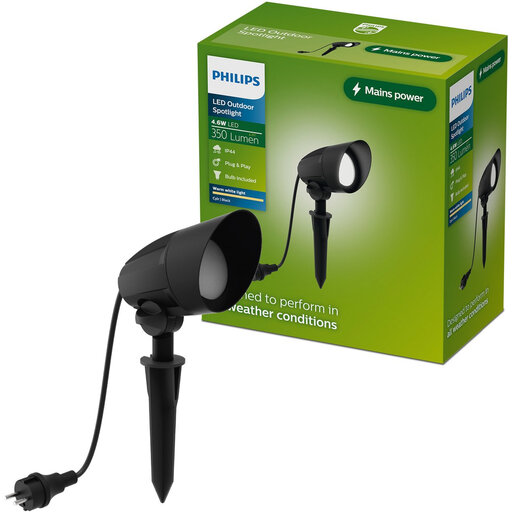
Why it suits this profile: This plug-in outdoor ground spotlight is designed to illuminate a tree, shrub, driveway or gate. The included GU10 LED bulb gives 350 lumens of warm white light at 2700 K.
The specifications list IP44, 230 V, a 150 cm cable and an included GU10 bulb. So you’ll know in advance that you need a suitable outdoor socket.
Aluminium and glass, adjustable positioning, 350 lumens and a replaceable GU10 light source.
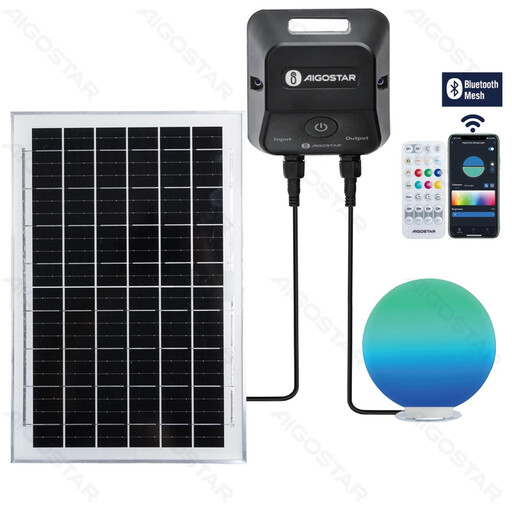
Why it suits this profile: This smart garden lighting is a good choice if you want to manage colours, schedules and multiple lights. According to the product description, the system can control more than 200 Bluetooth Mesh devices.
The product specifications list solar power, IP65, a 4000 mAh lithium battery and a maximum battery life of 24 hours. Do check in advance that the location gets enough sunlight.
RGB+CCT light, brightness control, scheduling, automatic switching on and installation without fixed wiring.
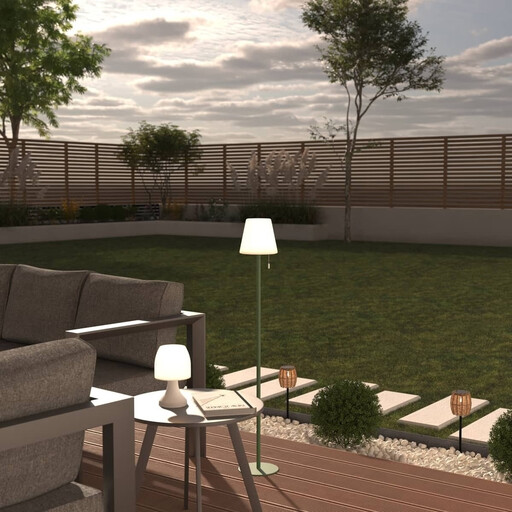
Why it suits this profile: This freestanding lamp is battery-powered, so you can use it in different spots on your patio or balcony. At 108 cm tall, it stands out beside a seating area or table.
The lamp has a stated IP44 rating, so it’s best suited to areas where it may be splashed. This helps you avoid using a decorative light in a spot that’s too exposed.
Three lighting modes, including multicolour, flame effect and white light; battery power and a weather-resistant plastic shade, according to the product description.
We’ve put together a complete, up-to-date list of products that meet these strict selection criteria and the applicable European safety requirements.
Choose a spot with as much direct daylight as possible and avoid shade from trees, walls and covered areas. Don’t place the solar panel beneath a light that comes on in the evening, as this could stop the light sensor from switching correctly. Push ground stakes gently into the soil and check that the ground is stable.
Lifespan varies depending on the model, operating conditions and power supply. Some product descriptions, for example, state a lifespan of up to 30,000 hours. This is a product specification provided by the brand, not a guarantee for every real-world situation. If the light has a replaceable GU10 bulb, you can replace the bulb separately later; with integrated LEDs, you may need to replace the entire fitting.
Solar garden lights don’t use mains electricity during normal operation. The practical costs are mainly the purchase price, battery replacement and any maintenance. With plug-in or hardwired lighting, wattage and the number of hours it’s on will affect running costs. So compare more than just the purchase price: consider the power supply, operating time and whether parts can be replaced.
