
Vandaag of morgen in huis

Kwaliteit gegarandeerd

Welkomstaanbiedingen ontgrendelen: GRATIS bezorging | Tot 80% korting | Gratis 30 dagen JoyPlus-proefperiode
Download de app
A xenon bulb that is gradually becoming less bright often only becomes noticeable when you are driving in the rain at night. Many motorists then replace just one bulb and order based on colour temperature or a striking light claim. This can result in the wrong fitting, a colour difference between the left and right sides, or lighting that has not been approved for the vehicle.
As a Joybuy Product Recommendation Officer, I therefore start with verifiable information: fitting, light source, wattage, colour temperature, packaging and compatibility. Below, you can read what to look out for before buying OSRAM xenon headlights.
D1S, D2S, D3S and D4S are not interchangeable. A D1S xenon bulb, for example, has a different connection and application from a D2S xenon bulb. D3S and D4S are also systems with mercury-free technology. Always check the fitting on the old bulb, in the car’s manual or via OSRAM’s official compatibility database.
According to OSRAM’s own research, the XENARC NIGHT BREAKER 220 can provide up to 220% more light than the statutory minimum standard. This percentage is a brand claim based on a specific comparison and does not mean that every car will show exactly the same improvement. Light output also depends on the headlight unit, reflector, lens, ballast, adjustment and condition of the headlight lens.
Xenon bulbs gradually deteriorate. As a result, a new bulb may be noticeably whiter or brighter than the old bulb on the other side. A xenon bulb, 2-pack is therefore a practical choice for many motorists: both sides receive the same light source and a similar colour. However, always check whether your vehicle was factory-fitted with xenon lighting. These bulbs are not intended as replacements for halogen headlights.
Always start by identifying the exact fitting:
The fitting alone is not enough. According to the product information, the bulbs are only approved for vehicles, lighting functions and countries listed in OSRAM’s official compatibility list. Before purchasing, check the vehicle make, model and year of manufacture in the database, as well as the lighting function and the country in which you drive.
A 4500K xenon bulb generally produces a neutral white colour. The OSRAM XENARC NIGHT BREAKER 220 is listed in the product information at 4500 Kelvin for D1S and D2S, and 4400 Kelvin for D3S and D4S. This suits motorists who want a white appearance without an especially cool tint.
A 6200K xenon bulb, such as the OSRAM XENARC COOL BLUE INTENSE, looks whiter and is described in the product information as having an LED-like appearance. However, a higher Kelvin value does not automatically mean more light on the road. As well as colour temperature, look at the lumen output, approval and light distribution in your headlight unit.
The OSRAM bulbs mentioned use 35 watts. The NIGHT BREAKER 220 is listed with up to 3200 lumens and a beam reaching up to 250 metres. These figures come from the product information; actual visibility varies by vehicle and headlight.
According to OSRAM’s own research, the NIGHT BREAKER 220 can provide up to 220% more light than the statutory minimum standard. For the COOL BLUE INTENSE, a claim of up to 150% more light compared with that standard is stated. When purchasing, also check whether the specific version is ECE-approved for your vehicle and application. A bulb that fits physically is not automatically road-legal in every combination.
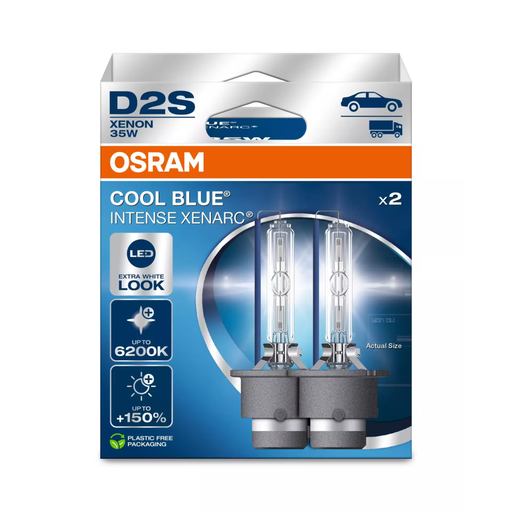
Why it suits this profile: A straightforward set for anyone who wants to replace their existing D2S lighting in pairs and achieve a whiter appearance.
The fitting and packaging are clearly specified as D2S and 2-pack. Even so, check OSRAM’s official list for your car.
Up to 6200K according to the product information, 35 watts and designed for D2S xenon systems.
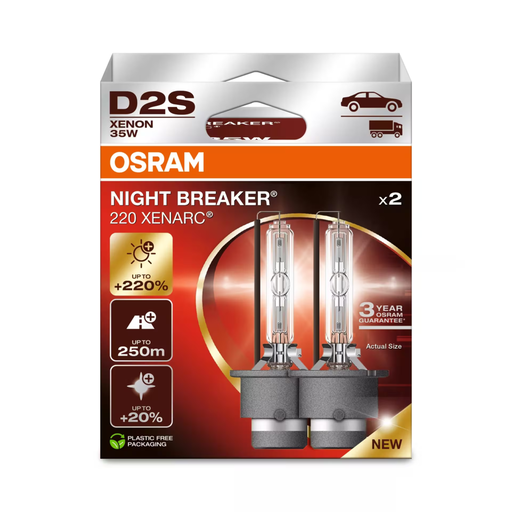
Why it suits this profile: For drivers primarily looking for greater light output from a suitable D2S xenon bulb.
The light claim is linked to the statutory minimum standard, not to a guaranteed improvement in every car.
Up to 220% more light according to OSRAM’s own research; 4500K, 3200 lumens and 35 watts according to the product information.
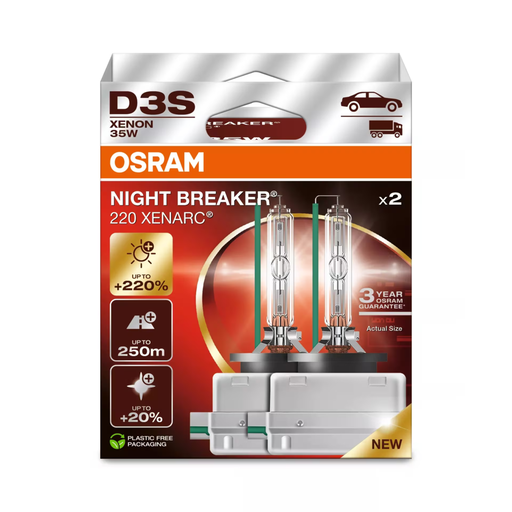
Why it suits this profile: Designed for vehicles with a factory-fitted D3S system, for example for frequent night-time driving or long journeys.
The D3S fitting and mercury-free technology are specifically stated. This avoids confusion with D1S, D2S or D4S bulbs.
According to the product information: 3200 lumens, 35 watts, 4400K and a light claim of up to 220% compared with the statutory minimum standard.
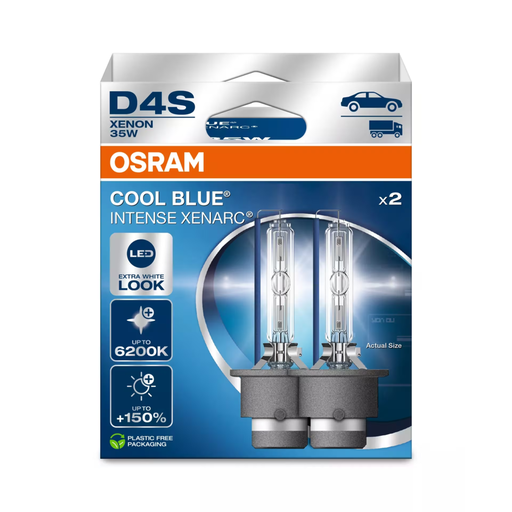
Why it suits this profile: For anyone looking to replace a D4S xenon headlight with a whiter, more modern-looking light colour.
Colour temperature is not used as evidence of greater light output. D4S compatibility must be checked separately.
Up to 6200K and a claim of up to 150% more light according to OSRAM’s own research; supplied as a set of two D4S bulbs.
A xenon HID headlight operates at high voltage. It is best to have it fitted by a garage, or follow only the official installation instructions for your vehicle. If you want to do the work yourself, bear the following points in mind:
Incorrect adjustment can dazzle oncoming drivers, even when the bulb itself is working correctly.
We have compiled a complete, up-to-date list of products that fully meet these strict selection criteria and the applicable European safety regulations.
Read the fitting on the old bulb or consult the vehicle documentation. Then check the exact vehicle in OSRAM’s official compatibility database. The car model or bulb base alone is not always sufficient.
This is usually advisable when one bulb has failed or is visibly ageing. A set of two helps limit differences in colour and brightness between the two headlights. When purchasing, check that the packaging actually contains two bulbs.
Service life depends on usage, how often the lights are switched on, the ballast, temperature and the condition of the headlight unit. Manufacturers do not specify the same practical service life for every car. Look out for signs such as gradual dimming, a change in colour, flickering or a bulb that no longer starts.
