
Vandaag of morgen in huis

Kwaliteit gegarandeerd

Welkomstaanbiedingen ontgrendelen: GRATIS bezorging | Tot 80% korting | Gratis 30 dagen JoyPlus-proefperiode
Download de app
Buying a new bulb seems simple: search for OSRAM car bulbs, choose a fitting and place your order. Yet many problems only become apparent after installation. The bulb may not fit properly, trigger a warning on the dashboard or be unsuitable for use on public roads in your vehicle.
So pay particular attention to these three common pitfalls:
First, check the bulb type in your car’s manual or on the existing bulb. Common types include H7, H4, H1 and H11. However, the fitting doesn’t just determine whether the bulb physically fits. The lighting function, headlight type, vehicle electronics and voltage also matter.
For LED retrofit car bulbs, such as OSRAM NIGHT BREAKER LED SMART H7 and OSRAM NIGHT BREAKER LED SPEED H7, you should consult the official OSRAM compatibility list. According to the product information, approval applies only to the vehicles, lighting functions and countries listed. Some cars also need a CANbus adapter to prevent warning messages or flickering.
The OSRAM NIGHT BREAKER LED SMART ECE H11 is a separate case. According to the product information, this bulb has ECE R37 approval for 12V vehicles with an H11 fitting. You should still check that your vehicle uses H11 for the lighting function you need.
H7 halogen bulbs are usually a direct replacement for an existing 12V, 55W H7 bulb. They generally don’t require software changes or an additional CANbus component. Their light is often warmer than LED; according to the product specifications, standard halogen bulbs are typically around 3,200–3,500K.
OSRAM NIGHT BREAKER halogen models focus on increased light output or a whiter appearance. According to OSRAM, the NIGHT BREAKER 220 H7 has a colour temperature of 3,700K and a stated beam distance of up to 150 metres. The COOL BLUE INTENSE H7 reaches up to 5,000K according to the product information, giving it a whiter, bluer appearance.
H7 LED bulbs use less power and usually produce a cool white light of around 6,000K. According to OSRAM’s own product information, certain NIGHT BREAKER LED models can last up to six times longer and use up to 60% less energy than halogen bulbs. These are manufacturer claims; actual lifespan depends on factors such as usage, heat dissipation and the vehicle’s electrical system.
Passenger cars usually use 12V. Heavy goods vehicles, buses and some agricultural or commercial vehicles commonly use 24V. A 12V bulb isn’t suitable as a replacement in a 24V system.
For heavy goods vehicles, for example, there’s an OSRAM NIGHT BREAKER LED H7 for 24V. According to OSRAM, this model is designed for heavy vehicles, and some vehicles may require a separate SMART CANBUS accessory cable.
A colour temperature of 6000K gives a cool white appearance, but it doesn’t indicate how good the beam is by itself. Always check the approval, lighting function and compatibility. For models that require it, keep the official approval document in the vehicle and follow the instructions for stickers on the headlight housing.
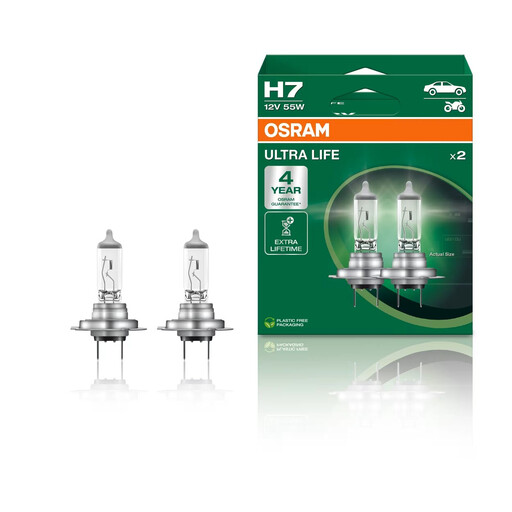
Why it suits this profile: A practical choice if you want to replace an existing H7 bulb without switching to LED.
The 55W H7 specification makes it clear that this is a halogen replacement, not a universal LED upgrade.
55W, P26.4t/PGJ19-1 fitting and a set of two bulbs. According to OSRAM, they last up to four times longer than standard halogen bulbs.
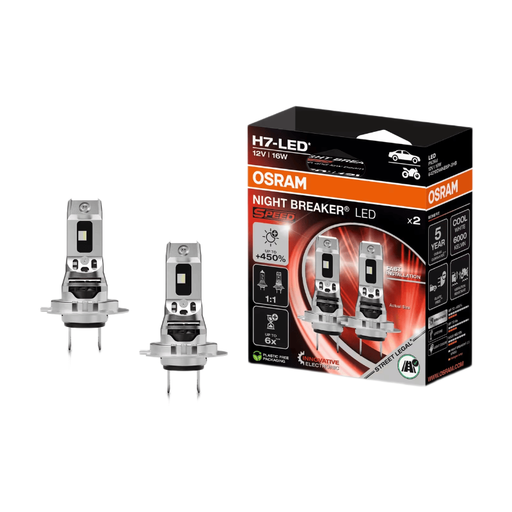
Why it suits this profile: For drivers looking for cool white LED light and a compact installation solution.
The manufacturer explicitly states that you need to check the official compatibility list, so this bulb isn’t automatically approved for every H7 car.
According to OSRAM: 6000K, 16W, up to 450% more light compared with the stated ECE minimum requirement, and a 1:1 design that needs no mechanical accessories.
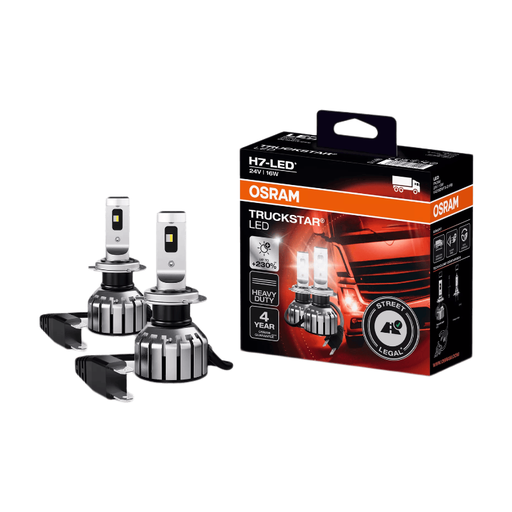
Why it suits this profile: Designed for HGV drivers, fleet managers and drivers of other 24V vehicles.
The voltage is clearly stated as 24V, reducing the risk of accidentally fitting this bulb in a standard 12V passenger car.
24V, H7 fitting, 6000K and a set of two bulbs. According to OSRAM, the design is intended for heavy-duty use and resistance to vibration.
Where possible, replace halogen bulbs in pairs so both sides have the same colour and light output. Don’t touch the glass of a halogen bulb with bare fingers; oil from your skin can create hot spots. When handling LED bulbs, hold them by the base, not by the LED chip or driver.
After fitting, check:
The same basic rules apply to H1 LED bulbs, H4 LED bulbs and H11 LED bulbs: check the fitting, voltage, lighting function and legal status first. For an H4/H19 bulb, you must also use the correct adapter if your vehicle requires H19.
We’ve put together a complete, up-to-date list of products that meet these strict selection criteria and the applicable European safety regulations.
No. For many LED retrofit models, approval only applies to the vehicles, lighting functions and countries on the official OSRAM compatibility list. Check this before installation. According to the product information, the H11 version with ECE R37 has broader approval for 12V vehicles with an H11 fitting.
It varies by model and usage. According to OSRAM, the ULTRA LIFE H7 is designed to last up to four times longer than standard halogen bulbs. This is a manufacturer claim; driving conditions, vibration and voltage fluctuations all affect real-world performance.
According to OSRAM product information, various NIGHT BREAKER LED models use up to 55% or 60% less energy than comparable halogen bulbs. Always check the stated wattage, vehicle voltage and whether a CANbus solution is needed.
