
Vandaag of morgen in huis

Kwaliteit gegarandeerd

Welkomstaanbiedingen ontgrendelen: GRATIS bezorging | Tot 80% korting | Gratis 30 dagen JoyPlus-proefperiode
Download de app
A flat battery rarely happens at a convenient time. You might be in a car park, on an A-road or at a campsite, with no jump leads or helping vehicle nearby. The OSRAM BatteryStart 400 jump starter is designed to get a 12V vehicle started without assistance. It can also be used as a power bank and a 12V power supply.
However, not every portable car jump starter is suitable for every vehicle. A high peak output on the packaging doesn’t tell you everything. Before buying, check vehicle compatibility, charge level and practical dimensions.
A figure such as 2,000A jump starter usually refers to the maximum peak current. That isn’t the same as the current the device can supply over a longer period. Check the nominal or rated starting current too. The OSRAM BatteryStart 400 has a nominal starting current of 400A and a peak output of 2,000A.
The engine size the product is designed for is important too. This lithium jump starter is specified for petrol engines up to 8 litres and diesel engines up to 4 litres. That doesn’t mean it will start a vehicle with every flat or faulty battery. A battery with internal damage, a problem with the starter motor or another electrical fault needs a different solution.
A capacity of 16,800 mAh sounds generous, but usable energy also depends on voltage, conversion losses and temperature. So don’t use mAh as your only point of comparison. What matters more is whether the jump starter suits your vehicle and whether you fully charge it before use.
According to its specifications, the OSRAM BatteryStart 400 has a lithium-ion battery, a nominal voltage of 12V and weighs around 1,174 grams. It’s portable enough to keep in a car, but it isn’t as small as some compact models with a lower starting current.
A car jump starter with a power bank can be handy, but check the connections. The BatteryStart 400 has two USB ports, a 12V output for accessories such as a tyre inflator or cool box, and a built-in LED light. These are practical extras for roadside breakdowns and outdoor activities.
Pay attention to the safety instructions too. Connect the red clamp to the positive terminal and the black clamp to the negative terminal. Check that the connections are secure, and remove the clamps as soon as the engine has started. Store the device somewhere cool and dry, away from naked flames.
Use this checklist when comparing a 12V car battery booster or emergency jump starter:
According to OSRAM’s product description, the BatteryStart 400 is suitable for common passenger cars, light commercial vehicles and multi-purpose vehicles. Still, check your specific vehicle in its handbook or specifications.
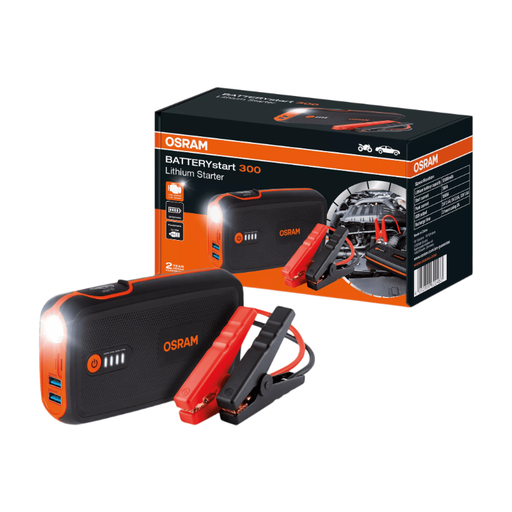
Why it suits this type of buyer: This more compact model is aimed at drivers of everyday cars and motorbikes who want a basic portable solution. According to the product information, it’s suitable for petrol engines up to 6 litres and diesel engines up to 3 litres.
The product information gives both a capacity of 13,000 mAh and a peak output of 1,500A. This makes it easier to compare its capacity and vehicle limits than if you relied on just one marketing figure.
Around 706 grams, 12V, dual USB power bank and built-in LED light.
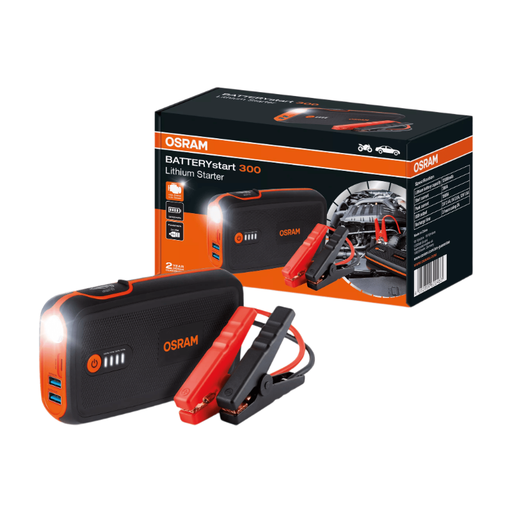
Why it suits this type of buyer: The BatteryStart 400 has a higher stated vehicle limit, making it suitable for drivers of larger cars, light commercial vehicles and recreational vehicles.
As well as a 2,000A peak output, the specifications list a 400A nominal starting current, a 16,800 mAh capacity and specific engine limits.
According to the product description, it’s suitable for petrol engines up to 8 litres and diesel engines up to 4 litres. It also has dual USB, a 12V output and an LED light.
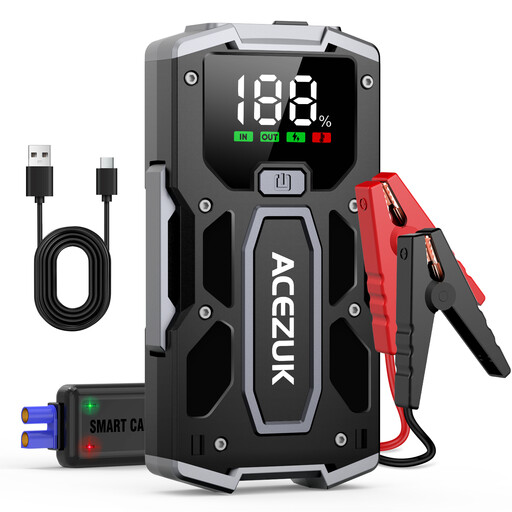
Why it suits this type of buyer: According to the product information, this model is designed for 12V cars, motorbikes, off-road vehicles and other uses where a display, lighting and multiple safety features are desirable.
According to the product description, an LCD display shows the battery status and temperature. It’s specified for petrol engines up to 7 litres and diesel engines up to 5.5 litres; check that it’s compatible with your vehicle.
Stated peak current of 6,000A, USB and USB-C connections, an LCD display and multi-mode LED lighting.
We’ve put together a full, up-to-date list of products that meet these strict selection criteria and current European safety requirements.
Switch off the vehicle and check the positive and negative terminals first. Connect the red clamp to the positive terminal and the black clamp to the negative terminal. Make sure both clamps are secure. Then start the vehicle according to the jump starter’s instructions. Remove the clamps as soon as the vehicle has started successfully.
According to the product information, the OSRAM BatteryStart 400 is designed for diesel engines up to 4 litres and petrol engines up to 8 litres. These are manufacturer specifications, not a guarantee that it will work in every situation. Temperature, battery condition, cable connections and any vehicle faults can also affect the result.
Its lifespan depends on storage temperature, how often it’s charged and how well it’s maintained. Fully charge the jump starter before storing it, and check its charge regularly. Keep it somewhere cool and dry, rather than leaving it in a hot car for long periods. A jump starter isn’t a substitute for a regular battery charger either: if your battery is losing charge slowly, a suitable 12V charger is often a better choice.
