
Photographing complete models
You want the shape, paper colour and folds to stand out consistently against a dark background. Framing, lighting and a stable setup come first.


When photographing complete origami models, framing, a stable setup and adjustable lighting matter more than an interchangeable lens. If you want to capture small folds in close-up, compare the close-up capabilities of the exact camera-and-lens combination. A compact camera keeps your setup simple, while a mirrorless camera gives you more choice of lenses, but may also require you to buy components separately.
You want the shape, paper colour and folds to stand out consistently against a dark background. Framing, lighting and a stable setup come first.
You want to capture individual folds or the texture of the paper in close-up, so you compare the close-up mode or lens on the exact setup.
You want to photograph models quickly with fewer separate camera components, and are happy to have less flexibility to change lenses later.
A good fit if: you want to photograph small details without changing lenses.
Bear in mind: the lens cannot be changed, and focusing at close range does not necessarily leave enough space for lighting.
A good fit if: you want to frame complete models and choose a lens for small details yourself.
Bear in mind: the supplied zoom lens determines the close-up capabilities; another lens may need to be bought separately.
First decide whether you’ll usually photograph the whole model or a small fold. Then consider the lighting, stability and components included in the exact setup. Canon Netherlands recommends using a tripod for consistent product compositions and explains the balance between aperture and exposure.
| What matters | What should you check? | Who is this for? |
|---|---|---|
| Keeping folds visible | Check whether you can position the lighting, assess the exposure and keep the camera stable. | If I want paper details to stand out against a dark background, I prioritise lighting and a repeatable setup. Around 40% of consumers prioritise lighting and repeatability. |
| Framing small details | Compare the close-up mode, focusing distance and maximum magnification of the exact camera-and-lens combination. | If I want to fill the frame with an individual fold, I look beyond the camera body’s name. Around 30% of consumers prioritise small fold details. |
| Keeping the model in focus | Check whether you can adjust the aperture and focus point, and whether your setup supports the depth of field you want. | When a model has folds at different distances, I want to be able to balance focus and lighting. Around 20% of consumers prioritise keeping the whole model in focus. |
| A simple setup | Compare the close-up mode and crop with the dimensions of your model; check which accessories are included. | If I’d rather not change lenses, a simple setup matters more than having extra lens options. Around 10% of consumers prioritise a compact setup without changing lenses. |
Lighting position and camera stability also affect how clearly your paper subject appears.
Assess the complete photography setup before choosing a camera based on a single specification.
Close-up capabilities depend on the lens included in the actual setup. A supplied zoom and a separate macro lens do not necessarily offer the same magnification.
Compare the specifications of the lens included with the setup, not just the camera name.
Photographing a small model from very close can limit the space available for lighting. The minimum focusing distance does not tell you how this will work in your setup.
Check the framing you want and the space available for lighting using a model of the size you usually photograph.
These examples can help you compare specifications across individual product ranges and lenses. A brand mention does not indicate the availability or suitability of every setup.
The EOS R50 is a mirrorless camera with an RF mount. You can use a zoom lens for complete models and choose a separate close-up lens if you wish.
The Z50II is a mirrorless camera for which you can select a suitable close-up lens separately.
The Tough TG-7 offers a compact option with a close-up mode and no interchangeable lens.
The α6400 is an option with interchangeable E-mount lenses.
Here you’ll find compact and mirrorless cameras with zoom lenses to compare for origami photography. For small folds, check the close-up capabilities of the exact setup and whether a tripod or lighting will suit your needs.
 No image available
An option to consider if you want to try different crops; check whether its close-up capabilities suit the details you want to photograph.
The product name lists 12× optical zoom, 4K, Wi-Fi and 64 MP.
 No image available
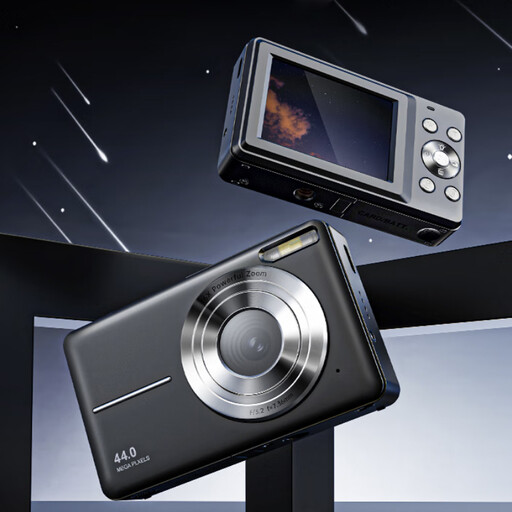
This pocket camera could suit you if you’re considering a compact camera. For small folds, also check the close-up capabilities of the exact setup.
The product name lists 4K, 44 MP and 16× digital zoom.
 No image available
A mirrorless camera kit with a zoom lens to consider if you want to try different framings; check separately whether the lens is suitable for the fold details you want to capture.
The product information lists a 24.2 MP APS-C sensor and a 16–50 mm lens. A memory card and adapter/charger are not included.
 No image available
A mirrorless camera with a zoom lens to compare if you want to adjust the framing of complete models; check the lens’s close-up capabilities for small details.
The product information lists a 24.2 MP APS-C sensor, manual focus and a 16–50 mm f/3.5–5.6 OSS II lens.
 No image available
A compact camera to consider if you don’t want an interchangeable lens; check that its framing and focusing capabilities suit your models.
The product information lists 2.7× optical zoom, autofocus and a tilting touchscreen.
No, not if you can frame the whole model well with your chosen lens. If you want to capture a small fold in close-up, compare the maximum magnification of the exact lens or the close-up mode of a compact camera.
Put the camera on a tripod and keep the background and lighting setup in place. For each model, also check the focus point and depth of field. A smaller aperture increases depth of field, but lets in less light.
Check what’s included in the exact setup and whether you need to choose a close-up lens, tripod or light separately. The Sony ZV-E10 kit described here does not include a memory card or adapter/charger.
If a product is faulty, contact the seller about your statutory guarantee. The Dutch Government states that there is no fixed statutory guarantee period in the Netherlands.