Who is this choice relevant to?

Parents who want to check school safety first

First, check whether your child’s school allows nuts and what arrangements it has in place for allergies. For example, Primary School Op de Kade also bans nuts in sandwich fillings; this is not a general school rule.

Parents looking for verifiably organic products

You want to be able to identify organic production, so check the labelling on the packaging. The European Commission explains what information accompanies the EU organic logo.

Parents looking for a simple addition to lunch

Compare individual nuts, a mix and nut butter by their ingredients and format, while taking your school’s rules and your child’s needs into account.

What should you look for in organic nuts for school?

What to consider What should you check? Who should give this more weight?
School rules and safety Check the school’s current rules and the allergen information on the label. The Netherlands Nutrition Centre also warns that whole nuts can pose a choking risk. I want to know first whether nuts are allowed at school and whether the allergens present comply with the arrangements for my child. Around 28% of consumers give school safety top priority.
Identifying organic products For pre-packed products produced in the EU and sold as organic, check for the EU organic logo, the control code and the EU/non-EU agriculture statement. The European Commission explains this labelling. If organic production is a deciding factor for me, I want to be able to identify the labelling on the product. Around 22% of consumers prioritise being able to identify organic products.
Ingredients and additives Read the ingredients list and compare the salt, sugar, any oil and the types of nuts separately. I want to know which nuts and other ingredients the product contains, rather than relying on the product name alone. Around 22% of consumers say ingredients are their main concern when buying.
Product format Decide whether you’re looking for individual nuts, a mix or a sandwich spread. The format does not change the school or allergy arrangements; if choosing whole nuts, also bear in mind the Netherlands Nutrition Centre’s warning about choking. I’m looking for a format that suits my child’s lunch and the arrangements in place for them. Around 17% of consumers give product format top priority.
Packaging and storage Compare the net weight and storage instructions. The Netherlands Nutrition Centre recommends storing nuts somewhere cool, dark and dry. I want to choose an amount that suits our needs and that I can store properly. Around 11% of consumers prioritise packaging and stock management.

Common pitfalls

  • Assuming organic means suitable for a nut-free school

    Organic labelling tells you nothing about the school’s rules. For example, Primary School Op de Kade also says that peanut butter and bread containing nuts are not allowed.

    Check your school’s current arrangements before buying nuts for your child’s lunch.

  • Assuming unsalted means unroasted or 100% nuts

    AH Organic cashews are unsalted, but they are roasted and contain sunflower oil. The PLUS nut mix is described as unroasted and unsalted.

    Read the ingredients and product description, and assess each feature separately.

  • Assuming an online product page means the item is currently available

    The Jumbo pages for the organic nut mixes mentioned here say that these products are no longer part of the online range.

    Check the current range before adding a product to your shopping list.

  • Buying more than you can store or use properly

    Nuts need to be stored somewhere cool, dark and dry. A pack that doesn’t suit how you use them may therefore be impractical.

    Compare the net weight and choose an amount that you can seal and store properly.

Brands to compare

A brand name or product category alone is no proof that a particular pack is organic. Check the organic labelling and ingredients on the individual product.

Albert Heijn

Albert Heijn lists an organic, unsalted cashew option.

  • The product information lists 200 g, 96% cashews, sunflower oil, the EU organic logo and NL-BIO-01. No salt or sugar is added.
  • The cashews are roasted, so unsalted does not mean unroasted or nuts only.

PLUS

PLUS lists an organic, unroasted and unsalted nut mix.

  • The mix contains 40% almonds, 35% hazelnuts, 12% Brazil nuts, 7% cashews and 6% walnuts.
  • The mix contains several types of nuts; check that they are all suitable under the relevant allergy and school arrangements.

Jumbo

Jumbo has published product information for organic, unroasted nut mixes.

  • The product information can help you compare ingredients and product features.
  • The online product pages mentioned say that these items are no longer part of the online range.

Lidl

Alesto is Lidl’s range of nuts, dried fruit and party snacks, among other things.

  • The range is worth considering when comparing nut products.
  • The range description does not prove that an individual pack is organically certified.

ALDI

ALDI has a category for nuts, seeds and kernels.

  • The category is a useful starting point for comparing nut products.
  • A category page does not confirm that an individual product is organically certified.

Duyvis

Duyvis offers nut and peanut products.

  • The manufacturer provides information on the packaging about possible traces.
  • Don’t assume the entire range is organic or suitable for a nut-free school; check the packaging and school rules.

Nut products at Joybuy

A nut mix for anyone looking for raw, unsalted nuts; check the packaging separately if organic certification matters to you.
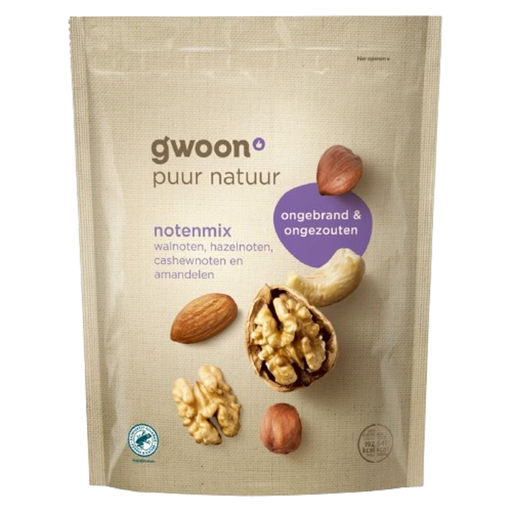
g'woon nut mix, raw and unsalted, 200 g

g'woon nut mix, raw and unsalted, 200 g

This mix could suit you if you’re looking for a variety of raw, unsalted nuts that meet your school’s rules and your child’s allergy needs.

The product name describes a 200 g mix of raw, unsalted nuts. It contains hazelnuts, walnuts, almonds and cashews, and may contain traces of peanuts.

If you specifically want to buy organic, check the organic labelling on the packaging.

View at Joybuy

Frequently asked questions

Are nuts allowed at every school in the Netherlands?

You can’t tell from the product packaging; check your school’s current rules. For example, Primary School Op de Kade says that peanuts, peanut butter and bread containing nuts are not allowed, but this is not a nationwide rule.

What should I check on an organic label?

For pre-packed products produced in the EU and sold as organic, check for the EU organic logo, the control body’s code and the EU, non-EU or EU/non-EU agriculture statement. The European Commission explains this labelling; don’t assume the same requirements apply to every imported product.

What allergen information should I check?

The Netherlands Food and Consumer Product Safety Authority says that allergen information must appear on the label of pre-packed products. Check which types of nuts are present and read any warnings on the packaging too.

Are organic products automatically healthier?

No. According to the Netherlands Nutrition Centre, there is generally no evidence that organic food is healthier than conventional food. So assess the ingredients and whether the product is suitable for your child’s lunch separately.

How should I store nuts at home?

Store nuts in a tightly sealed container somewhere cool, dark and dry. If the pack is unopened, follow the storage instructions and use-by date on the label.
