
Parents looking for an organic snack
You’re looking for peanuts with a crispy coating and want to be able to check the organic status of the specific product. The type of snack and its certification are separate considerations.


Only choose coated peanuts as an organic purchase if you can verify the certification on the specific pack; a crispy coating does not automatically make them a suitable everyday addition to breakfast. The Netherlands Nutrition Centre includes unsalted nuts and 100% nut butter among the choices in the Dutch Wheel of Five. Whole nuts and peanuts are not suitable for children under 4, according to the Netherlands Nutrition Centre.
You’re looking for peanuts with a crispy coating and want to be able to check the organic status of the specific product. The type of snack and its certification are separate considerations.
If you mainly want to add nuts to breakfast, it’s useful to distinguish coated peanuts from unsalted nuts or 100% nut butter. The Netherlands Nutrition Centre lists the latter options as choices in the Dutch Wheel of Five.
If your child will be eating them too, consider the form and ingredients separately. The Netherlands Nutrition Centre advises against giving whole nuts or peanuts to children under 4. If your child has severe eczema or a food allergy, it recommends speaking to their treating doctor or dietitian.
Choose this option if: you’re looking for peanuts with a seasoned, crispy coating for a snack. If you want to buy an organic product, check the certification of the specific one.
Bear in mind: the coating has its own ingredients, and ingredients and allergens vary between products.
Choose this option if: you’re mainly looking for an everyday addition of nuts, rather than a seasoned snack with a coating.
Bear in mind: unsalted nuts are a different product category, not a like-for-like alternative to coated peanuts.
Choose this option if: your child is under 4; the Netherlands Nutrition Centre advises against whole nuts or peanuts at this age.
Bear in mind: a different form won’t offer the same crispy snacking experience. If your child has severe eczema or a food allergy, the Netherlands Nutrition Centre recommends speaking to their treating doctor or dietitian.
The European Commission states that organic terms and the EU organic logo are subject to certification requirements. So check the pack of the specific product, rather than relying on the shop name or appearance alone.
| What to consider | What should you look for? | Who is this important to? |
|---|---|---|
| Organic certification | Check the organic label and inspection code on the pack of the specific product. | I want to verify the organic status before choosing a product; around 31% of consumers prioritise certification. |
| Using them at breakfast | Decide whether you’re looking for a snack or an everyday breakfast addition, then check the ingredients and nutritional information for that product. | I’m mainly looking for nuts to add to breakfast every day and want to distinguish them from a seasoned snack; around 25% of consumers prioritise suitability for breakfast. |
| Children and allergens | Don’t give whole nuts or peanuts to children under 4. If you have allergies, read the ingredients and allergen information on the pack. | I want to check which form is suitable and what allergens are listed on the label if my child will be eating them too; around 19% of consumers prioritise sharing food or allergens. |
| Flavour and coating | Compare the flavour and coating ingredients; don’t assume that a flavour description applies across an entire brand. | I’m specifically looking for peanuts with a crispy, seasoned coating for a snack; around 13% of consumers prioritise this snacking experience. |
| Packaging and storage | Check the pack size and follow the storage instructions for your chosen product. | I want to choose a pack that suits my needs and can be stored according to the label; around 12% of consumers prioritise packaging convenience. |
The terms ‘bio’ and ‘organic’ are protected. A pack’s appearance does not prove that the specific product is certified organic.
Check the organic label and certification information on the pack before choosing a product as organic.
The Netherlands Nutrition Centre advises against giving whole nuts or peanuts to children under 4, as they could choke on them.
Keep your choice of an adult snack separate from your choice of a suitable form for your child.
The name or flavour description alone doesn’t tell you which allergens or nutritional values apply to a specific product. For example, PLUS Borrelnoten Mild lists peanuts, wheat, milk and celery among its ingredients.
Read the ingredients, allergen details and nutritional information for the exact flavour you’re buying.
Duyvis describes its Borrelnootjes as peanuts with a crispy coating, with flavours including Cocktail, Provencale and Oriental in the range.
AH Borrelnoten Cocktail 300 g is an own-brand product containing 51% peanuts with a crispy dough coating.
Jumbo Borrelnoten Cocktail 300 g is an own-brand product containing 49.4% peanuts with a crispy dough coating.
PLUS Borrelnoten Mild 300 g is an own-brand product described as having a mild flavour.
Lidl Netherlands has a product page for coated peanuts.
ALDI lists Trader Joe’s Borrelnoten 300 g in bacon and cheese, poesta and paprika flavours.
This selection focuses on Duyvis products for savoury snacking. Check the pack of the specific product to see whether it is certified organic before treating it as an organic choice.
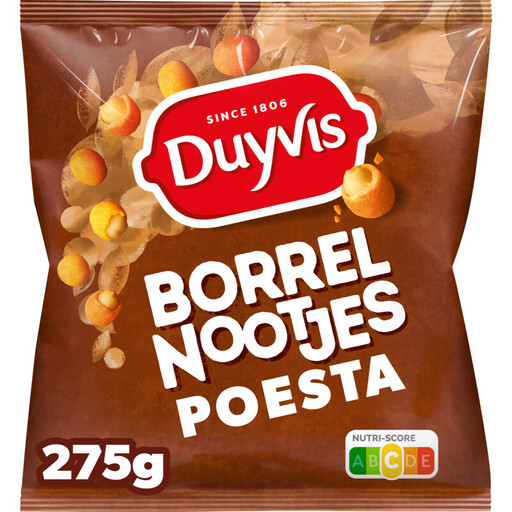 Image unavailable
A good fit for a snack when you’re looking for peanuts with a seasoned, crispy coating.
The product description lists 51% peanuts and a savoury herb mix. Contains peanuts, wheat/gluten, milk and celery; may contain traces of soya, mustard and other nuts.
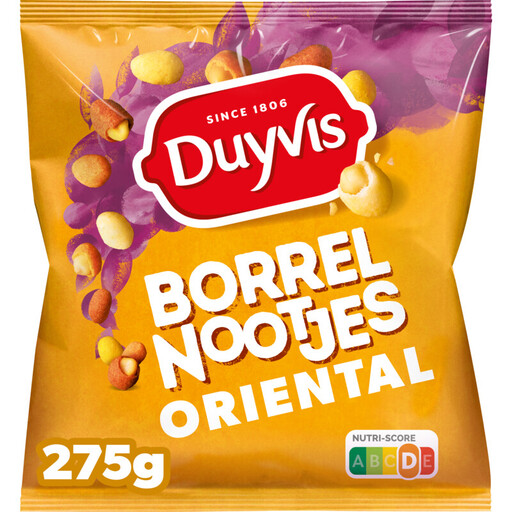 Image unavailable
A good fit for a savoury snack when you’re looking for peanuts with a crispy coating and curry flavour.
The product description lists 49% peanuts and curry flavour. Contains peanuts, wheat/gluten, barley and soya; may contain traces of milk, nuts and mustard.
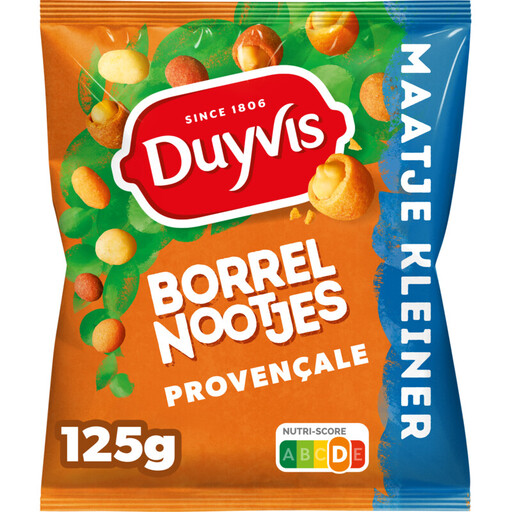 Image unavailable
A good fit for a savoury snack when you’re looking for peanuts with a crispy coating.
The product description lists 50% peanuts, onion and garlic flavour, and 30 g portions. Contains peanuts and wheat; may contain traces of milk, nuts, soya and mustard.
 Image unavailable
A good fit for a snack when you’re looking for coated peanuts with a savoury onion and garlic flavour.
The product description lists 50% peanuts. Contains peanuts and wheat/gluten; may contain traces of milk, nuts, soya and mustard.
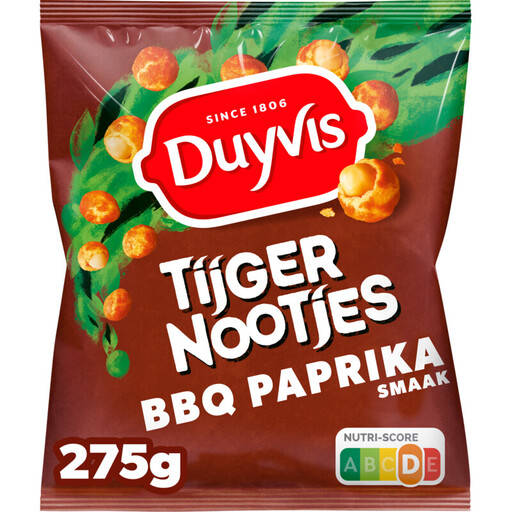 Image unavailable
A good fit for a savoury snack when you’re looking for a coated product with a BBQ paprika flavour.
The product description lists 40% peanuts and a double coating. Contains peanuts and wheat/gluten; may contain traces of milk, nuts, soya and mustard.
For prepacked foods produced in the EU and sold as organic, the EU organic logo is mandatory; the inspection code and the origin of the agricultural ingredients must also be shown. The European Commission states that the logo is optional for imported products that meet EU import requirements, so don’t assess those products solely by whether the logo is present.
No, not necessarily. According to the European Commission, at least 95% of the ingredients in a product made with multiple ingredients must be organic; the remaining 5% must meet additional requirements.
Don’t use whole peanuts or coated peanuts for this. The Netherlands Nutrition Centre discusses 100% peanut butter with no added salt or sugar as a way to introduce peanuts. If your child has severe eczema or a food allergy, the Netherlands Nutrition Centre recommends speaking to their treating doctor or dietitian first.
Follow the storage instructions on the pack of your chosen product. For the Jumbo and PLUS coated peanuts reviewed, the advice is to store them in a cool, dry, dark place; the Netherlands Nutrition Centre recommends storing nuts in a tightly sealed container in a dry place.
Before buying, check the ingredients and allergen information for the specific product, and check the packaging again when it arrives. The Netherlands Food and Consumer Product Safety Authority states that allergen information must appear on the label of prepacked products; Albert Heijn warns that ingredients and allergen information can change.