
If you want organic and less sugar
You’re looking for a biscuit where you can check both its organic status and sugar content. If it claims to contain less sugar, you’ll also want to know what it’s being compared with.


If you’re looking for an organic biscuit with less sugar, check both claims separately: look for the EU organic logo and inspection code to verify its organic status, then compare the sugar content per 100 g with similar biscuits. An organic biscuit isn’t automatically low in sugar, and a biscuit with little sugar isn’t automatically organic; it may also contain sweeteners. Decide which requirement matters most to you, and check the ingredients and any warnings on the packaging too.
You’re looking for a biscuit where you can check both its organic status and sugar content. If it claims to contain less sugar, you’ll also want to know what it’s being compared with.
You’re mainly comparing the sugar content per 100 g and may be open to sweeteners. The ingredients, allergens and any warnings on the label are important too.
If you’re looking for a vegan or gluten-free biscuit, check that the specific product meets those requirements. The claim ‘no refined sugar’ doesn’t tell you how much sugar the biscuit contains in total.
First, decide whether both organic status and less sugar are essential, or whether one matters more than the other. Then compare similar biscuits using the nutrition information per 100 g; according to the Netherlands Nutrition Centre, portions of different sizes aren’t as suitable for comparison.
| What to consider | What should you check? | Who is this most important for? |
|---|---|---|
| Organic and less sugar | Look for the EU organic logo and inspection code. Compare sugars per 100 g and check what a ‘less sugar’ claim is based on. | I don’t want to choose between organic ingredients and a lower sugar content; I want to check both on the packaging. This combined requirement is a priority for around 50% of consumers. |
| As little sugar as possible | Compare sugars per 100 g and check which sweeteners have been used and what warnings apply. | If sugar content is the deciding factor for me, I may be happy to choose a biscuit without an organic label. Around 30% of consumers prioritise this. |
| Other dietary requirements | Check the specific label for vegan or gluten-free claims, allergens and possible cross-contamination. | I’m looking for an organic biscuit that also suits my dietary requirements; a claim about the source of the sugar isn’t enough. This suitability matters most to around 20% of consumers. |
An organic certification relates to how a product is made, not how much sugar it contains. An organic biscuit could still contain more sugar than you’re looking for.
After checking for the EU organic logo, look at the ‘of which sugars’ figure per 100 g and compare it with a similar biscuit.
A low sugar content doesn’t confirm that a product is organic. Biscuits with sweeteners may also carry a warning: the product pages for Céréal Speculoos with Almond Pieces Sugar Free and AH Digestive 0% Sugar mention a possible laxative effect if eaten in excess.
Read the ingredients and warnings on the packaging, and check any organic claims separately.
This wording describes the ingredients used, not the total sugar content. Corn Crake states that its organic oat biscuits with chocolate contain 21.5 g of sugars per 100 g.
Compare the sugar content per 100 g, whatever the wording on the front of the pack.
Biscuits and stated portion sizes can vary. Figures per biscuit therefore don’t provide a like-for-like basis for comparing two products.
Start by comparing the nutrition information per 100 g. Then check the information per portion if you want to know what the stated serving contains.
Céréal offers both an organic biscuit with a ‘less sugar’ claim and a separate sugar-free biscuit. The two products meet different needs.
Two different Albert Heijn biscuits show why you should assess organic status and sugar content separately.
Corn Crake describes its oat biscuits with chocolate as organic, vegan and gluten-free.
This oat biscuit may be worth considering if you’re looking for a product with an organic claim and want to compare the sugar content yourself. Check the packaging to see whether the organic claim and any ‘less sugar’ claim meet your requirements.
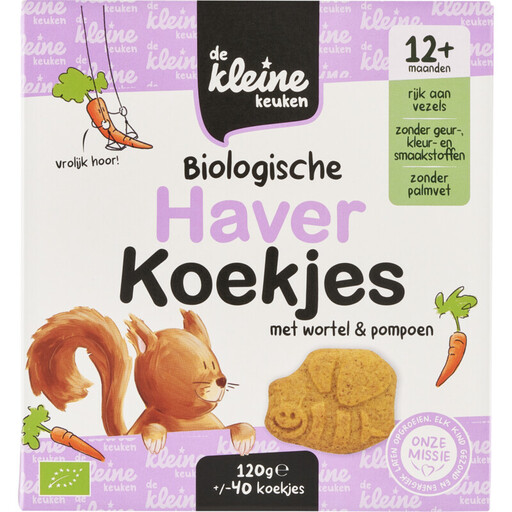 Image unavailable
An oat biscuit to consider if an organic claim matters to you. Check the packaging for the EU organic logo and inspection code. To assess the sugar content, compare the sugars per 100 g with those in a similar biscuit. The word ‘organic’ alone doesn’t confirm a specific sugar reduction.
Look on the packaging for the EU organic logo, the inspection body’s code and the origin statement for the agricultural ingredients. Skal Biocontrole explains that, in principle, composite products must contain at least 95% organic ingredients among those counted towards this figure to qualify for the organic certification; the certification says nothing about the sugar content.
No. Albert Heijn states that AH Organic Plain Oat Biscuits contain 23 g of sugars per 100 g. If sugar content matters to you too, compare the ‘of which sugars’ figure with that of a similar biscuit.
No, these terms don’t describe the same property or comparison. With a ‘less sugar’ claim, what matters most is which similar product it’s being compared with. Always check the nutrition information per 100 g and the ingredients list too.
As well as checking the sugar content, look at which sweeteners have been used and check for any warnings on the label. The product pages for Céréal Speculoos with Almond Pieces Sugar Free and AH Digestive 0% Sugar warn of a possible laxative effect if eaten in excess.
No. The wording doesn’t tell you how much sugar the product contains in total. Corn Crake describes its organic oat biscuits with chocolate as containing no refined sugars, while also stating that they contain 21.5 g of sugars per 100 g.