
Shoppers who insist on organic
You want to be able to verify an organic label rather than rely on words such as natural or high in fibre. Check the packaging for the EU organic logo, the control code and the indication of organic ingredients.


If organic is a must for you, choose crispbread with an organic label you can verify and a wholemeal designation. Then compare fibre and salt per 100 g and per serving, and read the allergen information. An organic label alone tells you nothing about gluten or whether iodised salt has been used.
You want to be able to verify an organic label rather than rely on words such as natural or high in fibre. Check the packaging for the EU organic logo, the control code and the indication of organic ingredients.
You eat crispbread regularly and want to know whether it is labelled wholemeal. Compare the fibre content per 100 g and per serving: if serving sizes differ, those two figures don’t tell you the same thing about what you eat.
If you avoid certain ingredients, the exact types of grain, sesame and any warnings about possible traces matter more than an organic or wholemeal label. Check the packaging of the product you choose.
First decide whether organic is a must for you. Then compare the wholemeal designation, nutritional information and ingredients of the products that meet this requirement.
| What to look for | What to check before buying | Who it matters to |
|---|---|---|
| Organic label | Check the EU organic logo, the control code and the indication of organic ingredients. | I want my crispbread to fit with my choice to eat organic, not simply carry an appealing nutritional claim. Around 36% of consumers would prioritise organic origin. |
| Wholemeal and fibre | Look for the wholemeal designation and compare fibre per 100 g and per serving. | If I eat crispbread often, I want to know which wholemeal option I’m choosing and how much fibre is in my usual serving. Wholemeal and fibre would be the top priority for around 29% of consumers. |
| Grains and other allergens | Read the ingredients and allergen information, including any warnings about possible traces, on the current packaging. | I need to check whether the option I’ve chosen contains grains or sesame that I avoid; an organic logo doesn’t tell me that. For around 21% of consumers, checking the ingredients would matter most. |
| Salt and iodine | Compare salt per 100 g and per serving; check separately whether iodised salt or iodine is listed. | If I eat several crackers in a day, I want to be able to compare salt levels without assuming that ordinary salt is iodised. For around 14% of consumers, this would be the first thing to check. |
A claim about fibre or wholemeal describes a different quality from an organic label. Standard wholemeal products can also contain fibre.
If organic is a must for you, check the organic label first, then compare the fibre content of products that meet your requirement.
The products described include, among other things, gluten-containing grains and sesame. The product category or organic certification is no substitute for checking the ingredients and allergen information.
For the exact product, read the allergen information and any warnings about possible traces on the current packaging.
It’s difficult to compare a figure per cracker with another pack when the crackers don’t weigh the same. Jumbo lists 0.71 g of salt per 100 g for its standard wholemeal crispbread; for Wasa Wholemeal, Jumbo lists 1.2 g per 100 g.
First use the figure per 100 g as your basis for comparison, then check what the nutritional information says about the serving you eat.
The Netherlands Nutrition Centre says that bakers’ salt is not compulsory in bread. The word salt on a pack alone won’t tell you whether iodised salt has been used in the crispbread you’ve chosen.
Look for an explicit mention of iodised salt or iodine on the packaging; don’t assume it’s included because of the type of bread.
Albert Heijn lists 225 g packs of AH Organic Wholemeal Crispbread on its product page.
Jumbo lists both organic wholemeal crackers and standard wholemeal crispbread. Check the product category and exact variant when comparing them.
According to Wasa, the ingredients in Wasa Wholemeal crispbread are wholemeal rye flour, yeast and salt.
Lidl lists wholemeal crispbread and Bio Knäckebrot as separate products.
ALDI describes Goud Gebakken Wholemeal Crispbread as a pack of 25 pieces, weighing 375 g in total.
These two Bolletje options are worth considering if you’re looking for wholemeal crispbread. If organic is a must for you, check the EU organic logo and control code on the exact pack before you decide.
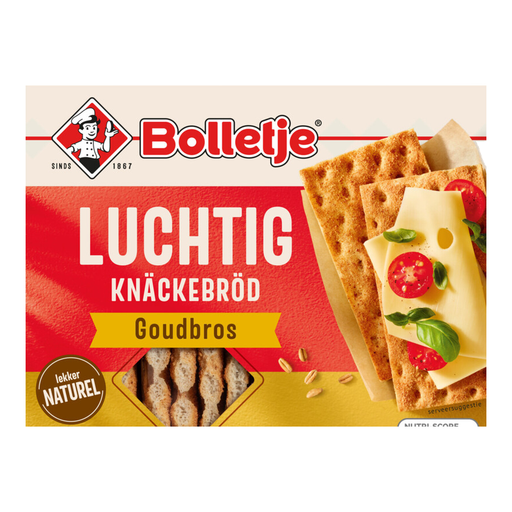 Image unavailable
An option to consider if you’re looking for crispbread for breakfast or lunch. Check the current packaging to make sure the organic label, ingredients and allergen information meet your requirements.
 Image unavailable
An option to consider if wholemeal crispbread is what you’re looking for. Before choosing, read the current nutritional information and allergen details; check separately for an organic label if that’s a requirement for you.
Look for the organic label, the EU organic logo and the control code on the packaging. Skal Biocontrole says the EU organic logo is compulsory for pre-packed foods produced in the EU and sold as organic.
No, you’ll need to read the ingredients list. According to the Netherlands Nutrition Centre, a product can only be called wholemeal if it is made entirely from wholemeal flour; the ingredients list shows which grains and other ingredients are in the variant you’ve chosen.
No, organic and wholemeal don’t mean gluten-free. Jumbo, for example, lists gluten-containing grains in its organic wholemeal crackers; check the allergen information for the exact product.
No, don’t assume crispbread contains iodised salt unless the packaging says so explicitly. The Netherlands Nutrition Centre states that bakers’ salt isn’t compulsory even in bread, so the word salt alone doesn’t answer the question about iodine.
Seal the pack tightly and follow the storage instructions for the product you’ve bought. For the variants described, Jumbo recommends storing them in a cool, dry and dark place.