
Students keeping an eye on portions
You want to use nuts without buying more than you can work into your meals. Check the pack size and think about how often you’ll use them.


Choose a pack size based on how much you use per meal and are likely to get through. Check the organic claim separately in the product information and any certification details. Take your recipe, how often you use the nuts and your storage options into account. Nuts are one ingredient in a meal, not a substitute for its other components.
You want to use nuts without buying more than you can work into your meals. Check the pack size and think about how often you’ll use them.
You want to be able to tell whether a product is labelled organic. Descriptions such as ‘natural’ or ‘unroasted’ don’t, on their own, tell you anything about its organic status.
You’re looking for nuts that suit your recipes and can be stored properly. For a cooked dish, follow its storage advice rather than the guidance for dry nuts.
Start by considering how much you’ll actually use, then check the organic product information. Choose a type and pack size to suit your recipe and storage routine.
| What to consider | What should you check? | Who should pay particular attention? |
|---|---|---|
| Portion and pack size | Check the net weight and work out how much you use per meal. Choose a quantity that suits how often you use nuts. | If I’m buying nuts for several meals, I want to know whether I’ll get through the pack as part of my usual cooking routine. Around 33% of consumers prioritise practical use and portion sizes. |
| Organic claim | Check the information for the exact product variant. If it carries the EU organic logo, look for the control code and farming origin. The European Commission explains the requirements for using the logo. | If I want to buy organic, I want to be able to find the claim on the product rather than rely on words such as ‘natural’ or ‘unroasted’. Around 25% of consumers prioritise evidence of organic status. |
| How you’ll use them in your recipe | Read the ingredients and salt information for the product variant, then decide whether a single type of nut or a mix will suit your dish. | If I’m adding nuts to a meal, I want to choose a type or mix that suits my recipe, while planning the rest of the meal separately. Around 25% of consumers prioritise how the nuts will work in a dish. |
| Using them up and storage | Choose a pack size that suits how much you use and follow the storage advice for the product or prepared dish. | If I don’t use all the nuts at once, I want to know how to store the rest appropriately and avoid applying advice for dry nuts to a cooked dish. Around 17% of consumers focus mainly on using products up and storing them correctly. |
A description of the flavour or processing doesn’t automatically confirm the organic status of that product variant.
Check the organic product information for the exact variant. If it carries the EU organic logo, also check the control body code and farming origin.
A larger pack won’t automatically suit your needs; you also need to be able to use its contents as part of your usual meal planning.
Choose a quantity based on your recipes and how often you use nuts.
Cooked nut rice needs to be stored differently from dry nuts.
The Netherlands Nutrition Centre advises cooling cooked leftovers quickly and putting them in a sealed container in the fridge or freezer.
The product name AH Biologisch Ongezouten cashewnoten identifies the cashews as organic and unsalted.
Jumbo Biologisch Ongebrande Cashewnoten 175 g is a product variant with information about its organic status.
The PLUS product listing is for a 150 g pack of organic mixed nuts.
The products below are unsalted peanuts and a raw, unsalted nut mix for use in recipes. Check the organic claim separately on the packaging: the product names don’t mention this feature.
 No image available
Suitable for recipes where you want to use unsalted peanuts.
The product information lists 99% peanuts and sunflower oil; the product may contain cashews.
 No image available
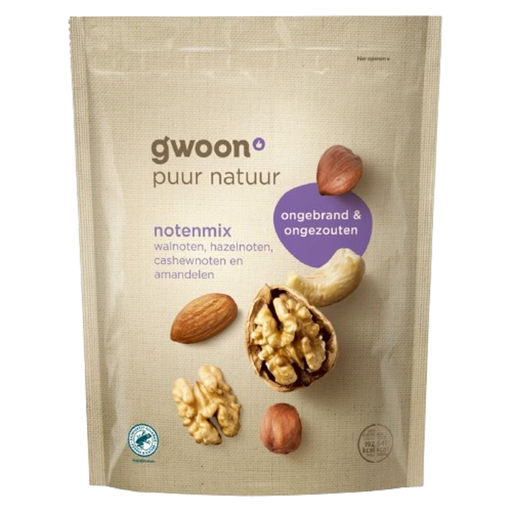
Suitable for dishes where you want to use several types of nuts in one mix.
The product information lists hazelnuts, walnuts, almonds and cashews. The product may contain traces of peanuts.
Not necessarily. The European Commission sets conditions for using the logo, including a minimum proportion of organic ingredients and rules for the other ingredients. Also check the control code and farming origin.
The organic claim doesn’t change which nuts the product contains. Check the ingredients and allergen information on the exact pack. A ‘organic’ or ‘roasted’ claim doesn’t tell you whether a product is suitable for someone with an allergy.
The Netherlands Food and Consumer Product Safety Authority says allergen information must appear on the label of prepacked foods. Peanuts and tree nuts are different allergens, so check the specific information on the pack.
The Netherlands Nutrition Centre says mixed unsalted nuts can be kept in a kitchen cupboard for 6 months and in the freezer for 1 year; their quality may decline after that. Also follow the storage advice on the pack.
No. The Netherlands Nutrition Centre advises cooling cooked leftovers quickly and storing them in a sealed container in the fridge or freezer. For a prepared dish, follow its storage advice rather than the guidance for dry nuts.