For organic nuts to enjoy as snacks or at breakfast, you can choose a single variety, such as almonds or walnuts, or a mix with set proportions. Check the organic label and certification code separately from the salt content, ingredients and allergens. According to the European Commission, the EU organic logo is also accompanied by information about the control body and the origin of the agricultural ingredients.
Who are these choices for?
Shoppers looking for organic snacks
You want organic nuts for the autumn holidays and want to be able to check what the organic label is based on. The European Commission explains that the EU organic logo is used for certified products. Albert Heijn and Jumbo’s product pages also list a certification code for their specific nuts.
Those who like nuts at breakfast and as snacks
You want to enjoy the same nuts as a snack and as a breakfast ingredient. Compare a single variety with a mix, and check the ingredients, salt information and storage advice for the specific product.
Families who snack together
You take allergens and the texture of the snack into account. The Netherlands Nutrition Centre advises against giving whole nuts or peanuts to children under 4 because of the risk of choking.
What should you look for when choosing?
Start with the organic label if it’s a requirement for you. Then choose a nut variety or mix, and check the allergens, packaging and storage instructions separately.
| What to consider |
What should you look for? |
Who is this most relevant to? |
| Organic label |
Check the EU organic logo, certification code and statement of origin on the packaging. |
If organic is a requirement for me, I want to be able to check the label on the packaging. Around 31% of consumers prioritise confidence that a product is organic. |
| Ingredients and how you’ll use them |
Check the ingredients, the proportions of nuts and the salt information; compare nutritional information on the same basis. |
If I want to use the nuts both at breakfast and as a snack, I’ll consider whether to choose a single variety or a set mix. Around 25% of consumers prioritise ingredients and using the product in different ways. |
| Snacking together |
Read the allergen and ‘may contain’ information, and consider whether the texture is suitable for everyone’s age. |
When different people are sharing the snack, I want to take allergens and the form of the snack into account. Around 25% of consumers prioritise family safety. |
| Quantity and storage |
Choose a pack size that suits how much you expect to use, and follow the storage advice on the packaging. |
If I’m buying nuts for several snack and breakfast occasions, I want a pack that suits how much we’ll use. Around 19% of consumers focus mainly on quantity and purchase costs. |
Common purchasing mistakes
-
Assuming organic, unsalted and unroasted mean the same thing
Organic certification, salt content and preparation method are separate product characteristics. So a regular unsalted nut mix isn’t automatically organic.
Check the organic label first, then look separately at the ingredients, salt content and processing.
-
Assuming a single nut variety means there are no other allergen risks
The Jumbo page for the walnuts reviewed lists possible traces of other nuts, peanuts and sesame.
As well as checking the ingredients, read the ‘may contain’ information and consider it for everyone sharing the snack.
-
Assuming whole nuts are an obvious choice for family snacking
The Netherlands Nutrition Centre advises against giving whole nuts or peanuts to children under 4 because of the risk of choking.
Choose a suitable texture for young children. The Netherlands Nutrition Centre suggests nut butter with no added sugar or salt as an alternative; check the allergens then too.
Brands to consider
Albert Heijn
The organic option reviewed is a single nut variety: unroasted almonds for snacking and breakfast.
- Albert Heijn lists the EU organic logo and certification code IT-BIO-009 for the almonds.
- The product page lists possible traces of other nuts and peanuts. This information applies to this product, not the entire range.
Jumbo
The organic option reviewed is a 110 g pack of unroasted walnuts.
- Jumbo lists certification code NL-BIO-01 and a salt content of 0,00 g per 100 g for the walnuts reviewed.
- The product page lists possible traces of other nuts, peanuts and sesame. The stated origin information should be assessed separately.
PLUS
PLUS sells the mix reviewed as organic. It contains five nut varieties in set proportions.
- The product information lists 40% almonds, 35% hazelnuts, 12% Brazil nuts, 7% cashews and 6% walnuts; the mix is unroasted and unsalted.
- With set proportions, you can’t choose how much of each variety to have. All five nuts listed are present allergens.
Lidl
Lidl’s regular nut mix reviewed is an option for comparison if organic certification isn’t a requirement.
- Lidl lists the mix as weighing 200 g and describes it as unroasted and unsalted.
- Being unroasted and unsalted is not proof of organic certification.
ALDI
The regular TRADER JOE'S nut mix reviewed is an option if you’re looking for a larger unsalted mix.
- For this mix, ALDI lists almonds, hazelnuts, walnuts and Brazil nuts, in a 500 g pack.
- The description ‘unsalted’ does not, on its own, prove organic certification.
Duyvis
Duyvis describes several peanut and party snack varieties, including fried, roasted and marinated peanuts, as well as coated peanuts.
- The different preparation methods help distinguish party snacks from plain, unroasted nuts.
- Check the organic label and ingredients for each variety. The brand name or party-snack positioning alone tells you nothing about these.
Nut mix on Joybuy
This product selection is a regular nut mix; organic certification has not been confirmed. So don’t choose this mix as a substitute if organic is a requirement for you.
 No image available
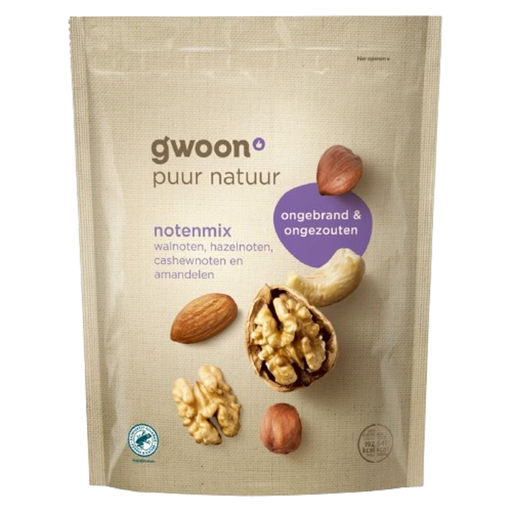
g'woon Nut Mix, unroasted and unsalted, 200 g
This mix may suit you if you’re looking for several types of nuts to enjoy as snacks or add to meals and breakfast; the product information describes it as a regular mix, not an organic option.
The description lists hazelnuts, walnuts, almonds and cashews.
The stated salt content is 0,01 g per 100 g.
The product information lists possible traces of peanuts; close the pack securely after opening.
View on Joybuy
Frequently asked questions
What information should accompany the EU organic logo on packaging?
According to the European Commission, the EU organic logo is accompanied by the code number of the control body and the origin category of the agricultural ingredients. The logo is compulsory for prepacked food produced in the EU and sold as organic; don’t automatically apply this requirement to imported products.
Does organic mean that nuts are also unsalted?
No, the organic label doesn’t tell you by itself whether a product is salted. Check the salt information separately; the Netherlands Nutrition Centre lists unsalted nuts as a choice within its Wheel of Five healthy eating guidelines.
Can you give whole nuts to children under 4?
The Netherlands Nutrition Centre advises against giving whole nuts or peanuts to children under 4 because of the risk of choking. It suggests nut butter with no added sugar or salt as an alternative; check the ingredients and allergens for that too.
What should you look for when checking allergens in a nut mix?
Check both the ingredients and the allergen and ‘may contain’ information on the packaging. The Netherlands Food and Consumer Product Safety Authority states that allergen information for prepacked products must be shown on the label.
How should you store the organic nuts reviewed?
Follow the advice for the specific product. Albert Heijn recommends storing the almonds reviewed at room temperature in a dark place; PLUS recommends storing the mix reviewed in a cool, dry and dark place. Check the storage instructions on the pack you buy too.


