
Portion-conscious snackers
You want to eat organic nuts and know in advance how much energy a weighed portion provides. An organic image doesn’t mean a product is low in energy.


Choose organic nuts based on the flavour and preparation you prefer, and assess their energy content based on the portion you weigh out. Organic or unsalted doesn’t mean low in calories: the AH almonds we looked at contain 625 kcal per 100 g, while PLUS BIO+ cashews contain 624 kcal per 100 g, according to the official product information from Albert Heijn and PLUS. For solid foods, the European Commission sets the maximum for a ‘low calorie’ claim at 40 kcal per 100 g.
You want to eat organic nuts and know in advance how much energy a weighed portion provides. An organic image doesn’t mean a product is low in energy.
You want to identify organic production through verifiable labelling, not just green packaging or a supermarket’s name.
You make a considered choice between, for example, unroasted almonds and roasted cashews, and check for oil, salt and allergens to suit your preferences.
Compare the nutritional values per 100 g, then weigh the portion you plan to eat. According to the official product information, AH Biologisch Amandelen ongebrand contains 625 kcal per 100 g, while PLUS BIO+ unsalted cashews contain 624 kcal per 100 g. For a 25 g portion, that works out at 156.25 and 156 kcal respectively. This small difference isn’t a compelling reason to change your flavour preference.
| What to consider | What to look for | Who is this important for? |
|---|---|---|
| Energy per portion | Check the kcal per 100 g and weigh your portion. Calculate the energy as kcal per 100 g × portion weight in grams ÷ 100. | If I want to know how much energy is in my weighed snack, I check both the nutritional values and the weight of my portion. Around 36% of consumers say managing the energy in each snack portion is their top priority. |
| Organic labelling | Where applicable, check for the EU organic logo, the code of the control body and the agricultural origin. | If I want to be sure of the organic claim, I check the information on the packaging rather than relying on the shop’s name. Around 29% of consumers put confidence in organic claims first. |
| Preparation and ingredients | Check the ingredients, preparation description, salt information and allergen information on the specific pack. | If I’m looking for a particular preparation or composition, I want to know whether, for example, oil has been added and which nuts are included. Around 21% of consumers say this is their most important consideration. |
| Pack size | Compare the net weight and think about how much you want to weigh out; store nuts in a dry, airtight container. | If I’m looking for a pack that suits my usage and storage space, I check the contents and storage advice. Around 14% of consumers give pack size and value for money the most weight. |
Organic production and salt content don’t, by themselves, tell you anything about a product’s energy value. The organic products we looked at are above the European threshold for a ‘low calorie’ claim on solid foods.
Use the nutrition table to compare energy values, and check the organic labelling to verify organic status.
PLUS BIO+ cashews are unsalted, but they are roasted and contain organic sunflower oil.
Check both the ingredients list and the preparation description for the variety you’re buying.
Net weight isn’t the same as portion size. For the almonds we looked at, Albert Heijn lists portions of 25 g; the pack contains several portions.
Weigh the amount you want to eat rather than treating the whole pack as one snack portion.
AH Biologisch Amandelen ongebrand is an option if you’re looking for organic, unroasted and unsalted almonds.
Jumbo Biologisch Ongebrande Amandelen 175 g suits anyone who prefers organic, unroasted and unsalted almonds.
BIO+ is the product brand of the unsalted cashews we looked at; PLUS is the retailer.
These nut products at Joybuy are options to compare by ingredients and energy per 100 g. Check the product packaging itself to see whether it carries an organic label.
 No image available
The product information lists the energy per 100 g, so you can calculate the value for a weighed portion.
The ingredients list gives 99% peanuts and sunflower oil. The stated energy value is 2690 kJ per 100 g, above the European Commission’s threshold of 170 kJ per 100 g for an ‘energy-reduced’ claim on solid foods.
The product information states that the product may contain traces of cashews.
 No image available
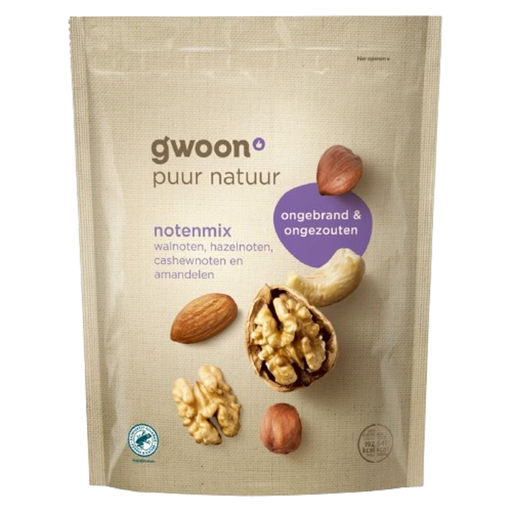
This mix is a good fit if you prefer raw, unsalted nuts and want to calculate the energy in a weighed portion.
The ingredients list gives 30% hazelnuts, 30% walnuts, 20% almonds and 20% cashews. The stated energy value is 2650 kJ per 100 g, above the European Commission’s threshold of 170 kJ per 100 g for an ‘energy-reduced’ claim on solid foods.
The product information states that the mix may contain traces of peanuts.
Not on the basis of an organic label, unsalted preparation or small portion. For solid foods, the European Commission sets the maximum for a ‘low calorie’ claim at 40 kcal (170 kJ) per 100 g. The organic nut products we looked at are above this threshold.
For prepacked organic foods produced in the EU, check for the EU organic logo, the code of the control body and the agricultural origin. The European Commission describes exceptions where use of the logo is optional, including certain imported and non-prepacked organic products. So the absence of a logo doesn’t prove that a product is non-organic in every case.
Organic certification doesn’t mean a product is allergen-free. Check the allergen declaration and any warnings about possible traces on the specific pack. The NVWA warns that allergens can cause severe allergic reactions in some people.
Multiply the kcal per 100 g by the weight of your portion in grams, then divide by 100. For example, at 625 kcal per 100 g, a 25 g portion works out at 156.25 kcal. This is a calculation based on the nutritional value per 100 g.
Store nuts in a dry, airtight container, preferably somewhere cool. Also follow the storage advice and best-before information on the specific pack.