Choose unsalted organic nuts as an addition to your daily breakfast, not as your sole source of fuel for marathon training. The Netherlands Nutrition Centre highlights the importance of carbohydrates during high-volume training. If you eat breakfast before a run, also consider the timing and what you can comfortably digest. Check the organic label, ingredients and allergen information separately on the packaging.
Who is this choice relevant to?
Runners looking to add to their everyday breakfast
You’re looking for nuts to add to your usual breakfast during a marathon training block. The Netherlands Nutrition Centre recommends unsalted nuts as part of your daily diet; you should also consider the carbohydrates in your overall eating plan.
Runners who train after breakfast
You want to know how much time to leave between eating and running, and whether breakfast sits well with you. The Netherlands Nutrition Centre recommends leaving around 2 to 3 hours between a meal and exercise. A daily topping and a pre-race breakfast don’t need to have the same ingredients.
Shoppers who want to check organic labels
You want to be able to distinguish an organic label from general claims about natural or sustainable products. The Netherlands Enterprise Agency and the European Commission explain the rules for organic labelling; check allergen information separately.
What should you look for?
Nuts with your everyday breakfast
A good fit if: you want to add nuts to your usual breakfast.
Consider: nuts don’t replace the carbohydrates that can be important during high-volume marathon training, according to the Netherlands Nutrition Centre.
Breakfast before a run
A good fit if: you’re planning breakfast shortly before a training session or race and are allowing enough time before the start.
Consider: the Netherlands Nutrition Centre recommends leaving around 2 to 3 hours between a meal and exercise; RunningNL recommends a breakfast low in fat and fibre before a race.
Fuel for long efforts
A good fit if: you want to top up your energy during a long run.
Consider: the Netherlands Nutrition Centre highlights carbohydrates during exercise lasting longer than an hour and suggests sports bars or gels as possible options; a bag of nuts isn’t a substitute for a fuelling plan for your run.
First decide when you want to eat the nuts, then check the organic label and the ingredients on the exact pack.
| What to consider |
What should you look for? |
Who is this most important to? |
| Fuel and timing |
Decide whether the nuts are for everyday breakfast or a meal shortly before a run, and which other sources of carbohydrates you’ll use. The Netherlands Nutrition Centre recommends leaving around 2 to 3 hours between a meal and exercise. |
When I plan breakfast and fuel for a long training day, I want those choices to suit the timing of my run. Around 36% of consumers put fuel and timing at the top of their shopping priorities. |
| Organic label |
Check the label and the relevant declarations. Products bearing the EU organic logo must show a control code and an indication of agricultural origin; the European Commission distinguishes between products made in the EU and certain imported products. |
I want to be able to check the organic label on the packaging, rather than relying on words such as ‘natural’. Around 29% of consumers prioritise clear organic labelling. |
| Ingredients for everyday use |
Read the ingredients list, check whether the nuts are unsalted and review the allergen information. The Netherlands Nutrition Centre recommends unsalted nuts and eating a variety of types. |
For my regular breakfast, I want to know which nuts and other ingredients are in the pack. Around 21% of consumers prioritise the ingredients for everyday use. |
| Packaging and storage |
Compare packs on the same weight basis and follow the storage advice on the label, including after opening. The Netherlands Nutrition Centre recommends following any product-specific storage instructions on the label. |
I want to choose an amount that suits how I use the product and store it according to the label. Around 14% of consumers prioritise packaging and cost per use. |
Common buying mistakes
-
Assuming nuts are a complete fuelling plan for a marathon
An organic label says nothing about your carbohydrate needs during high-volume training or what to eat during prolonged exercise. The Netherlands Nutrition Centre highlights carbohydrates as something to consider during marathon training.
First decide when you’ll eat and how you’ll fuel your run. Then choose nuts to suit the role they’ll play in your breakfast.
-
Assuming a generous nut topping is a good choice before a race
Advice for everyday breakfast and advice for a pre-race breakfast don’t necessarily follow the same principles. RunningNL recommends a pre-race breakfast that’s low in fat and fibre.
Distinguish between your usual breakfast and the one you eat before a run. Also consider the timing and what you can comfortably digest.
-
Confusing organic labelling with suitability for people with allergies
Organic labelling and allergen information answer different questions. The Netherlands Food and Consumer Product Safety Authority lists tree nuts and peanuts separately as allergens that must be identified on the label.
Check the allergen information on the exact pack; don’t treat an organic certification as proof that a product is allergen-free.
-
Looking only at pack size
If the pack size doesn’t suit how you use the product, some may go unused. The storage instructions on the label also apply to the pack you choose.
Choose a pack size that suits your needs and follow the storage instructions after opening.
Brands with relevant product listings
Albert Heijn
Albert Heijn’s product listings include organic cashews and organic walnuts.
- The retailer describes the cashews as unsalted and the walnuts as unroasted; these are product descriptions, not claims about sports performance.
- Check the current packaging for ingredients and allergens, as product information can change.
Jumbo
Jumbo lists organic unroasted walnuts in a 110 g pack.
- The retailer’s product page shows control code NL-BIO-01 alongside the organic label.
- Unroasted doesn’t automatically mean unsalted. Check the ingredients separately; the organic label says nothing about running performance.
PLUS
PLUS’s product listing describes shelled organic walnuts in a 110 g pack.
- The product name and pack size are listed as retailer information.
- Check the ingredients and allergens on the pack you buy; shelled is a product feature, not a nutritional or performance claim.
Joybuy product selection
This Joybuy selection is suited to everyday use as a topping for breakfast: a raw, unsalted nut mix. If you’re specifically looking for organic nuts, check the organic label on the exact pack.
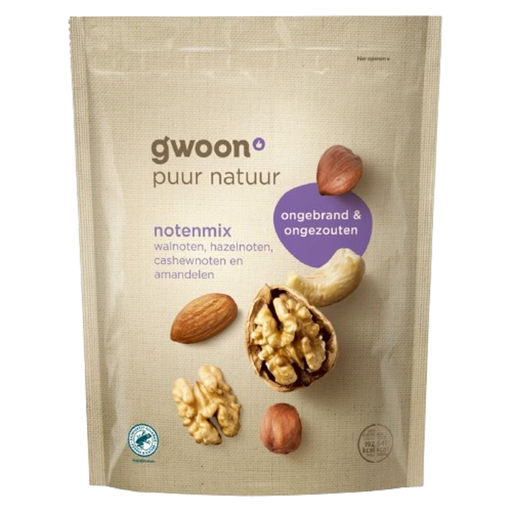 Image unavailable
g'woon Nut Mix Raw & Unsalted, 200 g
The product description suggests adding the mix to breakfast or other dishes.
Raw and unsalted; the pack contains 200 g.
The product description lists hazelnuts, walnuts, almonds and cashews.
The stated product warning mentions possible traces of peanuts; check the packaging.
View at Joybuy
Frequently asked questions
Can a handful of nuts replace my fuel for a long run?
No. Don’t treat nuts as a substitute for your overall carbohydrate plan. The Netherlands Nutrition Centre recommends paying extra attention to carbohydrates during high-volume marathon training and topping up carbohydrates during exercise lasting longer than an hour.
How long before a run should I have breakfast?
The Netherlands Nutrition Centre recommends having a good meal around 2 to 3 hours before exercise. For a pre-race breakfast, RunningNL also recommends keeping fat and fibre low; take into account what you can comfortably digest.
Do all organic nuts have to carry the EU organic logo?
No. According to the European Commission, the logo is compulsory for pre-packed organic food produced in the EU, but optional for certain imported products that meet EU import requirements. If the logo is used, it must be accompanied by the control code and the indication of agricultural origin.
Are naturally produced or sustainably sourced nuts automatically organic?
No. The Netherlands Enterprise Agency explains that ‘organic’ is a protected term: a product must comply with the relevant organic legislation to be described as organic.
How do I check allergens in organic nuts?
Read the allergen information separately from the organic label. The Netherlands Food and Consumer Product Safety Authority lists tree nuts and peanuts separately; for pre-packed products, allergen information appears on the label. So don’t base your choice solely on words such as ‘organic’ or ‘unroasted’.


